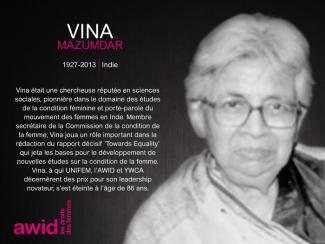
Vina Mazumdar
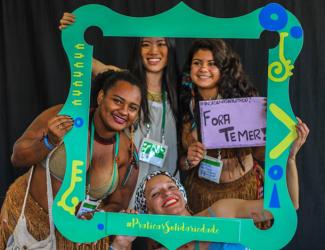
Young feminist activists play a critical role in women’s rights organizations and movements worldwide by bringing up new issues that feminists face today. Their strength, creativity and adaptability are vital to the sustainability of feminist organizing.
At the same time, they face specific impediments to their activism such as limited access to funding and support, lack of capacity-building opportunities, and a significant increase of attacks on young women human rights defenders. This creates a lack of visibility that makes more difficult their inclusion and effective participation within women’s rights movements.
AWID’s young feminist activism program was created to make sure the voices of young women are heard and reflected in feminist discourse. We want to ensure that young feminists have better access to funding, capacity-building opportunities and international processes. In addition to supporting young feminists directly, we are also working with women’s rights activists of all ages on practical models and strategies for effective multigenerational organizing.
We want young feminist activists to play a role in decision-making affecting their rights by:
Fostering community and sharing information through the Young Feminist Wire. Recognizing the importance of online media for the work of young feminists, our team launched the Young Feminist Wire in May 2010 to share information, build capacity through online webinars and e-discussions, and encourage community building.
Researching and building knowledge on young feminist activism, to increase the visibility and impact of young feminist activism within and across women’s rights movements and other key actors such as donors.
Promoting more effective multigenerational organizing, exploring better ways to work together.
Supporting young feminists to engage in global development processes such as those within the United Nations
Collaboration across all of AWID’s priority areas, including the Forum, to ensure young feminists’ key contributions, perspectives, needs and activism are reflected in debates, policies and programs affecting them.
Events in Indonesia, in late 2019 - in particular, signs of intensifying militarization and backlash against LGBTQ rights - led us to question AWID’s ability to maintain a reasonably safe and welcoming environment for the diversity of participants we aspire to bring together at the Forum.
After careful consideration the AWID Board of Directors decided to change the venue for the 14th International AWID Forum, in November 2019 from Bali to Taipei.
Taipei offers a strong degree of logistical capacities, and is accessible for many travellers (with a facilitated e-visa process for international conferences).
For more details:
Non, nous reconnaissons l’importance de votre travail, mais nous ne collectons pas les réponses fournies à titre individuel à l’heure actuelle.
.
This is a French article
- created from the French site
We are living in a world where the destruction of Nature fuels our current global economy. |
Even in times of climate crisis, governments continue to encourage large-scale agriculture industries to expand. These activities poison the land, threaten biodiversity, and destroy local food production and livelihoods. Meanwhile, while women produce the majority of our food in the world, they own almost none of the land. |
|
What if we perceived land and Nature not as private property to exploit, but as a whole to live in, learn from, and harmoniously coexist with? What if we repaired our relationships with the land and embraced more sustainable alternatives that nurture both the planet and its communities? Nous Sommes la Solution (We Are the Solution, NSS) is one of many women-led movements striving to do this. This is their story. |
|
Unless there are accessibility issues and/or you are filling the survey in other languages, we strongly encourage you to use KOBO for WITM standardized data collection and analysis.
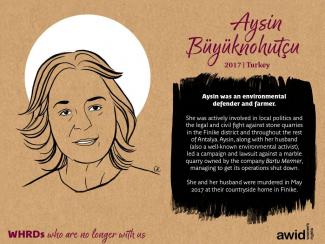
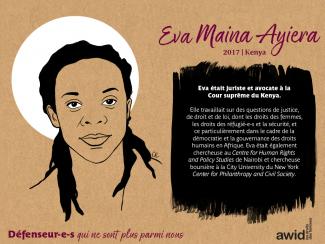
Notre hommage en ligne met à l’honneur cinq défenseuses des droits humains assassinées au Moyen-Orient ou en Afrique du Nord. Ces défenseuses étaient avocates ou militantes et ont œuvré pour les droits des femmes ou pour les droits civils. Leur mort met en évidence les conditions de travail souvent difficiles et dangereuses dans leurs pays respectifs. Nous vous invitons à vous joindre à nous pour commémorer la vie, le travail et l’activisme de ces femmes. Faites circuler ces mèmes auprès de vos collègues et amis ainsi que dans vos réseaux et twittez en utilisant les hashtags #WHRDTribute et #16Jours.
S'il vous plaît cliquez sur chaque image ci-dessous pour voir une version plus grande et pour télécharger comme un fichier


AGROECOLOGY AND FOOD SOVEREIGNTY AS RESISTANCE |
Today, large-scale industrial food production uses single-crop plantations, genetically modified organisms and other pesticides that destroy the land and knowledge of local communities. |
Agroecology is a resistance to corporate-driven agriculture. It prioritizes smaller scale agriculture, multiple crops and diversified food production, and the centering of local knowledge and practices. Agroecology goes hand-in-hand with demands for food sovereignty, or the “right of peoples to healthy and culturally appropriate food produced through ecologically sound and sustainable methods, and their right to define their own food and agriculture systems”(Via Campesina, Declaration of Nyéléni).
The role of women, indigenous and rural communities and people of color from the Global South is absolutely essential when it comes to food systems. Feminist agroecologists are working to dismantle oppressive gender roles and systems of patriarchy embedded within food production. As shown by the heroines of NSS, they are generating a liberatory agroecology by strengthening community resilience, empowering women peasants and farmers, and preserving local traditions, territories, and knowledge of food-producing communities.
La encuesta contiene 47 preguntas en total, de las cuales 27 son de respuesta obligatoria* y las 20 restantes son opcionales. La mayoría de las preguntas de la encuesta son de opción múltiple. Invitamos a responder la totalidad de las preguntas.
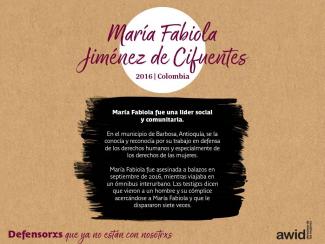
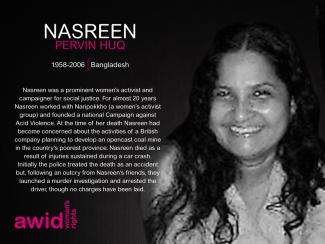
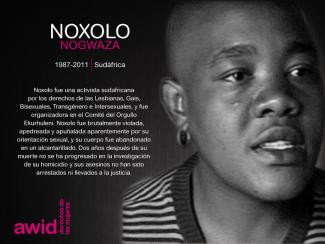
In our 2015 Online Tribute to Women Human Rights Defenders No Longer With Us we are commemorating four women from Sub-Saharan Africa, three of whom were murdered due to their work and/or who they were in their gender identity and sexual orientation. Their deaths highlight the violence LGBT persons often face in the region and across the globe. Please join AWID in honoring these women, their activism and legacy by sharing the memes below with your colleagues, networks and friends and by using the hashtags #WHRDTribute and #16Days.
Please click on each image below to see a larger version and download as a file