Special Focus

AWID is an international, feminist, membership organisation committed to achieving gender equality, sustainable development and women’s human rights

AWID Forum: Co-creating Feminist Futures

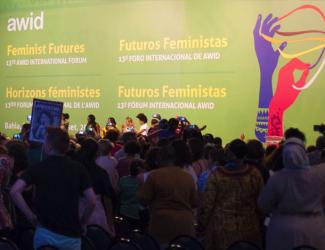
In September 2016, the 13th AWID international Forum brought together in Brazil over 1800 feminists and women’s rights advocates in a spirit of resistance and resilience.

This section highlights the gains, learnings and resources that came out of our rich conversations. We invite you to explore, share and comment!


What has happened since 2016?

One of the key takeaways from the 2016 Forum was the need to broaden and deepen our cross-movement work to address rising fascisms, fundamentalisms, corporate greed and climate change.

With this in mind, we have been working with multiple allies to grow these seeds of resistance:

And through our next strategic plan and Forum process, we are committed to keep developing ideas and deepen the learnings ignited at the 2016 Forum.

What happens now?

The world is a much different place than it was a year ago, and it will continue to change.

The next AWID Forum will take place in the Asia Pacific region (exact location and dates to be announced in 2018).

We look forward to you joining us!

About the AWID Forum

AWID Forums started in 1983, in Washington DC. Since then, the event has grown to become many things to many peoples: an iterative process of sharpening our analyses, vision and actions; a watershed moment that reinvigorates participants’ feminisms and energizes their organizing; and a political home for women human rights defenders to find sanctuary and solidarity.

Learn more about previous Forums

Related Content

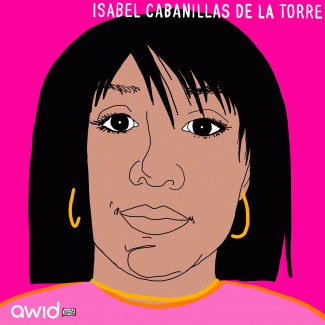
Isabel Cabanillas de la Torre

Isabel Cabanillas de la Torre was a much loved young feminist artist and activist from Ciudad Juárez, Mexico, known for her beautiful and evocative hand-painted clothing with eyes being an emblematic feature in her work. Her murals transformed the run down and vacant buildings in Ciudad Juarez’s downtown, bringing life and political commentary to their walls.

Through her art and political activism Isabel sought to draw attention to the gender based violence pervasive in her hometown. She volunteered with the women’s network Mesa de Mujeres on the Citizen Observatory on Gender to monitor the performance of judges, prosecutors and public defenders on cases of femicides and other gender based violations. She was also a member of Hijas de su Maquilera Madre, a feminist collective whose name makes reference to the daughters of mothers who are maquila workers. Some of these mothers were among the first victims of femicide in the city.

Isabel’s latest project, still in progress, was an art installation to protest a Canadian company that was looking to mine copper in the Samalayuca Desert. 

On 18 January, 2020 Isabel was shot while riding her bike back home in Downtown Juárez, in what appeared to be a targeted killing, her body found beside her bike.

Isabel’s murder, sparked a new wave of outrage against femicides in the region, hundreds marched to the US-Mexico border bridge, blocking it for hours and chanting “Ni una mas” (Not one more) as feminist collectives continue to protest the murders of women throughout Mexico. In 2019 alone, 3142 women and girls were killed in Mexico, many of whom were targeted specifically because of their gender.

She loved riding her bike.

"The bike for her was a symbol of freedom. A symbol of being free in the streets." - Marisol (a friend of Isabel’s)  

L’AWID est-elle une organisation du Nord ou du Sud ?

L’AWID est une organisation mondiale.

Notre travail est de portée internationale. Nous collaborons étroitement avec nos membres et d’autres organisations pour les droits des femmes et autres allié-e-s, tant au niveau local que national et régional. Nous faisons en sorte que leurs réalités nourrissent notre travail.

  • Nous avons des bureaux au Mexique et au Canada.
  • Notre équipe est répartie dans plus de 15 pays aux quatre coins de la planète.
  • Dix des treize membres de notre conseil d’administration proviennent de pays du Sud. 

En savoir plus à propos de l'AWID

Snippet - WCFM Contact us- En

Contact Us

If your funding institution is already a part of the Database and you would like to contact us to update your record, or if you would like to leave some feedback for us, please use the form above.

Snippet Opening Dance Performance EN

Número de baile de apertura

Por Pia Love

dancer with angel wings

Ver la apertura

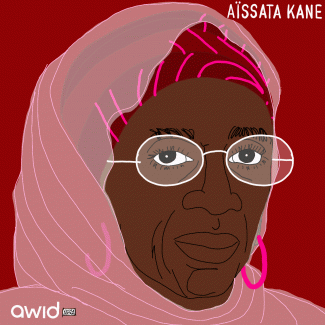
Aïssata Kane

Aïssata Kane, también conocida afectuosamente como «Yaye Kadia»” [«Madre Kadia»], fue una feminista comprometida, durante toda su vida, con la defensa de los derechos de las mujeres africanas y, en especial, mauritanas.

En 1975 fue la primera mujer en ocupar el cargo de Ministra de Protección Familiar y Asuntos Sociales, puesto desde el cual Aïssata trabajó fervientemente para mejorar el estatus de las mujeres de su país.

Este trabajo incluyó el fomento de la educación de niñas y mujeres, la lucha contra la práctica de alimentación forzada de mujeres jóvenes, la incidencia para la inclusión de una legislación sobre derechos maritales, y la promoción de la creación de un cupo de representación femenino en el Parlamento.

«[Aïssata] materializaba todas sus pasiones con humildad, valentía y determinación. No quería molestar a nadie con su lucha en todos estos frentes simultáneos.» - Ball Halimata Dem, sobrina de Aïssata

Fundó la Unión Nacional de Mujeres de Mauritania (UNFM), creando y publicando con otras activistas Marienou, una revista dedicada a la emancipación de las mujeres mauritanas. Aïssata también dirigió varias organizaciones subregionales y locales, por ejemplo, como Presidenta de la Asociación Internacional de Mujeres Francófonas (AIFF) y, como firme ecologista, fue Presidenta de la Asociación para la Protección del Medio Ambiente de Mauritania (APEM).

En 2018, recibió el Premio a la Mujer Pionera, en honor a su trabajo para la promoción del estatus de las mujeres de Mauritania y como reconocimiento de su fuerte liderazgo y su sentido de la innovación.

Aïssata falleció el 10 de agosto de 2019.

I have written a paper about an issue related to Women’s Rights and Development. How can I share it with AWID’s members?

Clone of Snippet - WITM About the survey - FR

In 2023, feminist and 
women's rights organizations 
had a median annual budget of $22,000

In contrast, over $1 billion went to three anti-rights groups 2021-2022, with funding for anti-gender networks still rising.1

1 Global Philanthropy Project, 2024

Snippet She is on her way_Fest (FR)

Session plénière:

"Elle est en chemin":
alternatives, féminismes et monde alternatif

Felogene Anumo, AWID
Dr. Vandana Shiva, India
Dr. Dilar Dirik, Kurdistan
Nana Akosua Hanson, Ghana

regarder la session plénière


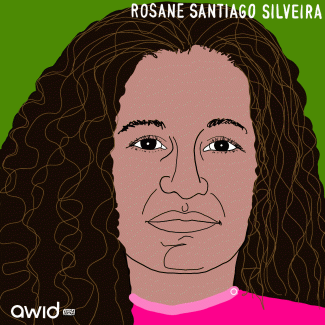
Rosane Santiago Silveira

Rosane Santiago Silveira, que l’on appelait affectueusement Rô Conceição, était une activiste brésilienne pour l’environnement et les droits humains qui se battait inlassablement pour protéger l’environnement, là où il était le plus menacé. 

Il pouvait entre autres s’agir de le défendre sur l’île de Barra Valha, mise en danger par une exploitation pétrolière, ou de le protéger avec des campagnes contre l’accaparement des terres et l’expansion de plantations d’eucalyptus dans l’État de Bahia, où Rosane était membre du conseil de la réserve d’extractivistes de Cassurubá.

« La réserve d’extractivistes est une zone protégée où les familles résidentes vivent des produits naturels extraits de la forêt. Ces activités contribuent à protéger l’intégrité de la forêt. » - Global Justice Ecology Project (source initiale : Rede Brasil Atual)

Elle participait à des activités syndicales et des mouvements culturels et de défense des droits humains. Rosane consacrait une grande partie de sa vie à des causes qui lui étaient chères, mais qui concernaient également la terre, les forêts, les rivières et les communautés dont les droits et vies sont constamment en danger. 

Elle a été torturée et assassinée le 29 janvier 2019 à Nova Viçosa, une ville du sud de Bahia. 

« Malheureusement, un sentiment d’insécurité totale règne désormais, parce que l’État ne juge pas ces crimes. Nous étions avec elle à Noël, et tout le monde s’est rendu compte qu’elle était inquiète. Nous savons maintenant qu’elle avait reçu trois menaces de mort », Tuian, le fils de Rosane dans un entretien avec Rádio Brasil Atual. (source initiale : Rede Brasil Atual)

2002: comienzan las conversaciones acerca de una agenda de Financiación para el Desarrollo

La Conferencia de Monterrey sobre la Financiación para el Desarrollo marcó el comienzo de las conversaciones acerca de una agenda de Financiación para el Desarrollo.

  • El Consenso de Monterrey fue adoptado durante la primera Conferencia Internacional sobre la Financiación para el Desarrollo. Fue la primera reunión organizada por la ONU con nivel de cumbre para abordar aspectos esenciales del desarrollo global, entre ellos los temas financieros y otros conexos.
  • Durante la Conferencia y sus procesos preparatorios se dio una cooperación sin precedentes entre las Naciones Unidas y el Banco Mundial (BM), el Fondo Monetario Internacional (FMI) y la Organización Mundial del Comercio (OMC) para promover mayor coherencia y cohesión entre los sistemas e instituciones monetarias, comerciales y financieras internacionales.
  • Monterrey también marcó la primera ocasión en que se debatió la financiación para el desarrollo entre gobiernos, representantes de la sociedad civil y el sector empresarial. Estos actores llevaron la discusión más allá de lo ‘técnico’ para abordar cómo movilizar y canalizar recursos financieros a fin de alcanzar las metas internacionalmente convenidas en conferencias y cumbres de la ONU celebradas en la década de 1990, entre ellas los Objetivos de Desarrollo del Milenio (ODM).
  • El WWG [Grupo de Mujeres] señaló el significado histórico de la conferencia, afirmando que tenía el potencial de abordar desafíos estructurales que continúan obstaculizando el desarrollo. Sin embargo, también planteó sus preocupaciones por los efectos del incremento de la militarización y del fundamentalismo sobre las mujeres, pese a que el Consenso de Monterrey dio por sentado que el sistema económico y financiero mundial funcionaba bien para todas las personas.

Para saber más sobre los seis temas centrales de Monterrey los mecanismos de seguimiento a esta conferencia, consulta Género y financiación para el desarrollo, de Maria Floro, Nilufer Çagatay, John Willoughby y Korkut Ertürk (INSTRAW, 2004).

WITM - Refreshed INFOGRAPHIC 2 ES

¿De qué manera el financiamiento no satisface las necesidades de los movimientos  feministas?

Los movimientos feministas necesitan financiamiento básico y de largo plazo (incluidos ahorros y reservas) para poder mantenerse focalizados en el cambio sistémico. Las reservas no son algo extra: son esenciales para la sostenibilidad.

Consulta los datos sobre la calidad del financiamiento

Snippet Day 14_Fest (EN)

The Crear, Résister, Transform Story

Coumba Toure

watch video


Closing Remarks: Where do we go to from here?

Cindy Clark, AWID

watch video


Fem Joy: Closing Party

DJ Miss Ray
DJ Luana Flores
Phoenix Inana

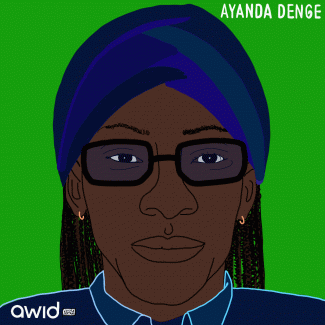
Ayanda Denge

“I am a wonder… Therefore I have been born by a mother! As I begin to stutter, my life has been like no other…” - Ayanda Denge  (read the whole poem below)

Ayanda Denge was a transwomxn, sex worker, activist, poet. She was Xhosa, from Port Elizabeth in the Eastern Cape of South Africa. After travelling through different cities of the country, she moved to Cape Town. 

As a committed and fervent social justice activist, she fought for the rights of sex workers, trans persons, and for those of people living with HIV and AIDS. She was also a motivational speaker on cancer awareness, and campaigned for affordable and social housing, especially for poor and working-class people. Ayanda stood tall as a mountain against different and often abusive faces of discrimination. 

“Being transgender is not a double dose, but it’s a triple dose of stigmatisation and discrimination. You are discriminated against for your sexual identity, you are discriminated against for your work, and you are discriminated against for your HIV status.” - Ayanda Denge, 2016

She was acting chairperson at the Sex Workers Education and Advocacy Taskforce (SWEAT) and also worked as an Outreach Coordinator at Sisonke, a national sex workers’ movement in South Africa. 

“From us, from our regional head office, to SWEAT where I sit on the board, to Sisonke, a movement of sex workers in Cape Town. We all amalgamate, we have one cry and it’s a cry that is recognised internationally by international sex workers. We want decriminalisation of sex work.” - Ayanda Denge, 2016

She lived in the Ahmed Kathrada House, which was being occupied by the Reclaim the City campaign for social housing. In 2018, Ayanda was elected house leader. On 24 March 2019, she was stabbed to death in her room. The year prior, another resident was killed.

Reclaim the City draws a connection between the safety of the house residents and the Provincial Government withholding electricity and the human right to water: 

“We cannot separate the safety of women and LGBTQI people living in the occupation from the refusal by the Western Cape Provincial Government to turn the electricity and water back on at Ahmed Kathrada House.

The house is pitch black at night. We need lights to keep each other safe. It is as if the Province wishes to punish poor and working class people, whose only crime is that we needed a home. While they may disagree with our reasons for occupying, they should be ashamed of themselves for putting politics before the safety and dignity of residents of this city.

Rest in Peace comrade Ayanda Denge, we shall remember you as we carry the torch forward in the struggle for decent well-located housing.”

Poem by Ayanda: 

I am a wonder…
Therefore I have been born by a mother!
As I begin to stutter,
My life has been like no other.
Born in pain
Nourished by rain
For me to gain
Was living in a drain.
As I shed a tear
I stand up and hold my spear.
Voices echo, do not fear
Challenges within a year,
Challenges of hurt are on my case;
Community applauds as they assume I have won my race;
But in reality my work strides at a tortoise pace;
On bended knee I bow and ask for grace.
For the Lord
Is my Sword;
To remind humanity
That he provides sanity.
Why Lord am I this wonder?
The Lord answers me with the rain and thunder,
For questioning my father
Who has in the book of lambs
A name called Ayanda.
From the streets my life was never sweet
The people I had to meet;
At times I would never greet;
Even though I had to eat;
I’d opt to take a bow
Rather than a seat

Listen to the poem in Ayanda’s voice

“For my life represents that of a lotus flower, that out of murky and troubled waters I bloomed to be beautiful and strong...” - Ayanda Denge, watch and listen 


Tributes: 

“Ayanda, I want to say to you that you are still a survivor, in our hearts and minds. You are gone but you are everywhere, because you are love. How beautiful it is to be loved, and to give love. And Ayanda, that is the gift that you have given us. Thank you for all of the love, we truly did need you. Going forward, I promise to you that we will all commit to continue with the struggle that you have dedicated so much energy and your time to. And we will commit ourselves to pursuing justice in this awful ending to your life.” - Transcript of a message, in a farewell Tribute to Ayanda

“Ayanda was an activist by nature. She knew her rights and would not mind fighting for the rights of others. For me, it was no shock that she was involved with many organizations and it was known that she was a people’s person. It did not need to be the rights of LGBTI but just the rights of everyone that she stood for.” - Ayanda’s sister
 

2009: l´ONU organise une conférence sur l´impact de la crise économique

La Conférence des Nations Unies de 2009 sur la crise financière et économique mondiale et son incidence sur le développement

  • La  conférence  de 2009  était l’aboutissement de celle de Doha en 2008. La Déclaration de Doha avait  mandaté  les Nations Unies  pour organiser, sous l’égide du Président de l’Assemblée générale, une conférence consacrée à la crise financière et économique mondiale et à son incidence sur le développement.
  • Pendant la conférence, les groupes de femmes, par le biais du WWG ont souligné l’impact de la crise financière mondiale sur les groupes les plus vulnérables. Dans sa déclaration aux membres (en anglais), le WWG a  proposé une liste d’actions nécessaires que les États membres devraient mettre en œuvre pour pallier  aux conséquences de la crise sur les femmes. Le groupe de travail a également déclaré que la prise en compte des autres groupes sociaux touchés par la crise était essentielle pour apporter une réponse qui soit en accord avec les normes et les engagements internationaux relatifs à l’égalité des genres, aux droits des femmes, aux droits humains et à l’autonomisation. 

Snippet - COP30 - Resisting Ecofascisms - ES

Resistencia a los ecofascismos: Un diálogo entre movimientos en la COP30

Cómo los movimientos resisten las agendas fascistas en relación con el cambio climático.

📅 Martes 11 de noviembre de 2025
📍 Hotel Beira Rio, Belém, Pará

Snippet intro text_Festival (EN)

¡Nuestro festival tuvo 130 presentadorxs, facilitadorxs y artistas, de 43 países, a lo largo de más de 40 sesiones!