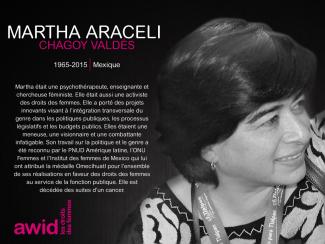
Martha Araceli Chagoy Valdes
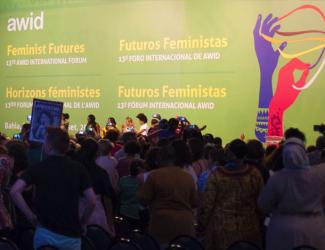
In September 2016, the 13th AWID international Forum brought together in Brazil over 1800 feminists and women’s rights advocates in a spirit of resistance and resilience.
This section highlights the gains, learnings and resources that came out of our rich conversations. We invite you to explore, share and comment!
One of the key takeaways from the 2016 Forum was the need to broaden and deepen our cross-movement work to address rising fascisms, fundamentalisms, corporate greed and climate change.
With this in mind, we have been working with multiple allies to grow these seeds of resistance:
And through our next strategic plan and Forum process, we are committed to keep developing ideas and deepen the learnings ignited at the 2016 Forum.
AWID Forums started in 1983, in Washington DC. Since then, the event has grown to become many things to many peoples: an iterative process of sharpening our analyses, vision and actions; a watershed moment that reinvigorates participants’ feminisms and energizes their organizing; and a political home for women human rights defenders to find sanctuary and solidarity.
We know feminists still need and deserve more and better resources! We have revised our funder database.
The Who Can Fund Me? Database is an easy-to-use, practical tool for movements looking for funders from philanthropic foundations, multilateral funders to women’s and feminist funds to support vital lifesaving efforts.
Nous nous posons la même question et nous pensons qu'elle n’admet pas de réponse simple. Le Forum de l’AWID pourrait être, pour de nombreux participant·e·s, l'un des rares voyages internationaux qu'ils·elles effectueront au cours de leur vie. La pandémie nous a révélé les possibilités mais aussi les limites des espaces virtuels pour la construction de mouvements : rien ne vaut une rencontre en personne. Les mouvements ont besoin de connexions transfrontalières pour renforcer leur pouvoir collectif face aux menaces qui pèsent sur eux, notamment la crise climatique. Nous sommes d'avis que le prochain Forum de l'AWID pourrait ouvrir un espace stratégique afin d'organiser ces conversations et explorer les alternatives qui se posent aux voyages internationaux. L'élément hybride du Forum est une composante importante de cette exploration.
As heteropatriarchal capitalism continues to force us into consumerism and compliance, we are finding that our struggles are being siloed and separated by physical as well as virtual borders.
And with the additional challenges of a global pandemic to overcome, this divide-and-conquer strategy has been favorable for the proliferation of exploitation across many areas.
Yet, From September 1 to September 30, 2021, Crear | Résister | Transform: a festival for feminist movements! took us on a journey of what it means to embody our realities in virtual spaces. At the festival, feminist activists from across the world came together, not only to share experiences of hard-won freedoms, resistances, and cross-borders solidarities, but to articulate what a transnational form of togetherness could look like.
It is this togetherness that has the potential to defy borders, weaving a vision for a future that is transformative because it is abolitionist and anti-capitalist. Spread out over a month, across digital infrastructures that we occupied with our queerness, our resistance, and our imaginaires, the festival showed a way to deviate from the systems that make us complicit in the oppression of others and ourselves.
Though Audre Lorde taught us that the master’s tools will never dismantle the master’s house, Sara Ahmed showed us that we can misuse them. Because we had to make space for assembly, in spite of all the other demands on our time, it became possible to imagine a disruption to the reality of heteropatriarchal capitalism.
Now, if we understand assembly as a form of pleasure, then it becomes possible to make the link between transgressive pleasure and transnational/transdigital resistance. Between the kinds of pleasure that challenges borders on the one hand, and queerness, campiness, land and indigenous struggle, anti-capitalism, and anti-colonial organizing on the other.
This issue attempted to capture a sense of how the festival’s exercise in assembly took on multiple shapes and imaginations. Beyond direct collaborations with some of its speakers and dreamers, we brought on a plethora of other voices from the Global South to be in conversation with many of its themes and subjects. Below is a map of some of the festival’s panels that most inspired us.
Movements marching globally for climate justice.
📅 Saturday, November 15, 2025
📍 Multiple Locations
«Yo no planeaba ser una cantante, el canto planeó estar en mí.» - Dorothy Masuka (entrevista de Mail & Guardian)
Una de estas canciones, titulada «Dr. Malan» (por el político pro-apartheid D.F. Malan) fue prohibida. Luego, en 1961, grabó «Lumumba», una canción sobre el asesinato del líder anticolonial Patrice Lumumba. El trabajo y el activismo de Dorothy atrajeron la atención de la División Especial de la policía sudafricana, y fue forzada a un exilio político que se prolongaría durante tres décadas. Durante ese tiempo, trabajó con grupos independentistas, incluido el Congreso Nacional Africano. En 1992, cuando el apartheid comenzó a desmoronarse y Nelson Mandela fue liberado de prisión, Dorothy regresó a Sudáfrica.
Su trabajo incluye la primera canción que grabó, en 1953, titulada «Hamba Notsokolo», que fue un éxito durante la década de 1950, y hoy es un clásico muy valorado. También escribió «El Yow Phata Phata», una canción que fue adaptada por Miriam Makeba, quien hizo de «Pata, Pata» un hit internacional.
Arraigados en la resistencia, la música y el activismo de Dorothy (popularmente conocida como «Auntie Dot» [«Tía Dot»]) estaban entretejidos, y dejaron un legado magnífico e inspirador.
Dorothy falleció en Johannesburgo el 23 de febrero de 2019 a la edad de 83 años, por problemas de salud.
Entrevista a Dorothy Masuka de Mail & Guardian (en inglés)
Escucha su música:
Le Forum a été un espace clé pour le Mouvement des femmes autochtones (Indigenous Women’s Movement, IWM) dans son rapport au féminisme. Aux Forums de l’AWID, elles ont appliqué la même stratégie que celle utilisée pour les Nations Unies. Au cours de ce processus, les deux mouvements ont été transformés : de nouvelles voix et questions ont émergé au sein de l’IWM, et les féministes ont commencé à changer leurs discours et leurs pratiques autour des droits fonciers et de la spiritualité, elles ont mieux compris les droits collectifs et ont inclus l’IWM dans leurs événements et leurs programmes. Mónica Alemán et María Manuela Sequeira, de l’IWM, nous ont raconté cette histoire.
con Nazik Abylgaziva, Amaranta Gómez Regalado, Cindy Weisner y Lucineia Freitas
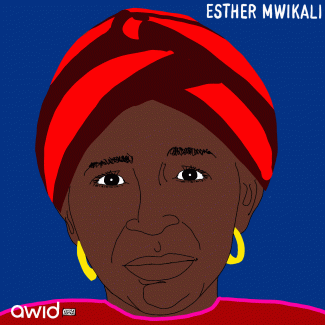
Esther Mwikali habitait dans le village de Mithini, dans le comté de Murang’a au Kenya. Activiste des droits fonciers, importante et appréciée, elle travaillait sur les abus à l’égard de squatters vivant sur des terres revendiquées par des magnats. Esther a participé à une enquête qui comprenait également des violations de droits fonciers à Makaya par de puissants individus.
Suite à l’absence d’Esther lors d’une réunion de village, une équipe de patrouille est partie à sa recherche. Le 27 août 2019, deux jours après sa disparition, on retrouva son corps dans une ferme proche de sa propriété, montrant des signes de torture. Elle fut sauvagement assassinée.
« Esther était reconnue pour son travail auprès des membres de la communauté, empêchant les évictions de terres revendiquées des magnats. Les activistes du coin n’ont aucun doute sur le lien entre son meurtre et les luttes constantes pour les terres dans la région. C’est un tragique rappel de la fréquence alarmante d’assassinats extrajudiciaires régulièrement menés au Kenya » - Global Wittness Report, juillet 2020
« Nous associons la mort de Mwikali aux luttes pour les terres par ici. Nous demandons au gouvernement de mener une enquête sur ce sujet au plus tôt. » - James Mburu, porte-parole des squatters
« Des mesures devraient être prises à l’égard des individus suspectés d’avoir menacé les squatters, et notamment la famille Mwikali. » - Alice Karanja, National Coalition of Human Rights Defenders (coalition nationale des défenseur·e·s des droits humains)
« L’impact de son travail et sa ténacité demeureront encore en vie pour les prochaines décennies au Kenya. CJGEA console avec les personnes endeuillées et appelle à la justice. » - Center for Justice and Governmental Action (Centre pour la justice et l’action gouvernementale, CJGEA) communiqué de presse, 13 septembre 2019
Les agradecemos su interés por visitar el sitio web de AWID. Para obtener más información sobre nuestro trabajo, visiten https://www.awid.org/es
Esta publicación (zine) colaborativa surgió de una serie de círculos de intercambio que reunieron a feministas de todo el mundo durante 2022. El propósito fue intercambiar ideas y aprender mutuamente de qué manera las comunidades responden a la crisis climática en diversos contextos locales.
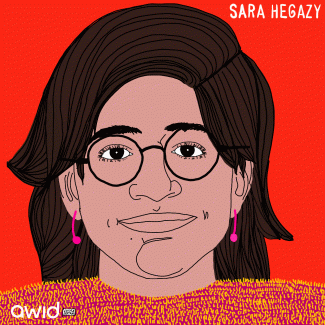
Sara Hegazy, a bold Egyptian LGBTQI+ rights activist, lived in a society where the members of her community, their bodies and lives often face lethal prejudice. The roots of Sara’s resistance were in the deconstruction of a dominant, oppressive and patriarchal system, and its anti-rights actors.
"[In Egypt], every person who is not male, Muslim, Sunni, straight, and a supporter of the system, is rejected, repressed, stigmatized, arrested, exiled, or killed. This matter is related to the patriarchal system as a whole, since the state cannot practice its repression against citizens without a pre-existing oppression since childhood." - Sara Hegazy wrote on March 6, 2020
The suppression of Sara’s voice by the Egyptian government reached its violent peak in 2017, when she was arrested for raising a rainbow flag at the Mashrou’ Leila (Lebanese band whose lead vocalist is openly gay) concert in Cairo. What followed were charges of joining an illegal group along with “promoting sexual deviancy and debauchery”.
"It was an act of support and solidarity — not only with the [Mashrou' Leila] vocalist but for everyone who is oppressed...We were proud to hold the flag. We wouldn't have imagined the reaction of society and the Egyptian state. For them, I was a criminal — someone who was seeking to destroy the moral structure of society." - Sara Hegazy
Sara was jailed for three months, where she was tortured and sexually assaulted. In January 2018, after being released on bail, she sought asylum in Canada where she was safe but imprisoned by the memories of the abuse and violence her body and soul had gone through.
"I left this experience after three months with a very intense, serious case of PTSD [post-traumatic stress disorder]. Prison killed me. It destroyed me." - Sara Hegazy told NPR
Sara took her own life on 14 June 2020, leaving a handwritten note in Arabic:
“To my siblings – I tried to find redemption and failed, forgive me.”
“To my friends – the experience [journey] was harsh and I am too weak to resist it, forgive me.
“To the world – you were cruel to a great extent, but I forgive.”
Her legacy and courage will be carried forward by those who love her and believe in what she fought for.
“To Sarah: Rest, just rest, spared from this relentless violence, this state-powered lethal patriarchy. In rage, in grief, in exhaustion, we resist.” - Rasha Younes, an LGBT rights researcher at Human Rights Watch. Read the complete text
Mashrou’ Leila’s lead vocalist sings tribute to Sara Hegazy
The “Where is the Money?” #WITM survey is now live! Dive in and share your experience with funding your organizing with feminists around the world.
Learn more and take the survey
Around the world, feminist, women’s rights, and allied movements are confronting power and reimagining a politics of liberation. The contributions that fuel this work come in many forms, from financial and political resources to daily acts of resistance and survival.
AWID’s Resourcing Feminist Movements (RFM) Initiative shines a light on the current funding ecosystem, which range from self-generated models of resourcing to more formal funding streams.
Through our research and analysis, we examine how funding practices can better serve our movements. We critically explore the contradictions in “funding” social transformation, especially in the face of increasing political repression, anti-rights agendas, and rising corporate power. Above all, we build collective strategies that support thriving, robust, and resilient movements.
Create and amplify alternatives: We amplify funding practices that center activists’ own priorities and engage a diverse range of funders and activists in crafting new, dynamic models for resourcing feminist movements, particularly in the context of closing civil society space.
Build knowledge: We explore, exchange, and strengthen knowledge about how movements are attracting, organizing, and using the resources they need to accomplish meaningful change.
Advocate: We work in partnerships, such as the Count Me In! Consortium, to influence funding agendas and open space for feminist movements to be in direct dialogue to shift power and money.