Related content
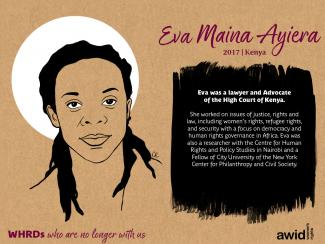
AfriCOG's security forum: Eva Ayiera on key drivers of Kenya's security threats (Video)
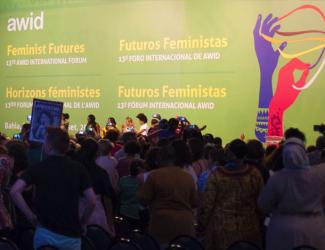
In September 2016, the 13th AWID international Forum brought together in Brazil over 1800 feminists and women’s rights advocates in a spirit of resistance and resilience.
This section highlights the gains, learnings and resources that came out of our rich conversations. We invite you to explore, share and comment!
One of the key takeaways from the 2016 Forum was the need to broaden and deepen our cross-movement work to address rising fascisms, fundamentalisms, corporate greed and climate change.
With this in mind, we have been working with multiple allies to grow these seeds of resistance:
And through our next strategic plan and Forum process, we are committed to keep developing ideas and deepen the learnings ignited at the 2016 Forum.
AWID Forums started in 1983, in Washington DC. Since then, the event has grown to become many things to many peoples: an iterative process of sharpening our analyses, vision and actions; a watershed moment that reinvigorates participants’ feminisms and energizes their organizing; and a political home for women human rights defenders to find sanctuary and solidarity.
Related content
AfriCOG's security forum: Eva Ayiera on key drivers of Kenya's security threats (Video)
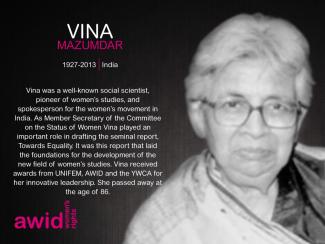
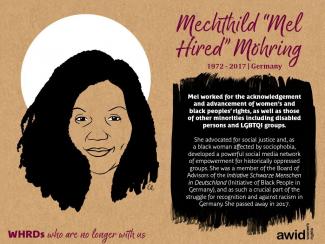
Estas defensoras lucharon por los derechos sobre la tierra, de las mujeres y de los pueblos indígenas; haciendo frente a las industrias extractivas, escribiendo poesía y promoviendo el amor. Una de ellas desapareció hace ya 19 años. Únete a nosotras para recordar y honrar a estas defensoras de derechos humanos, su trabajo y su legado, compartiendo los memes aquí incluidos; y tuiteando las etiquetas #WHRDTribute y #16Días.
Por favor, haz click en cada imagen de abajo para ver una versión más grande y para descargar como un archivo.


NOUS SOMMES LA SOLUTION
Somos la Solución
No, we appreciate your work but are not asking for responses from individuals at this time.
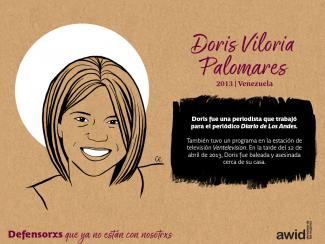
These transgender women were murdered because of their activism and their gender identity. There are insufficient laws recognizing trans* rights, and even where these laws exist, very little is being done to safeguard the rights of trans* people. Please join AWID in honoring these defenders, their activism and legacy by sharing the memes below with your colleagues, networks and friends and by using the hashtags #WHRDTribute and #16Days.
Please click on each image below to see a larger version and download as a file


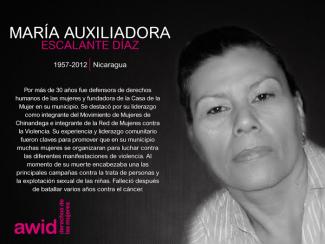
Tenemos el placer de presentarte a Mariama Sonko, inspiradora ecofeminista, campesina y defensora de los derechos humanos y de las mujeres, que vive actualmente en Niaguis, en el suroeste de Senegal.
Al crecer en una familia y comunidad campesina rural, fue testigo del papel esencial de la mujer en la producción de alimentos y el almacenamiento de semillas desde la infancia, mientras estaba inmersa en el trabajo y ritmos de la tierra.
Mariama ha defendido el conocimiento agrícola local y las prácticas campesinas desde los años 1990. Como madre de 5 hijos, los alimentos que ella misma cultiva son la principal fuente de sustento de su familia.
Actualmente es presidenta de Nous Sommes la Solution y está comprometida con la promoción de las prácticas agroecológicas y la agricultura familiar, con el fomento de la soberanía alimentaria, la biodiversidad y la preservación de las semillas campesinas, y con la exigencia del acceso equitativo a los recursos y a la tierra en África Occidenta para las mujeres.
Fuente: AWID’s Feminist Realities Festival Crear | Résister | Transform - 2º día
La encuesta está disponible en KOBO, una plataforma de fuente abierta para recopilar, gestionar y visualizar datos. Para participar, simplemente haz clic en el enlace a la encuesta aquí. Sigue las instrucciones para responder la encuesta.
This section highlights key resources recommended by AWID so you can conduct your own WITM research.
In this section
Online tools
Once you gather these resources, you can estimate the costs for your research using our “Ready to Go? Worksheet”

The Ready to Go? Worksheet helps you estimate resources, staff and budget needed for your research
Oui, elle est accessible aux personnes ayant une diversité de capacités d’audition, de mouvement, de vision et cognitives.
We all can dance
by Mechthild Möhring (aka serialmel)
How I punt myself at the narrow hard knitting I once retrieved. I'm dancing in the kitchen when I'm alone. Gracile and powerful. When I'm in company I'm clumsy. My body scandalizes, scandalizes the laws of look I feel, scandalizes the words which banished me. "Of course she can dance, it's in her blood as a Black person." "If she is able to dance nicely she is good in bed" they whisper, they murmur, no - they say it openly into my face. They smirk and rub themselves against me and let me move back. I stumble and fall. My feet reject their duty. Bearish I get out of breath. Smiling I place myself out of events and notice how my face freezes into a mask.
Translated into English by Tsepo Bollwinkel
Original in German
Tanzen können wir alle
Von Mechthild Möhring (aka serialmel)
Wie ich mich stosse an den engen, harten Maschen, in die ich mich einst zurückgezogen habe. Ich tanze in der Küche, wenn ich allein bin. Grazil und kraftvoll. Wenn ich in Gesellschaft bin, bin ich unbeholfen. Mein Körper eckt an, an die Gesetze des Blicks, den ich spüre, an die Worte, die mich bannten. „Natürlich kann sie tanzen, als Schwarze hat sie das im Blut.“ „Wenn sie gut tanzen kann, dann ist sie auch gut im Bett“ flüstern sie, raunen sie, nein, sie sagen es mir laut ins Gesicht. Sie grinsen und reiben sich an mir und lassen mich zurückweichen. Ich stolpere und falle. Meine Füsse verweigern ihren Dienst. Tollpatschig gerate ich ausser Atem. Lächelnd setze ich mich an den Rand des Geschehens und bemerke, wie mein Gesicht zur Maske erstarrt.
Interviews produce in-depth information that you cannot easily obtain from surveys. While surveys focuses mainly on quantifiable data and closed questions, interviews allow for expert opinions from activists and donors, and open-ended questions which can provide context to survey data results.
In this section
- General tips
1. Before conducting your interviews
2. During the interviews- Specialized interviews
1. Donor interviews
2. Women’s rights organizations and activists interviews- Preliminary findings
Send the interviewees a concept note with your objectives for the interview and for your overall research, as well as a list of questions.
This allows them to prepare answers for more complicated questions and look up information that they may not have immediately on hand.
Do not base your questions on assumptions about your interviewees’ knowledge.
Instead, first clarify what they know – this will reveal information as well.
- DON’T: “Given the current funding trends in Switzerland, do you know of any opportunities for collaboration? This question assumes that the interviewee knows current funding trends and that their understanding of funding trends matches yours.
- DO: First ask “What is your understanding of current funding trends in Switzerland?”, followed by “Do you know of any opportunities for collaboration?” This will reveal what their understanding is, giving you even more information than the first question.
Interviews with donors will allow you to build deeper relationships with them, which will be useful when you conduct post-research advocacy. They will also provide you with deeper insight into funders’ decision-making processes.
Suggested topics of focus for donor interviews:
Interviews with women’s rights organizations and activists will provide you with insight into their on-the-ground realities. Again, these interviews will allow you to build deeper relationships that can be incorporated into your advocacy, particularly to encourage collaboration between donors and activists.
Suggested topics of focus for women’s rights organizations and activist interviews:
Through the course of your WITM research, we recommend analyzing your preliminary findings. Presenting your preliminary findings opens up opportunities to conduct more interviews and get feedback on your research process and initial results. This feedback can be incorporated into your final research.
AWID conducts “WITM convenings” to share preliminary results of survey data and interviews. These gatherings allow participants (activists, women’s rights organizations, and donors) to debate and discuss the results, clarifying the context, creating more ownership amongst members of the movement, and providing more input for final research.
For example, the Resource Mobilization Hub for Indigenous Women’s Rights at the World Summit on Indigenous Philanthropy was used as a space to debut preliminary results.
4. Collect and analyze your data

• 1.5 - 3 months
• 1 or more research person(s)
• List of donors and women’s rights organizations and activists to interview
• Prepared interview questions
• Concept Note (You can use the research framing you created in the “Frame your research” section)
• AWID Sample Interview Questions: Donors
• AWID Sample Interview Questions: Activists & Women’s Rights Organizations
4. Collect and analyze your data

Notre rapport annuel 2013 retrace les temps forts du travail que nous avons réalisé au cours de l'année, afin de contribuer à l'avancement des droits des femmes et de l'égalité des genres à travers le monde.
