None On Record

Young Feminist Activism

Organizing creatively, facing an increasing threat

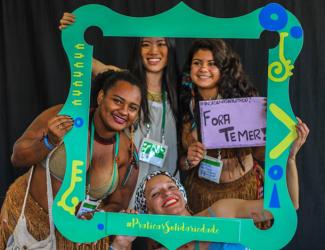
Young feminist activists play a critical role in women’s rights organizations and movements worldwide by bringing up new issues that feminists face today. Their strength, creativity and adaptability are vital to the sustainability of feminist organizing.

At the same time, they face specific impediments to their activism such as limited access to funding and support, lack of capacity-building opportunities, and a significant increase of attacks on young women human rights defenders. This creates a lack of visibility that makes more difficult their inclusion and effective participation within women’s rights movements.

A multigenerational approach

AWID’s young feminist activism program was created to make sure the voices of young women are heard and reflected in feminist discourse. We want to ensure that young feminists have better access to funding, capacity-building opportunities and international processes. In addition to supporting young feminists directly, we are also working with women’s rights activists of all ages on practical models and strategies for effective multigenerational organizing.

Our Actions

We want young feminist activists to play a role in decision-making affecting their rights by:

  • Fostering community and sharing information through the Young Feminist Wire. Recognizing the importance of online media for the work of young feminists, our team launched the Young Feminist Wire in May 2010 to share information, build capacity through online webinars and e-discussions, and encourage community building.

  • Researching and building knowledge on young feminist activism, to increase the visibility and impact of young feminist activism within and across women’s rights movements and other key actors such as donors.

  • Promoting more effective multigenerational organizing, exploring better ways to work together.

  • Supporting young feminists to engage in global development processes such as those within the United Nations

  • Collaboration across all of AWID’s priority areas, including the Forum, to ensure young feminists’ key contributions, perspectives, needs and activism are reflected in debates, policies and programs affecting them.

Related Content

What issues does AWID work on?

AWID works towards the realization of gender justice and women’s human rights worldwide. We work to strengthen the voices and impact of women’s rights advocates, organizations and movements. Our main Priority Areas relate to themes that are closely linked to dominant global trends.

These themes reflect growing challenges that negatively impact women’s rights worldwide.

  • Economic Justice
  • Resourcing Women’s Rights
  • Challenging Religious Fundamentalisms
  • Women Human Rights Defenders
  • Young Feminist Activism

Find out more about AWID's Priority Areas

Will there be any support for materials or other preparatory costs for workshops?

You can expect all the standard materials for workshops and presentations: flip charts, markers, sticky notes, in addition to projectors and audio-visual equipment. Any additional materials are the responsibility of the activity organizers. AWID’s logistics team will be available to answer questions and advise.

Snippet Propositions féministes pour une économie juste FR

L’AWID, le Centre pour le leadership mondial des femmes (CWGL en anglais) et le Réseau de Développement et de Communication des Femmes Africaines (FEMNET), proposent ce document de réflexion pour questionner les concepts traditionnels liés au développement. Il inclut également une série de propositions pour un programme féministe en faveur de la justice de genre, de la justice économique et de la justice en matière de développement.

En savoir plus sur les origines du projet


Les propositions

Ces propositions sont formulées pour être discutées, débattues, mises en pièces, adaptées, adoptées ou encore pour en inspirer d’autres.

Nilcéa Freire

Nilcéa Freire fue una activista feminista, política y académica brasileña. Como perseverante defensora de los derechos de las mujeres y de las minorías subrepresentadas de su país, su vida y su trabajo acumularon una larga historia de luchas y victorias.

«Mientras se resiste, tenemos que empujar para avanzar y los avances que vamos a poder lograr en este momento, a mi juicio, serán a través de la organización estupenda que las jóvenes mujeres blancas, pero sobre todo, las mujeres negras, están haciendo en todas las capitales, y las grandes ciudades de Brasil.» - Nilcéa Freire

En 1999, se convirtió en la primera mujer Rectora de la Universidad del Estado de Río de Janeiro (UERJ). Desde ese puesto, impulsó la implementación de la primera política de acción afirmativa para estudiantes que se graduaban de escuelas públicas, que exigía un cupo específico para estudiantes negrxs de sectores de bajos ingresos, sistema adoptado por decenas de otras universidades públicas.

Unos años más tarde, Nilcéa encabezó la Secretaría Especial de Políticas para las Mujeres del gobierno del ex-presidente Luiz Inácio Lula da Silva. Desde esta función, lideró la Primera Conferencia Nacional de Mujeres Brasileñas, en la que participaron más de doce mil mujeres de todo el país. El resultado de este trabajo colectivo fue incorporado en el Plan Nacional de Políticas para las Mujeres.

Su compromiso con las mujeres y las personas afrobrasileñas e indígenas se reflejó también en su trabajo de promoción de sus derechos, a través de iniciativas de la Fundación Ford en Brasil, de la cual fue Directora Regional.

La activista feminista Manoela Miklos describió a Nilcéa como «una mujer sin igual».

Nilcéa falleció en Río de Janeiro el 29 de diciembre de 2019 a los 66 años, víctima de un cáncer.


 «No tengo palabras ante la noticia de la muerte de la querida Nilcéa Freire. Es demasiado triste saber que partió tan pronto. Siempre formó parte de las filas de quienes no aceptan las injusticias del mundo. Fue Ministra de las Mujeres, una activista, siempre activa en la causa feminista. ¡La extrañaremos mucho!» - Jandira Feghali, Diputada Federal

La feminista brasileña Nilcéa Freire nos dice por qué es importante solidarizarse con Brasil
¿Publican un informe anual?

Sí. AWID publica informes anuales.

Todos nuestros informes anuales estan disponibles en línea.

Ver todos los informes anuales de AWID

ฟอรัม AWID นานาชาติ คืออะไร

ทุกสามถึงสี่ปี AWID จะเป็นเจ้าภาพงานประชุมนานาชาติที่สำคัญ โดยจะเป็นการประชุมขนาดใหญ่ระดับโลกที่หัวใจหลักอยู่ที่ขบวนการเฟมินิสต์และความเป็นธรรมทางเพศที่หลากหลาย เป็นการรวมตัวกันระดับโลกของนักกิจกรรมเฟมินิสต์ เครือข่ายพันธมิตร นักวิชาการ แหล่งทุน และผู้กำหนดนโยบาย โดยฟอรัมเปลี่ยนสถานที่จัดหมุนเวียนไปในต่างภูมิภาคและในประเทศต่างๆทั่วซีกโลกใต้

Snippet She is on her way_Fest (EN)

Plenary session:

She is on her way:
Alternatives, feminisms and another world

Felogene Anumo, AWID
Dr. Vandana Shiva, India
Dr. Dilar Dirik, Kurdistan
Nana Akosua Hanson, Ghana

watch plenary


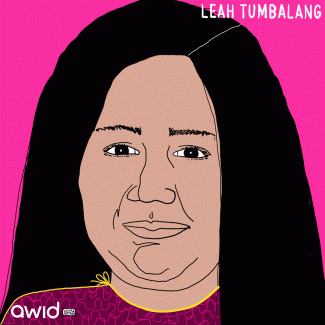
Leah Tumbalang

Leah Tumbalang était une femme lumad de Mindanao, aux Philippines. L’histoire du peuple autochtone Lumad recouvre des générations de résistance à l'exploitation minière à grande échelle par les entreprises, la protection des domaines ancestraux, des ressources et de la culture, et la lutte pour le droit à l'autodétermination. 

Leah était une leader lumad, ainsi qu’une dirigeante du Kaugalingong Sistema Igpasasindog tu Lumadnong Ogpaan (Kasilo), une organisation paysanne lumad plaidant contre l'arrivée des sociétés minières à Bukidnon, dans la province de Mindanao. Elle s’est montrée inébranlable dans son activisme antimines, militant avec ferveur contre les effets dévastateurs de l'extraction minière sur l'environnement et les terres des peuples autochtones. Leah était également une organisatrice de la liste du parti Bayan Muna, membre du parti politique de gauche Makabayan.

Depuis près d’une décennie, Leah (ainsi que d’autres membres de Kasilo) recevait des menaces du fait qu'elle codirigeait l'opposition contre le déploiement de groupes paramilitaires soupçonnés d’être soutenus par des intérêts miniers. 

« En tant que leader des Lumad au sein de leur communauté, elle est au premier plan pour lutter en faveur de leurs droits à la terre ancestrale et à l'autodétermination ». - Organisation régionale lumad de Kalumbay

Être en première ligne de la résistance implique également souvent d’être la cible de violences et victime de l’impunité. Leah a non seulement reçu de nombreuses menaces de mort, mais elle a été assassinée le 23 août 2019 à Valencia, dans la province de Bukidnon.  

Selon un rapport de Global Witness, « les Philippines sont le pays à avoir été le plus touché en chiffre absolu » pour ce qui est des meurtres d’activistes écologistes en 2018. 


Lisez le rapport du Global Witness, publié en juillet 2019

En savoir plus sur les femmes lumad aux Philippines et leur lutte intergénérationnelle pour l'autodétermination
 

J’ai rédigé un article en rapport avec les droits des femmes et le développement. Comment puis-je le partager avec les membres de l’AWID ?

ฉันจำเป็นต้องเป็นสมาชิก AWID หรือไม่เพื่อเข้าร่วมฟอรัม

ไม่ คุณไม่จะเป็นต้องเป็นสมาชิก AWID เพื่อที่จะเข้าร่วมฟอรัม แต่สมาชิก AWID จะได้รับส่วนลดค่าลงทะเบียนรวมถึงสิทธิประโยชน์อื่นๆ เรียนรู้เพิ่มเติมเกี่ยวกับการเป็นสมาชิก AWID

Snippet Day 14_Fest (ES)

La historia de Crear, Résister, Transform

Coumba Toure

ver vide


Palabras de clausura: ¿Cómo seguimos?

Cindy Clark, AWID

ver video


Fem Joy: ¡Fiesta de cierre!

DJ Miss Ray
DJ Luana Flores
Phoenix Inana

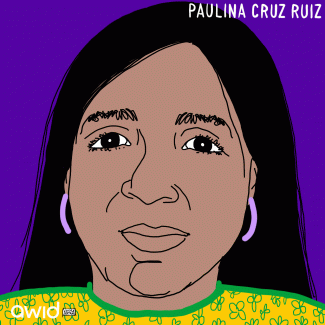
Paulina Cruz Ruiz

Paulina Cruz Ruiz, from the Rabinal, Baja Verapaz region of Guatemala, was an ancestral Maya Achí (Indigenous) authority and a human rights defender.

She was actively involved in community organizing and resistance, including legal measures against mining projects on Indigenous territory, projects that would severely affect and damage the socio-environmental fabric.  

“The extractive industry model promoted by the Guatemalan government and the construction of large-scale development projects on indigenous lands without community consent has been a source of ongoing disputes with resistance movements.” - Minority Rights Group International

Paulina was also part of the March for Dignity, Life and Justice, in which on 1 May 2019 thousands of Guatemalans started a march of eight days against corruption and impunity in the prosecution and assassinations of human rights, peasant and Indigenous leaders and land defenders.

Paulina was murdered on 14 September 2019 near her home in the village of Xococ. 

According to the Minority Rights Group International, “one of the major ongoing issues affecting Mayan communities is the increasing activity of the mining industry.”


Read more about the Mayans of Guatemala

Read more about the March for Dignity, Life and Justice


2005: Second High-level Dialogue takes place

Second High-level Dialogue on Financing for Development

  • The overall theme of the Second High-level Dialogue on Financing for Development, from 27-28 June 2005 was The Monterrey Consensus: status of implementation and tasks ahead. 
  • Apart from the traditional six roundtables on each of the individual chapters of the Monterrey Consensus, there was an informal interactive dialogue with the participation of a range of stakeholders including women’s rights groups.  
  • There was a call from ‘developing’ nations that global challenges and local needs and possibilities be taken into account when interacting with different groups including women, youth, people with disabilities etc. on the themes identified in the Monterrey consensus.  

บุคคลหรือองค์กรสามารถส่งใบสมัครหลายกิจกรรมได้หรือไม่

คุณสามารถส่งกิจกรรมได้มากถึง 2 กิจกรรมในฐานะผู้จัดกิจกรรม และคุณยังสามารถเป็นผู้ร่วมจัดในการส่งกิจกรรมของผู้อื่นได้

Snippet intro text_Festival (FR)

Notre festival a réuni 130 conférencièr.e.s, animateur.ice.s et artistes de 43 pays, réparti.e.s sur plus de 40 sessions !

2011: el quinto Diálogo de Alto Nivel inicia las conversaciones sobre la Agenda de Desarrollo Post-2015

El Quinto Diálogo de Alto Nivel sobre la Financiación para el Desarrollo, realizado el 7 y 8 de diciembre de 2011, marcó el comienzo de las conversaciones en torno a la Agenda de Desarrollo Post-2015 y sus relaciones con la financiación para el desarrollo. Esta conferencia puso especial énfasis en incrementar la ayuda para financiar los ODM. En sus observaciones finales, el Presidente en Funciones de la Asamblea General pidió a los Estados Miembros que comenzaran a pensar en el marco para el desarrollo post-2015.