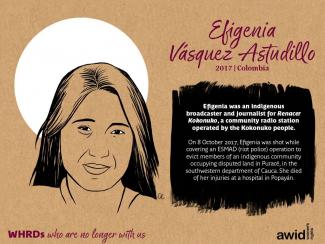
Efigenia Vásquez Astudillo

Young feminist activists play a critical role in women’s rights organizations and movements worldwide by bringing up new issues that feminists face today. Their strength, creativity and adaptability are vital to the sustainability of feminist organizing.
At the same time, they face specific impediments to their activism such as limited access to funding and support, lack of capacity-building opportunities, and a significant increase of attacks on young women human rights defenders. This creates a lack of visibility that makes more difficult their inclusion and effective participation within women’s rights movements.
AWID’s young feminist activism program was created to make sure the voices of young women are heard and reflected in feminist discourse. We want to ensure that young feminists have better access to funding, capacity-building opportunities and international processes. In addition to supporting young feminists directly, we are also working with women’s rights activists of all ages on practical models and strategies for effective multigenerational organizing.
We want young feminist activists to play a role in decision-making affecting their rights by:
Fostering community and sharing information through the Young Feminist Wire. Recognizing the importance of online media for the work of young feminists, our team launched the Young Feminist Wire in May 2010 to share information, build capacity through online webinars and e-discussions, and encourage community building.
Researching and building knowledge on young feminist activism, to increase the visibility and impact of young feminist activism within and across women’s rights movements and other key actors such as donors.
Promoting more effective multigenerational organizing, exploring better ways to work together.
Supporting young feminists to engage in global development processes such as those within the United Nations
Collaboration across all of AWID’s priority areas, including the Forum, to ensure young feminists’ key contributions, perspectives, needs and activism are reflected in debates, policies and programs affecting them.
Les Femmes Maintiennent les Soins | Les Soins Soutiennent la Vie | La Vie Soutient l'Économie | Qui s'Occupe des Femmes ? | Pas Une de Moins1 | Ensemble | Déjeuner du Dimanche
1Nenhuna a menos se traduit littéralement par « pas une femme de moins » ou « ni una menos » en espagnol - un célèbre slogan féministe en Amérique latine qui a émergé en Argentine en réponse à l'augmentation de la violence sexiste.
Compilación de noticias sobre la organización y/o el trabajo de AWID
Notas de prensa, dosieres y kits
Le financement extérieur inclut les subventions et autres formes de financement de la part de fondations philanthropiques, de gouvernements, de financeurs bilatéraux, multilatéraux ou d’entreprise et de donateur·rices individuel·les, qu’elles et ils soient de votre pays ou de l’étranger. Il exclut les ressources que les groupes, organisations et/ou mouvements génèrent de manière autonome (ressource en anglais), telles que les cotisations d’adhésion, contributions volontaires du personnel, de membres et/ou de soutiens, les collectes de fonds communautaires, les locations de salles et ventes de services. Les définitions des différents types de financement, ainsi que de courtes descriptions des différents bailleurs de fonds, sont incluses dans l’enquête pour une meilleure compréhension.

Click on the image to open the PDF
 |
Where we are now |
Where we want to be |
Current funding by sector |
 |
 |
 |
| Download & share | Download & share | Download & share |
Yes, the survey is accessible to people with a diverse range of hearing, movement, sight, and cognitive abilities.
We are living in a world where the destruction of Nature fuels our current global economy. |
Even in times of climate crisis, governments continue to encourage large-scale agriculture industries to expand. These activities poison the land, threaten biodiversity, and destroy local food production and livelihoods. Meanwhile, while women produce the majority of our food in the world, they own almost none of the land. |
|
What if we perceived land and Nature not as private property to exploit, but as a whole to live in, learn from, and harmoniously coexist with? What if we repaired our relationships with the land and embraced more sustainable alternatives that nurture both the planet and its communities? Nous Sommes la Solution (We Are the Solution, NSS) is one of many women-led movements striving to do this. This is their story. |
|

La información contenida en esta comunicación es confidencial y está destinada exclusivamente la persona que lo recibe.
Esta comunicación podría contener información que es propiedad de la Asociación para los Derechos de las Mujeres y el Desarrollo (AWID, por sus siglas en inglés). Esta información no puede reproducirse ni diseminarse ni parcialmente ni en su totalidad sin el consentimiento escrito de AWID.
AWID no garantiza que la información aquí contenida sea completa o correcta. Esta comunicación no es una oferta para elaborar ningún tipo de acuerdo y no es una confirmación de ningún acuerdo descrito en este documento, a menos que el contexto indique claramente lo contrario.
AWID no está actuando en calidad de asesora de ningún acuerdo que pueda surgir de este documento, y esta comunicación no constituye una recomendación, guía o propuesta para elaborar un acuerdo.
AWID no garantiza o asegura los resultados esperados de cualquier acuerdo. Esta comunicación puede contener puntos de vista y opiniones que pueden no corresponderse con aquellos de AWID.
No tendrá derecho a utilizar la información contenida en esta comunicación con fines de llegar a cualquier tipo de propuesta de acuerdo u otro.
El tiempo estimado para responder la encuesta es de 30 minutos.
AGROECOLOGY AND FOOD SOVEREIGNTY AS RESISTANCE |
Today, large-scale industrial food production uses single-crop plantations, genetically modified organisms and other pesticides that destroy the land and knowledge of local communities. |
Agroecology is a resistance to corporate-driven agriculture. It prioritizes smaller scale agriculture, multiple crops and diversified food production, and the centering of local knowledge and practices. Agroecology goes hand-in-hand with demands for food sovereignty, or the “right of peoples to healthy and culturally appropriate food produced through ecologically sound and sustainable methods, and their right to define their own food and agriculture systems”(Via Campesina, Declaration of Nyéléni).
The role of women, indigenous and rural communities and people of color from the Global South is absolutely essential when it comes to food systems. Feminist agroecologists are working to dismantle oppressive gender roles and systems of patriarchy embedded within food production. As shown by the heroines of NSS, they are generating a liberatory agroecology by strengthening community resilience, empowering women peasants and farmers, and preserving local traditions, territories, and knowledge of food-producing communities.