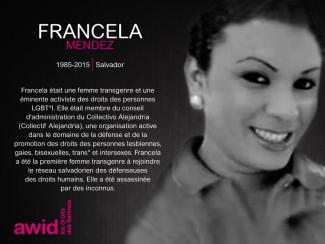
Francela Mendez
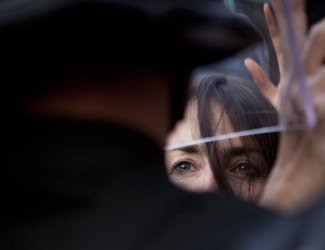
WHRDs are self-identified women and lesbian, bisexual, transgender, queer and intersex (LBTQI) people and others who defend rights and are subject to gender-specific risks and threats due to their human rights work and/or as a direct consequence of their gender identity or sexual orientation.
WHRDs are subject to systematic violence and discrimination due to their identities and unyielding struggles for rights, equality and justice.
The WHRD Program collaborates with international and regional partners as well as the AWID membership to raise awareness about these risks and threats, advocate for feminist and holistic measures of protection and safety, and actively promote a culture of self-care and collective well being in our movements.
WHRDs are exposed to the same types of risks that all other defenders who defend human rights, communities, and the environment face. However, they are also exposed to gender-based violence and gender-specific risks because they challenge existing gender norms within their communities and societies.
We work collaboratively with international and regional networks and our membership
We aim to contribute to a safer world for WHRDs, their families and communities. We believe that action for rights and justice should not put WHRDs at risk; it should be appreciated and celebrated.
Promoting collaboration and coordination among human rights and women’s rights organizations at the international level to strengthen responses concerning safety and wellbeing of WHRDs.
Supporting regional networks of WHRDs and their organizations, such as the Mesoamerican Initiative for WHRDs and the WHRD Middle East and North Africa Coalition, in promoting and strengthening collective action for protection - emphasizing the establishment of solidarity and protection networks, the promotion of self-care, and advocacy and mobilization for the safety of WHRDs;
Increasing the visibility and recognition of WHRDs and their struggles, as well as the risks that they encounter by documenting the attacks that they face, and researching, producing, and disseminating information on their struggles, strategies, and challenges:
Mobilizing urgent responses of international solidarity for WHRDs at risk through our international and regional networks, and our active membership.
La inversión con impacto de género (IIG) se ha convertido en tendencia como una solución a la desigualdad de género. Sin embargo, como lo demuestra nuestro informe, en realidad es parte del problema. Las instituciones públicas y privadas que fomentan la IIG la equiparan con la promoción de la igualdad de género y con mayores recursos para mujeres y niñas.
Por el contrario, la IIG es otra expresión de la subordinación de nuestras vidas y nuestras sociedades a la misma lógica financiera que ha configurado, y sigue configurando, las profundas desigualdades de nuestro mundo.
Con este informe, AWID ofrece a lxs lectorxs (feministas, defensorxs de la justicia de género y otrxs actorxs del sector de la inversión con impacto de género) un análisis crítico y pruebas fundamentadas para entender la IIG, sus narrativas y sus implicancias económicas y políticas para los movimientos feministas.
by Siufung Law
“97..! 98.. where is 98? 98! Please come back to the lineup!... 99! 100!...” The backstage lady relentlessly asked each athlete to queue up at the humid, sweaty, overcrowded backstage. (...)
< artwork: “When They See Us” by Lame Dilotsotlhe

AWID Community Jobs Board: Available for all AWID members, upon signing up for the AWID Community access. Whether you're looking for full-time advocacy roles, project-based consulting opportunities, paid internships or volunteer positions, this community-led jobs board is a valuable resource to help you find work that makes change possible.
Mena Mangal était une éminente journaliste de télévision, défenseure des droits des femmes et conseillère culturelle du Wolesi Jirga, la chambre basse du parlement national afghan.
Pendant plus d’une décennie, Mena a travaillé pour Ariana TC, la chaîne en pashto Lamar de Tolo TV et la chaîne de télévision nationale privée Shamshad TV. Mena était principalement présentatrice d’émissions sur les droits des femmes et la culture.
« La défenseure des droits des femmes Wazhma Frogh a dit que Mangal « se faisait entendre » et s’exprimait ouvertement en faveur de la défense de son peuple. »
Loin des écrans, elle dirigeait également des plateformes sur les réseaux sociaux, promouvant les droits à l’éducation et au travail des filles et femmes afghanes. Sur le plan de sa vie privée, Mena a longuement écrit sur le mariage arrangé qu’elle a été forcée d’accepter en 2017, et le long processus qui s’en est suivi pour finalement obtenir le divorce.
Dans un post sur Facebook, Mena avait écrit qu’elle recevait des menaces de mort de sources inconnues, mais qu’elle continuerait néanmoins son travail.
Elle a été attaquée le 11 mai 2019 par des hommes armés inconnus et tuée en plein jour et dans un espace public, dans le sud-est de Kaboul.
« La situation nous inquiète, car elle a un impact direct sur les femmes qui travaillent en dehors de la maison... Les femmes journalistes changent de profession du fait de l’augmentation des risques auxquels elles sont confrontées. » - Robina Hamdard, défenseure des droits des femmes à Kaboul
I have belonged to you for as long as I can remember. As a young girl, I did not know there was a word -feminist- for us people, who aspire to overcome and dismantle the patriarchy, who seek refuge in the arms of inclusion and intersectionality, who treat people as equals regardless of their gender, race, sexuality, religion, and ethnicity, who are constantly learning to do better, to be better and to use their privilege to uplift others.
When I was 14, my middle school French teacher, a 6ft tall thirty-year-old man, assaulted a female student in my class in front of all of us. The student, who was a childhood friend of mine, and several girls in my class went to the headmaster to report him, parents got involved, and the entire class of 30 students vouched for the girl. But all our attempts to hold him accountable failed and the administration covered up the girl’s story and he never got fired or persecuted. The girls in my class and I were outraged so we did what every young raging feminist would do. WE EGGED HIS CAR! and though the eggs get washed off easier and the paint we used to write “Pig” and “Khamaj '' -scumbag- needed to get scrubbed off. I will never forget how that made us girls feel. Liberated, enraged, happy, close-knit, and in power. The same feeling replicates in every feminist setting I have been in ever since. The teen feminist in me grew up to join Women Deliver, AWID, Unootha, facilitate feminist workshops at university, and even get persecuted for my feminist affiliation at 19, but that’s another story for another letter.
Feminist movements and spaces offer me safety and empowerment. They are the mothers we wished we had and the link we needed to connect and organize ourselves despite our differences against a common enemy that has been undermining everyone, patriarchy. It is through you that I learned to be resilient and to gather my strengths and skills and direct them towards uplifting others and bringing to light the marginalized and giving a voice to the voiceless.
What I love most about you, feminist movements is that you mess up sometimes, you disregard and marginalize as well, you have bias as does every other movement but what makes you different is that you always strive to be better. Accountability is not something you’re afraid of and you are an ever-changing collective that reflects how altruism and philanthropy in the effort of gender equity change as time passes.
May you always grow, may you do better, may you always rage, may you always roar, may you always love, may you always speak different tongues, and may you always be in power.
Love, light, and rage,
Lina
por Akua Antiwiwaa
Delante mío hay una foto vieja, borrosa. En ella, estoy toda vestida de blanco, desde las perlas sujetas en mi cabello y apretadas contra mis orejas, hasta las que rodean holgadamente mis pequeñas muñecas. (...)
arte: «Cultura Negra», Astrid Milena González Quintero >
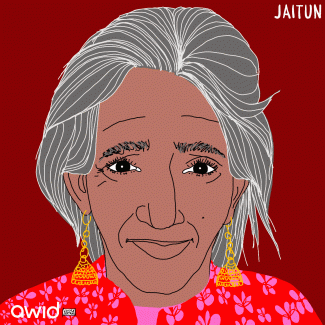
Jaitun, commonly referred to as ‘Amma’, was committed to ensuring the reproductive rights of women and girls in India. She was particularly dedicated to advocating for those living in poverty and who are most marginalized, including Dalit and Muslim women and girls.
Jaitun was the vital force behind the case Jaitun v Janpura Maternity Home & Ors. Her perseverance for justice led to a ground-breaking judgment issued by the High Court of Delhi, holding the Indian government accountable for failing to deliver a number of its legally-binding obligations such as reproductive health care and the right to food.
Her daughter Fatema who was living under the poverty line was denied reproductive services and had to deliver her child in public, under a tree. At the time, both Jaitun and Fatema were homeless as a result of their home being demolished by the government as part of redevelopment and gentrification in New Delhi.
“The judgment has since been used by countless lawyers and activists globally, including the Former United Nations Special Rapporteur on the Right to Health, not only as a source of inspiration but as a solid springboard to further justice.” - Jameen Kaur
Jaitun has inspired many other women living in poverty to claim their rights. She passed away in 2017.
“In Jaitun’s death, we have now lost an inimitable warrior for justice, but her spirit of defiance lives on.” - Jameen Kaur
“In my 18 years as a human rights advocate, I have not met a woman that has inspired and moved my spirit in the same way Amma did. Her roaring courage; her imitable humour - we used to compare her to the Bollywood actress Hema Melini - as she would be upset we had spent so much time away from her - she would say, with a twinkle in her eye, ‘You have forgotten Amma, Amma is not speaking to you’ and then with great dramatics turn her back, only to turn around laughing and stretching her arms out for a hug. Her kindness and ultimately her love and joy for love and the right for all of us to live with dignity. I miss her terribly.” - Jameen Kaur
Je suis ravie de te faire part d’un de mes rendez-vous les plus remarquables en tant que féministe en situation de handicap. C’était le 30 mai 2014. L’Organisation nationale des puissantes dames porteuses d’un handicap visuel (NOVEL) participait aux festivités de la Fashion Week 2014 des Philippines, au profit de notre campagne de plaidoyer pour les cannes blanches. Deux dames aveugles défilaient sur le podium pour promouvoir la canne blanche comme symbole de l’égalité des genres, de l’autonomisation, de l’inclusion totale et de la participation égale des femmes et des filles porteuses de handicap visuel au sein de la société.
J’étais extrêmement nerveuse au moment de leur passage devant la foule, en tant que porte-parole de notre projet auprès des productions Runway (j’avais douloureusement attendu cette approbation pendant une année entière), sachant qu’elles n’étaient pas des mannequins, elles avaient été nommées Madame Philippines Vision et la première dauphine 2013 de Madame Philippines sur Roues, Signe et Vision par Tahanang Walang Hagdanan, Inc. (« Maison sans marches »). Elles n’avaient pas pu participer à leur séance d’orientation et s’étaient entraînées la veille au soir sans pouvoir le faire avec des mannequins professionnelles. Avant que ne commence le spectacle, je les avais appelées pour booster leur confiance et prier ensemble que Dieu les guide. Lorsqu’elles ont quitté le podium, j’ai pris une grande respiration alors que les larmes coulaient sur mes joues. Je me sentais euphorique parce que nous y étions parvenues malgré toutes les difficultés! Notre message au monde disant que les femmes et les filles en situation de handicap visuel pouvaient marcher en toute dignité, liberté et indépendance sur la même base d’égalité que les autres, grâce à notre appareil d’aide – les cannes blanches – qui était passé! On a parlé de nous sur les réseaux sociaux ainsi que sur les chaînes de télévision.
Ma vie de féministe en situation de handicap a débutcé comme un moyen de réparer mon manque de confiance et de trouver une autre trajectoire de réussite pour ma vie après avoir survécu à une vicieuse attaque à l’acide en 2007, alors que j’attendais le véhicule qui devait me ramener chez moi depuis le bureau. Mes yeux ont été fortement touchés, au point où je suis devenue une femme malvoyante.
Ce progrès n’est pas sans coût, tout comme il n’est pas parfait. Les activistes féministes, les groupes et les activistes se retrouvent face aux difficultés typiques rencontrées dans les contextes conservateurs et affectés par des conflits. Mais l’impact du mouvement des jeunes féministes au Soudan mérite d’être encensé. Dépasser les obstacles internes des différences de culture, de religion et des conflits historiques est un défi en soi, que les jeunes féministes au Soudan semblent relever activement. La création d’écoles féministes au Darfour et dans le Kordofan révèle la trajectoire unique du travail des jeunes féministes au Soudan, dont nous pouvons tirer des enseignements.
Je n’avais jamais pensé que ma vie pourrait être aussi joyeuse et pleine de sens avant de rencontrer les femmes leaders du mouvement pour le genre et le handicap, qui n’ont cessé depuis d’exercer une influence positive sur moi. Leurs mots d’encouragement m’ont plu et sont devenus la musique la plus douce à mes oreilles. Mon cœur brisé bondit comme un oiseau qui prend son envol à chaque fois que je pense à elles et au féminisme qui m’a encouragée à contribuer pour que les choses changent pour nos sœurs en situation de handicap qui sont invisibles et pour celles qui continuent à être discriminées. Jusqu’à ce jour, je suis consumée par le désir d’être avec le mouvement. Je ne peux cacher mon excitation chaque fois que je soumets des propositions de projets à différentes parties prenantes pour l’autonomisation, le développement et la promotion de nos sœurs en situation de handicap. Ou à chaque fois que j’interviens dans des conversations locales, nationales et internationales pour faire entendre nos voix, même lorsque cela est à mes dépens.
De manière inattendue, j’ai été choisie pour représenter notre pays à l’assemblée générale de l’Union mondiale des aveugles (UMA) en 2012 en Thaïlande, bien que je venais d’arriver dans le mouvement en faveur du handicap. Cette même année, j’ai été la seule femme élue au comité de l’Union philippine des aveugles (UPA). J’ai eu envie de me rapprocher de nos sœurs ayant un handicap visuel et de les informer sur leurs droits et afin qu’elles connaissent les questions transversales. En 2013, nous avons officiellement lancé NOVEL pour soutenir l’autonomisation de nos sœurs en situation de handicap, constituer des coalitions de mouvements de plurihandicap et de mouvements de femmes et promouvoir le développement inclusif du genre du handicap.
Ma participation en tant que copersonne pour les ressources des femmes en situation de handicap dans notre soumission au rapport alternatif à la CEDAW en 2016 avec les groupes de femmes marginalisées, coordonné par Women’s Legal and Human Rights Bureau (WLB), m’a ouvert de nombreuses portes et également permis de travailler avec différentes organisations de femmes et de participer aux Journées internationales de l’inclusion de Berlin en 2017, aux côtés de trois leaders philippines en situation de handicap; journées au cours desquelles nous avons fait part de nos bonnes pratiques, et principalement de notre engagement auprès de mouvements des femmes d’autres pays.
Ma trajectoire en tant que féministe en situation de handicap a été une véritable montagne russe émotionnelle pour moi. J’en ai retiré beaucoup de joie et un sentiment de valeur lors du travail pour la promotion de nos sœurs en situation de handicap pour une participation totalement inclusive, égale et efficace dans la société, mais je me suis également sentie frustrée et en colère lorsque j’ai tout donné et que j’ai essuyé des remarques négatives. Malgré tout, c’est ce que je ressens parce que je suis amoureuse du mouvement.
Je vois mon avenir dans le travail en solidarité avec le mouvement afin de veiller à ce que nos sœurs, en situation de handicap ou non, puissent profiter de, et participer également et entièrement dans la société.
Plein d’amour,
Gina Rose P. Balanlay
Féministe en situation de handicap
Philippines
No hay nada como estar en un espacio compartido, intercambiar energías corporales, mirar a alguien a los ojos y establecer conexiones, ver el mundo y hacer algo juntxs. Eventos como el Foro se encuentran entre los más fuertes del movimiento feminista mundial...
- Jac s m Kee, Malasia
Mobilisant des coiffeurs·ses transgenres de la classe ouvrière et des reines de beauté, les leaders dynamiques du seul parti politique LGBT au monde mènent une quête historique pour élire une femme trans au Congrès philippin.
In contrast, over $1 billion went
to three anti-rights groups in 2021-2022,
with funding for anti-gender networks still rising.
Isabel Cabanillas de la Torre fue una activista joven y una artista feminista muy querida de Ciudad Juárez, México, conocida por sus hermosos diseños evocadores de indumentaria pintada a manoen los que los ojos eran una característica emblemática de su trabajo. Sus murales transformaron los edificios abandonados y vacíos del centro de Ciudad Juárez, al sumarles vida y crítica política a sus paredes.
A través de su arte y de su activismo político, Isabel buscó llamar la atención sobre la violencia de género que se extendía por su ciudad natal. Colaboró como voluntaria con la red Mesa de Mujeres en el proyecto «Observatorio Ciudadano de Género», que monitoreaba la actuación de jueces, fiscales y defensorxs públicxs en casos de femicidios y otras violaciones a los derechos basadas en el género. Integró también «Hijas De Su Maquilera Madre», una colectiva feminista cuyo nombre alude a las hijas de madres que son trabajadoras de la maquila. Algunas de estas madres fueron las primeras víctimas de femicidio en Ciudad Juárez.
El último proyecto de Isabel (todavía en curso) fue una instalación artística para protestar contra una compañía canadiense que quería extraer cobre de los Médanos de Samalayuca.
El 18 de enero de 2020 Isabel fue atacada a balazos mientras volvía a su casa del centro de Ciudad Juárez en bicicleta, víctima, aparentemente, de un asesinato selectivo. Su cuerpo fue encontrado junto a su bicicleta.
El asesinato de Isabel desató una nueva ola de indignación contra los femicidios de la región: cientos de personas marcharon hacia el puente de la frontera entre EEUU y México, y lo bloquearon durante horas mientras cantaban «Ni una más», que es la protesta continua de las colectivas feministas contra los asesinatos de las mujeres en todo México. Solamente en 2019, 3.142 mujeres y niñas fueron asesinadas en el país; muchas de ellas fueron atacadas específicamente por su género.
Amaba andar en bicicleta.
«La bicicleta era un símbolo de libertad para ella. Simbolizaba ser libre en las calles.» - Marisol, amiga de Isabel
The body is a powerful entity. As women, our bodies are controlled, oppressed and policed from the womb. The way we look, move, dress, walk, speak, gesture, laugh. I often wondered at what drives patriarchal fears around the power of female bodies. Where I come from sex work and sex workers were whispered of with simultaneous contempt, disgust, fascination, pity and condemnation.
Where I come from sex work and sex workers were whispered of with simultaneous contempt, disgust, fascination, pity and condemnation.
I first encountered sex work and sex workers at age 22. Simple conversations, sitting in circles, chatting over coffee and tea, we explored each other’s lives, experiences, thoughts and feelings.
For sex workers, sex work was the most worthwhile choice out of all other options to pay bills, to support family, to have more flexible working hours, to have sex. Just as I chose my job as the most worthwhile, to pay bills, to support family, to have more flexible working hours.
These individuals, women and men, taught me that I made my own decisions about my body… where I focus its life and energy, whether I use it for pleasure or pain, whether I trade it in or give it freely, and how I want to feel about my body. The awareness was as exciting as it was empowering.
Crear | Résister | Transform: a festival for feminist movements – 2021… you accompanied me through a series of life-changing moments (!!!)
We call these ‘events,’ though in truth, to me, your feminist learning spaces are, where I take a little of what’s inside me, a little of what your speakers say and some from the discussions to go deeper into our understanding.
Sharing… Partaking… Immersing…
in strength, in vulnerability, in pleasure.
Simply being the transformative feminist that I am, without pretentions, without misgivings…
Welcoming the transformative feminist that I have always been, without even knowing the term or acknowledging it in such a manner or in such terms…
Finding home for the fiercely transformative feminist living within me…
Despite the anger, rage and frustration of not being treated as equals and being treated with ‘less __ than,’
I did not always consider myself a feminist nor did I recognise myself within the feminist movement or discourse… Truly, I appreciate doors being held open, chairs being pulled out to be seated, acknowledgement as a woman, of my femininity.
At times I dismissed the patriarchy with annoyance, at times, I responded with frustration and anger but I did not address it… I did not notice its sinister, insidious toxicity… I was privileged enough to be able to work through it, to survive it, to overcome it, to excel in spite of it… I did not question enough, challenge enough, push my boundaries enough… I did not do enough…
connecting with sex workers, exploring sexuality, and the women for peace and security...
Until I became fully aware and understood the implications of both privilege and oppression that was intersectional.
Until I realised what it meant to fight for gender justice and not simply ‘equality for all.’
Practitioner and facilitator no longer, I am a transformative feminist practitioner and facilitator.
Being a feminist means that I will act
Plunging into uncertain, fragile, complex (and possibly quite violent) future…
I am deeply grateful for you and I promise to remain fierce in addressing and redressing problematic issues around gender, race, ethnicity, social class, sexual orientation and ability, and remain present and faithful to the struggle for inclusion, equity and justice.
Khin Khin
Du 2 au 5 décembre 2024, à Bangkok, en Thaïlande ! Nous nous rassemblerons au Centre national de convention de la Reine Sirikit (QSNCC) et aussi virtuellement en ligne.