Jean-Marc Ferré | Flickr (CC BY-NC-ND 2.0)
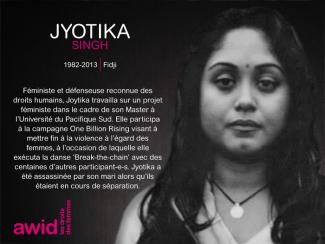
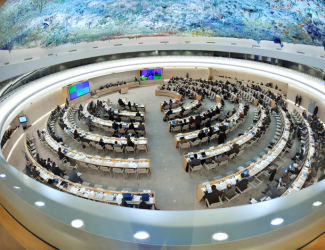
A general view of participants at the 16th session of the Human Rights Council in Geneva, Switzerland.

Human Rights Council (HRC)

The Human Rights Council (HRC) is the key intergovernmental body within the United Nations system responsible for the promotion and protection of all human rights around the globe. It holds three regular sessions a year: in March, June and September. The Office of the UN High Commissioner for Human Rights (OHCHR) is the secretariat for the HRC.

The HRC works by:

  • Debating and passing resolutions on global human rights issues and human rights situations in particular countries

  • Examining complaints from victims of human rights violations or activist organizations on behalf of victims of human rights violations

  • Appointing independent experts (known as “Special Procedures”) to review human rights violations in specific countries and examine and further global human rights issues

  • Engaging in discussions with experts and governments on human rights issues

  • Assessing the human rights records of all UN Member States every four and a half years through the Universal Periodic Review

Learn more about the HRC


AWID works with feminist, progressive and human rights partners to share key knowledge, convene civil society dialogues and events, and influence negotiations and outcomes of the session.

With our partners, our work will:

◾️ Monitor, track and analyze anti-rights actors, discourses and strategies and their impact on resolutions

◾️ Raise awareness of the findings of the 2017 and 2021 OURs Trends Reports.

◾️Support the work of feminist UN experts in the face of backlash and pressure

◾️Advocate for state accountability
 
◾️ Work with feminist movements and civil society organizations to advance rights related to gender and sexuality.
 

Related Content

Snippet FEA EoS The Ivy (ES)

An illustration of a vine with vine like leaves in neon with purple background

La Hiedra
Comunidad y vecindario

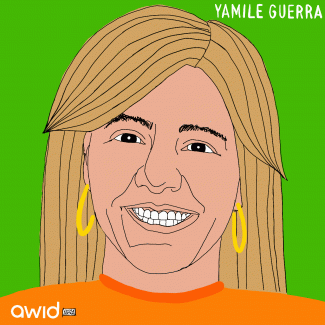
Yamile Guerra

Yamile Guerra was a well-known lawyer, community leader and political activist in the Santander region of Colombia.

She was actively working to resolve disputes between local communities and developers, advocating against illegal land appropriation. Yamile had occupied various political posts, including as the Secretary General for the Santander government in Bogota and also aspired for the Mayor’s Office of Bucaramanga. In the last few years of her life, Yamile became increasingly active in environmental causes, particularly in the defense of the biodiverse wetlands of Santurbán against development, a region which supplies nearly 2 million people with freshwater.

According to her family and friends, Yamile received daily threats against her life and had asked the authorities for protection. 

“She was very very aware of this issue [land litigation] and she said many times that she felt insecure.” - Alixon Navarro Munoz, journalist and friend of Guerra family

On July 20, 2019 Yamile was shot to death by two men in Floridablanca, Santander. She had just finished discussing a land dispute with them. A suspect was later arrested for her murder and admitted to being paid to carry out her assassination. According to reports, Yamile was the third member of her family to have been killed in relation to land disputes. Her father, Hernando Guerra was murdered several years previously.

Yamile’s assassination is part of a wave of violence and systematic killing of hundreds of social activists and human rights defenders in Colombia. According to the Institute for Development and Peace Studies (INDEPAZ), at the time of Yamile’s death, over 700 community leaders and human rights activists had been killed since the country signed a peace agreement in August 2016. Most were murdered for confronting illegal drug trafficking and mining operations, with indigenous people, Afro-Colombians and women human rights defenders being most at risk. 

Less than a week after Yamile’s death, thousands of Colombians marched all over towns and cities, holding up black and white photos of activists who had been killed, with signs that read: "Without leaders there can be no peace" and "No more bloodshed”.

Yamile Guerra was only 42 years old at the time of her assassination. 
Remembering: A Tribute to WHRDs no longer with us

AWID honors feminists and Women Human Rights Defenders (WHRDs) who have died and whose contributions to the advancement of human rights are very much missed.


Celebrating Activists and WHRDs

AWID’s WHRD Tribute is a photo exhibition featuring feminist, women’s rights and social justice activists from around the world who are no longer with us. 

The Tribute was first launched in 2012, at AWID’s 12th International Forum, in Turkey. It took shape with a physical exhibit of portraits and biographies of feminists and activists who passed away. The initiative was described by Forum participants as being a unique, moving and energizing way to commemorate our collective history.

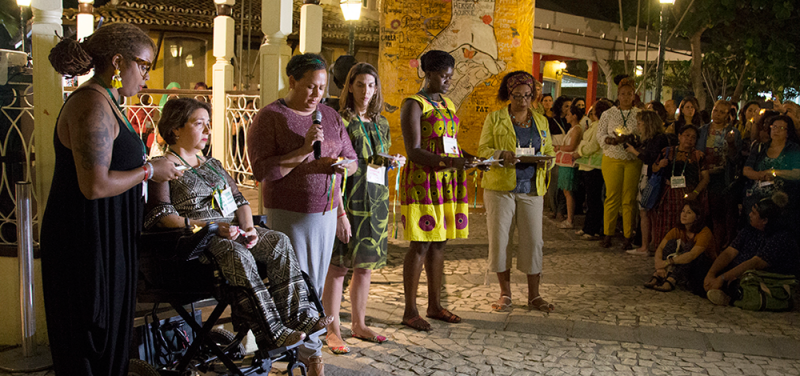
At the 13th International Forum in Brazil, we honored activists and WHRDs with a mural unveiling ceremony in four languages, a dance performance and a Brazilian ritual.

In between the events, the Tribute lives as an online gallery that is updated every year as part of the 16 Days Campaign Against Gender Based Violence (25 November – 10 December).

Contributions from all over the world

Since 2012, through our annual Tribute to Women Human Rights Defenders (WHRDs) no longer with us, over 400 feminists and WHRDs from 11 regions and 80 countries have been featured. 

AWID would like to thank the families and organizations who shared their personal stories and contributed to this memorial. We join them in continuing the remarkable work of these women and forging efforts to ensure justice is achieved in cases that remain in impunity.

Visit the WHRD Tribute online exhibit

The violence and threaths against WHRDs persist

In addition to paying homage to these incredible activists, the Tribute particularly sheds light on the plight of WHRDs who have been assassinated or disappeared.

One third of those featured in the Tribute were activists who have been murdered or disappeared in suspicious circumstances. They were specifically targeted for who they were and the work they did to challenge: 

  • State power
  • Heteronormativity
  • Fundamentalisms
  • Corporations
  • Patriarchy
  • Organized Crime
  • Corruption
  • Militarization…

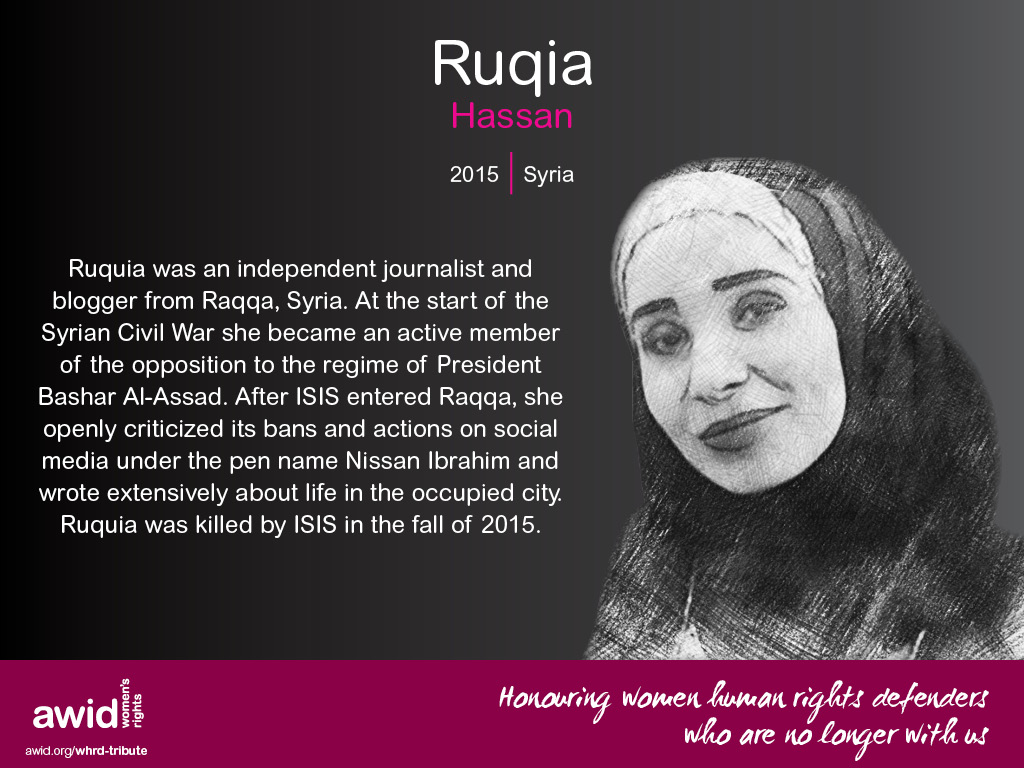
Women like Agnes Torres, from Mexico, was killed because of her gender identity and sexual orientation; or Cheryl Ananayo, an environmental activist from the Philippines was assassinated as she struggled against a mining company; or Ruqia Hassan, a Syrian independent journalist and blogger killed for her criticism of ISIS. And so many others.

With the WHRD Tribute, we bring them all into our collective memory and carry their legacy of struggle as our torch in the feminists’ and women’s rights movements. We recognize that security, safety and self-care must be a priority in all our political agendas. And we call on to governments and international bodies to collectively address violence against feminists and WHRDs.

We believe this is a critical step to ensure the sustainability of our movements for gender equality, women’s rights, and justice for all.

Visit the WHRD Tribute online exhibit

Pourquoi devrais-je envisager de participer à l’enquête?

Votre participation à l’enquête WITM est importante à plusieurs égards. Vous aurez, notamment, l’occasion de faire part de votre expérience vécue de la mobilisation de fonds pour soutenir votre organisation, de réclamer votre autorité en tant qu’experte sur la manière dont l’argent est transféré et qui il atteint réellement, et de contribuer à un plaidoyer collectif et cohérent auprès de financeurs afin que les fonds circulent davantage et soient de meilleure qualité. Au cours des deux dernières décennies, la recherche WITM de l’AWID s’est révélée être une ressource clé pour les activistes et les financeurs. Nous vous invitons chaleureusement à participer à sa troisième édition pour souligner la situation actuelle des ressources, remettre en question les fausses solutions, et identifier les modifications nécessaires dans le financement afin que les mouvements s’épanouissent et relèvent les défis complexes de notre époque.

AWID為何選擇台北作為此次國際論壇的舉辦地點呢?

我們認為在亞太區域,台北最能讓我們為全球女性主義社群打造一個安全又可「造反」的空間。

即將召開的論壇與會者多元,台北提供了相當穩定與安全的環境。同時也具備穩健的勤務服務能力,方便許多旅客來往(提供國際論壇與會者便利的電子簽證流程)

當地的女性主義運動社群也歡迎論壇到來並積極與全球女性主義者串連。

我們選擇台北的考量詳情見此 

Snippet FEA Ecofeminism (FR)

Afrique de l’Ouest

NOUS SOMMES LA SOLUTION


ÉCOFÉMINISME :

Le Respect de Tout ce que Nous Avons Autour de Nous

Binta Sarr

Binta Sarr fue una activista por la justicia social, económica, cultural y política, y una ingeniera hidráulica en Senegal. Después de 13 años en la administración pública, Binta dejó ese camino para trabajar con mujeres rurales y marginadas.

Fue de este compromiso que surgió la Association for the Advancement of Senegalese Women [Asociación para el Avance de las Mujeres Senegalesas] (APROFES, por sus siglas en inglés), un movimiento y organización de base que Binta fundó en 1987. Uno de sus principales enfoques fue la formación de dirigentes, en relación no solo con las actividades económicas, sino también con los derechos de las mujeres y el acceso a los puestos de toma de decisiones.

"Las poblaciones de base deben organizarse, movilizarse, asumir el control ciudadano y exigir la gobernabilidad democrática en todos los sectores del espacio público. La prioridad de los movimientos sociales debe ir más allá de la lucha contra la pobreza y debe centrarse en programas de desarrollo articulados y coherentes en consonancia con los principios de los derechos humanos, teniendo en cuenta al mismo tiempo sus necesidades y preocupaciones tanto a nivel nacional como subregional y desde una perspectiva de integración africana y mundial". - Binta Sarr

Partiendo de la convicción de Binta de que el cambio fundamental de la condición de la mujer requiere una transformación de las actitudes masculinas, APROFES adoptó un enfoque interdisciplinario,  al utilizar la radio, los seminarios y el teatro popular, además de proporcionar una educación pública innovadora y  brindar apoyo cultural a las acciones de sensibilización. Su compañía de teatro popular representó piezas originales sobre el sistema de castas en el Senegal, el alcoholismo y la violencia conyugal. Binta y su equipo también analizaron la conexión crucial entre la comunidad y el mundo en general.

"Para APROFES, se trata de estudiar y tener en cuenta las interacciones entre lo micro y lo macro, lo local y lo global y también, las diferentes facetas del desarrollo. Desde la esclavitud hasta la colonización, el neocolonialismo y la mercantilización del desarrollo humano, la mayor parte de los recursos de África y del Tercer Mundo (petróleo, oro, minerales y otros recursos naturales) están todavía bajo el control de carteles financieros y las otras multinacionales que dominan este mundo globalizado". - Binta Sarr

Binta fue una de las integrantes fundadoras de la sección femenina de la Asociación Cultural y Deportiva Magg Daan. Recibió distinciones del Gobernador Regional y del Ministro de Hidrología por su "devoción por la población rural".

Nacida en 1954 en Guiguineo, un pequeño pueblo rural, Binta falleció en septiembre de 2019.


Tributos:

"La pérdida es inconmensurable, el dolor es pesado y profundo, pero resistiremos para no llorar a Binta; no lloraremos a Binta, mantendremos la imagen de su amplia sonrisa en todas las circunstancias, para resistir e inspirarnos en ella, para mantener, consolidar y desarrollar su obra..." - Página de Facebook de Aprofes, 24 de septiembre de 2019.

"¡Adiós Binta! Creemos que tu inmenso legado será preservado." - Elimane FALL , presidente de ACS Magg-Daan

En su lucha por los derechos humanos enfrentan la injusticia en América Latina

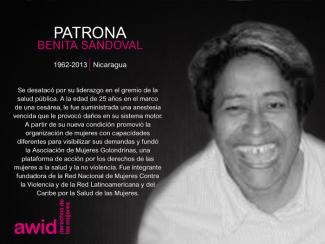
Este año honramos a 19 defensoras de la región de América Latina y el Caribe. De ellas, 16 fueron asesinadas, incluyendo a 6 periodistas y 4 defensoras LGBTQI. Únete a nosotras en la conmemoración de  sus vidas y trabajo,  compartiendo los memes aquí incluidos con tus colegas, amistades y redes; y tuiteando las etiquetas #WHRDTribute y #16Días.


Por favor, haz click en cada imagen de abajo para ver una versión más grande y para descargar como un archivo.

[scald=2398:sdl_editor_representation]
[scald=2396:sdl_editor_representation]
[scald=2393:sdl_editor_representation]
[scald=2390:sdl_editor_representation]
[scald=2389:sdl_editor_representation]
[scald=2388:sdl_editor_representation]


Our group, organization and/or movement has not taken or mobilized funding from external funders, should we take the survey?

Yes! We recognize and appreciate different reasons why feminists, in their respective contexts, don’t have external funding: from being ineligible to apply for grants and/or receive money from abroad, to relying on resources generated autonomously as a political strategy in its own right. We want to hear from you regardless of your experience with external funding.

Snippet FEA Mariama Sonko (FR)

Nous avons le plaisir de vous présenter Mariama Sonko, agricultrice rurale, éco-féministe et défenseuse des droits humains, vivant actuellement à Niaguis, une ville du sud-ouest du Sénégal.

Ayant grandi dans une famille et une communauté rurale d’agriculteur·rices, elle a été témoin du rôle essentiel des femmes dans la production alimentaire et la conservation des semences depuis son plus jeune âge, tout en étant immergée dans le travail de la terre.

Mariama défend les savoirs agricoles locaux et les pratiques paysannes depuis les années 90. En tant que mère de 5 enfants, la nourriture qu'elle cultive elle-même est la principale source de subsistance de sa famille.

Elle est actuellement présidente de Nous Sommes la Solution et s'engage à promouvoir les pratiques agroécologiques et l'agriculture familiale, à encourager la souveraineté alimentaire, la biodiversité et la préservation des semences paysannes, et à exiger un accès équitable aux ressources et à la terre à travers l'Afrique de l'Ouest.

Source: AWID’s Feminist Realities Festival Crear | Résister | Transform - Day 2/ 2ème jour/ 2º día

Laurie Carlos

Laurie Carlos était une comédienne, réalisatrice, danseuse, dramaturge et poétesse aux États-Unis. Artiste hors pair et visionnaire, c’est avec de puissants modes de communication qu’elle a su transmettre son art. 

« Laurie entrait dans la pièce (n’importe quelle pièce/toutes les pièces) avec une perspicacité déroutante, un génie artistique, une rigueur incarnée, une féroce réalité – et une détermination à être libre... et à libérer les autres. Une faiseuse de magie. Une devineresse. Une métamorphe. Laurie m’a dit un jour qu’elle entrait dans le corps des gens pour trouver ce dont ils et elles avaient besoin. » - Sharon Bridgforth

Elle a employé plusieurs styles de performance alliant les gestes rythmiques au texte. Laurie encadrait les nouveaux·elles comédien·ne·s, performeur·euse·s et dramaturges, et a contribué à développer leur travail dans le cadre de la bourse Naked Stages pour les artistes émergent·e·s. Associée artistique au Penumbra Theatre, elle a participé à la sélection de scripts à produire, dans l’objectif « d’intégrer des voix plus féminines dans le théâtre ». Laurie faisait également partie des Urban Bush Women, une compagnie de danse contemporaine reconnue qui contait les histoires de femmes de la diaspora africaine.

Elle fit ses débuts à Broadway dans le rôle de Lady in Blue, en 1976, dans la production originale et primée du drame poétique For colored girls who have considered suicide / when the rainbow is enuf de Ntozake Shange. L’oeuvre de Laurie inclut White Chocolate, The Cooking Show et Organdy Falsetto

« Je raconte les histoires à travers le mouvement – les danses intérieures qui se produisent spontanément, comme dans la vie – la musique et le texte. Si j’écris une ligne, ce n’est pas forcément une ligne qui sera dite ; ce peut être une ligne qui sera bougée. Une ligne à partir de laquelle de la musique est créée. Le geste devient phrase. Tant de ce que nous sommes en tant que femmes, en tant qu’êtres, tient aux gestes que nous exprimons les un·e·s par rapport aux autres, tout le temps, et particulièrement dans les moments d’émotion. Le geste devient une phrase, ou un état de fait. Si j’écris “quatre gestes” dans un script, cela ne signifie pas que je ne dis rien;cela veut dire que j’ai ouvert la voie à ce que quelque chose soit dit physiquement. » Laurie Carlos

Laurie est née et a grandi à New York, a travaillé et vécu à Minneapolis-Saint-Paul. Elle est décédée le 29 décembre 2016, à l’âge de 67 ans, après un combat contre le cancer du côlon. 


Hommages :

« Je pense que c’était exactement l’intention de Laurie. De nous sauver. De la médiocrité. De l’ego. De la paresse. De la création artistique inaboutie. De la paralysie par la peur.
Laurie voulait nous aider à briller pleinement.
Dans notre expression artistique.
Dans nos vies. » - Sharon Bridgforth pour le Pillsbury House Theatre

« Quiconque connaissait Laurie aurait dit que c’était une personne singulière. Elle était sa propre personne. Elle était sa propre personne, sa propre artiste ; elle mettait en scène le monde tel qu’elle le connaissait avec un vrai style et une compréhension fine, et elle habitait son art. » – Lou Bellamy, Fondatrice de la Penumbra Theatre Company, pour le Star Tribune 

Lire un hommage complet par Sharon Bridgforth (seulement en anglais)

WHRDs from the South and Southeast Asian region

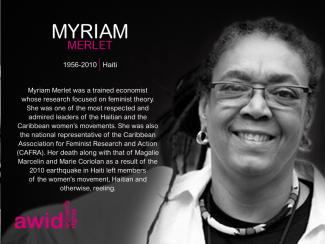
7 Women Human Rights Defenders from across the South and Southeast Asian region are honored in this year’s Online Tribute. These defenders have made key contributions to advancing human and women’s rights, indigenous people’s rights, and the right to education. These WHRDs were lawyers, women’s rights activists, scholars, and politicians. Please join AWID in commemorating t their work and legacy by sharing the memes below with your colleagues, networks and friends and by using the hashtags #WHRDTribute and #16Days. 


Please click on each image below to see a larger version and download as a file


¿Cuáles son los idiomas oficiales de ¿Dónde está el dinero?

Por el momento, la encuesta en KOBO está disponible en árabe, español, francés, inglés, portugués y ruso. Tendrás oportunidad de seleccionar el idioma de preferencia al inicio de la encuesta.

Snippet FEA Bio fertilizer and Sum-Pack (EN)

ILLUSTRATION OF NSS Products: Bio fertilizer and Sum-Pack - Natural stock cubes

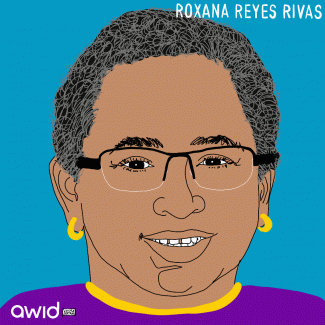
Roxana Reyes Rivas

Roxana Reyes Rivas, philosopher, feminist, lesbian, poet, politician and LGBT and women’s rights activist from Costa Rica. Owner of a sharp pen and incisive humour, a laugh a minute. She was born in 1960 and raised in San Ramón of Alajuela, when it was a rural town, and her whole life she would break away from the mandates of what it meant to be a woman.   

With El Reguero (Costa Rican lesbian group) she organized lesbian festivals for over a decade, fun-filled formative spaces to come together at a time when the Costa Rican government and society persecuted and criminalized the lesbian existence. For hundreds of women the lesbian festivals where the only place they could be themselves and come together with others like them.  

Roxana would often say founding political parties was one of her hobbies. “It’s important for people to understand there are other ways to do politics, that many issues need to be solved collectively”. She was one of the founders of the New Feminist League and VAMOS, a human rights focused political party.

“The philosophical trade is meant to jab, to help people ask themselves questions. A philosopher who doesn’t irritate anyone is not doing her job”. For 30 years Roxana taught philosophy at several Costa Rican public universities. Through her guidance, generations of students reflected about the ethical dilemmas in science and technology.  

Roxana’s favourite tool was humour, she created the Glowing Pumpkin award, an acknowledgement to ignorance that she would bestow upon public figures, through her social media channels, mocking their anti-rights expressions and statements.  

An aggressive cancer took Roxana at the end of 2019, before she could publish a compilation of her poems, a departing gift from the creative mind of a feminist who always raised her voice against injustice.