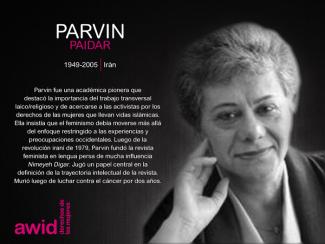
Parvin Paidar
Over the past few years, a troubling new trend at the international human rights level is being observed, where discourses on ‘protecting the family’ are being employed to defend violations committed against family members, to bolster and justify impunity, and to restrict equal rights within and to family life.
The campaign to "Protect the Family" is driven by ultra-conservative efforts to impose "traditional" and patriarchal interpretations of the family, and to move rights out of the hands of family members and into the institution of ‘the family’.
Since 2014, a group of states have been operating as a bloc in human rights spaces under the name “Group of Friends of the Family”, and resolutions on “Protection of the Family” have been successfully passed every year since 2014.
This agenda has spread beyond the Human Rights Council. We have seen regressive language on “the family” being introduced at the Commission on the Status of Women, and attempts made to introduce it in negotiations on the Sustainable Development Goals.
AWID works with partners and allies to jointly resist “Protection of the Family” and other regressive agendas, and to uphold the universality of human rights.
In response to the increased influence of regressive actors in human rights spaces, AWID joined allies to form the Observatory on the Universality of Rights (OURs). OURs is a collaborative project that monitors, analyzes, and shares information on anti-rights initiatives like “Protection of the Family”.
Rights at Risk, the first OURs report, charts a map of the actors making up the global anti-rights lobby, identifies their key discourses and strategies, and the effect they are having on our human rights.
The report outlines “Protection of the Family” as an agenda that has fostered collaboration across a broad range of regressive actors at the UN. It describes it as: “a strategic framework that houses “multiple patriarchal and anti-rights positions, where the framework, in turn, aims to justify and institutionalize these positions.”
Leila is a transnational feminist leader, strategist, and advisor with over 25 years of organizing, advocacy and philanthropic experience advancing human rights, gender equality, and sexual and reproductive rights and justice. She was born in Algeria and educated in the U.S., France, and Morocco; over her professional career, she has lived and worked in forty countries across Africa, Europe, Latin America and Asia. Leila currently serves as a Senior International Fellow at the Asfari Institute for Civil Society and Citizenship at the American University of Beirut in Lebanon and as Senior Strategist for various feminist movements and organizations as well as the the Urgent Action Fund-Africa and Trust Africa on an initiative on Reimagining Feminist and Pan-African Philanthropies.
From 2017-2023, Leila held the position as Vice-President of Programs at Global Fund for Women where she oversaw its strategic grantmaking, movement-strengthening, global advocacy and philanthropic collaborations. At GFW, she doubled its grantmaking to over $17 million, launched its feminist and gender-based movements and crises work, created an adolescent girls program led by a girls’ advisory council and led its philanthropic advocacy work. Prior to that she served on the senior leadership team of Ipas from 2002 to 2016 where she published extensively on abortion rights and justice, lead global advocacy efforts and partnered with feminist groups working on self-management, community strategies and stigma reduction around bodily integrity and sexual and reproductive rights.
Leila is currently researching shifts in the philanthropic sector including recognizing non-institutional practices of giving resources in the Global South and efforts to decolonize practices in the Global North. She has written extensively on the political nature of veiling across North Africa and the Middle East, abortion practices in majority Muslim contexts and feminist approaches to sexual and reproductive health, rights and justice.
Leila holds an MPH in public health and a MA in Middle Eastern and North African Studies, studied Islamic law in Morocco and pursued doctoral studies in sociology in France. She studied Arabic and speaks French and English fluently. She is a mother of two feminist young women, an avid scuba diver, mountain bike rider, skier, and outdoor enthusiast.
Dado que la encuesta ¿Dónde está el dinero? se centra en las realidades de la dotación de recursos para las organizaciones feministas, la mayoría de las preguntas indagan acerca del financiamiento de tu agrupación entre 2021 y 2023. Para responder la encuesta, necesitarás tener a mano cierta información como, por ejemplo, presupuestos anuales y las fuentes clave de financiamiento.
Listen to the story here:
Culturellement nomade, née à Hong Kong et enracinée dans un héritage turco-pakistanais, l'amour de Fatima pour les récits - tant pour les lire que pour les cocréer - a alimenté sa passion pour l'activisme à travers la communication. Forte de sa formation en journalisme, Fatima a travaillé pendant 7 ans dans les domaines de la communication numérique et médiatique avec des ONG qui offrent des opportunités d'éducation et de l’aide juridique aux réfugié·e·s et demandeur·se·s d'asile, ainsi qu'avec le mouvement féministe musulman qui applique une perspective féministe et fondée sur les droits dans la compréhension et la quête d’égalité et de justice au sein de la tradition juridique musulmane. Elle rédige régulièrement des tribunes sur les questions féministes dans les pays du Sud.
Grâce à la narration dans cette ère ultra digitale des réseaux sociaux, Fatima continue de collaborer avec des animateur·rice·s communautaires et des activistes de terrain pour créer du contenu audiovisuel dans le but de cultiver des ponts de compréhension vers la libération collective et la décolonisation. Les jours où elle ne travaille pas, elle regarde attentivement des films féministes indépendants venant d’Iran, du Maroc et du Pakistan, et les autres jours elle interprète de la poésie orale avec ses camarades à Kuala Lumpur.
Tout à fait. Vos réponses seront supprimées à la fin du processus de traitement et d’analyse des données. Elles ne seront utilisées qu’à des fins de recherche. Les données ne seront JAMAIS partagées en dehors de l’AWID et ne seront traitées que par le personnel de l’AWID et des consultant·es qui collaborent avec nous à la recherche WITM.
La confidentialité de votre vie privée et votre anonymat sont nos priorités. Notre politique de confidentialité est disponible ici.

The survey is open until the end of August 2024. Please complete it within this timeframe to ensure your responses are included in the analysis.
We all can dance
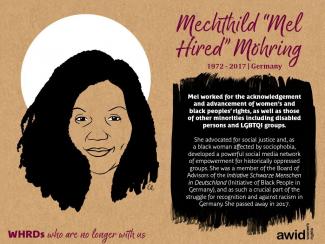
by Mechthild Möhring (aka serialmel)
How I punt myself at the narrow hard knitting I once retrieved. I'm dancing in the kitchen when I'm alone. Gracile and powerful. When I'm in company I'm clumsy. My body scandalizes, scandalizes the laws of look I feel, scandalizes the words which banished me. "Of course she can dance, it's in her blood as a Black person." "If she is able to dance nicely she is good in bed" they whisper, they murmur, no - they say it openly into my face. They smirk and rub themselves against me and let me move back. I stumble and fall. My feet reject their duty. Bearish I get out of breath. Smiling I place myself out of events and notice how my face freezes into a mask.
Translated into English by Tsepo Bollwinkel
Original in German
Tanzen können wir alle
Von Mechthild Möhring (aka serialmel)
Wie ich mich stosse an den engen, harten Maschen, in die ich mich einst zurückgezogen habe. Ich tanze in der Küche, wenn ich allein bin. Grazil und kraftvoll. Wenn ich in Gesellschaft bin, bin ich unbeholfen. Mein Körper eckt an, an die Gesetze des Blicks, den ich spüre, an die Worte, die mich bannten. „Natürlich kann sie tanzen, als Schwarze hat sie das im Blut.“ „Wenn sie gut tanzen kann, dann ist sie auch gut im Bett“ flüstern sie, raunen sie, nein, sie sagen es mir laut ins Gesicht. Sie grinsen und reiben sich an mir und lassen mich zurückweichen. Ich stolpere und falle. Meine Füsse verweigern ihren Dienst. Tollpatschig gerate ich ausser Atem. Lächelnd setze ich mich an den Rand des Geschehens und bemerke, wie mein Gesicht zur Maske erstarrt.
A dynamic network of people around the world, AWID members are researchers, academics, students, educators, activists, business people, policy-makers, development practitioners, funders, and more. Our members - of every age - are those who make AWID a unique global feminist association.
We offer different types of memberships geared to income level and whether you are an individual or an organization. Currently we have over 5000 members, individual and institutional, from 164 countries.
We collaborate for advocacy on specific issues, members vote in elections for our Board, and can also participate in and contribute to our Priority Areas through webinars, surveys, or urgent actions, for example.
Our institutional membership draws from a broad range of organizations interested in advancing gender justice and women’s human rights, including women’s rights organizations, from the local to the global levels, grassroots networks, major international institutions, government departments, university programs and more. 63% of our members are from the global South and 38% are under the age of 30.
نكمل مشوار بناء الحشد الذي بدأناه قبل 20 عاماً لموارد أفضل وأكبر لحركات التغيير الاجتماعي بقيادة نسوية، تدعوكم/ن جمعية حقوق المرأة في التنمية لاستكمال استطلاعنا
A latin-american gender identity
The term travesti is often mistakenly translated as "transvestite" in English. However, it is a Latin American gender identity with no equivalent in other languages, and exclusively female. It is a person designated male at birth who identifies as female. They may or may not undergo bodily changes, and should always be addressed with she/her pronouns.
Travesti is not only a gender identity located outside of gender binarism, it is also a cultural identity rooted in Latin American movements. The term was initially pejorative, but it was later re-appropriated as a symbol of resistance and dignity.
Every travesti is trans because she does not identify with the gender designated at birth, however not every travesti considers themselves as a trans woman, since travesti is already a gender identity on its own.
Source: Berkins, Lohana. (2006). Travestis: una Identidad Política [Travestis: a Political Identity]. Trabajo presentado en el Panel Sexualidades contemporáneas en las VIII Jornadas Nacionales de Historia de las Mujeres/ III Congreso Iberoamericano de Estudios de Género Diferencia Desigualdad. Construirnos en la diversidad, Villa Giardino, Córdoba, 25 al 28 de octubre de 2006.
Contenido relacionado
Huffington Post: Muere Kate Millett, activista y referente feminista
TeleSUR: Muere la autora feminista Kate Millett a los 82 años