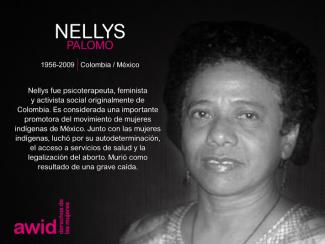
Nellys Palomo
AWID’s Tribute is an art exhibition honouring feminists, women’s rights and social justice activists from around the world who are no longer with us.
This year’s tribute tells stories and shares narratives about those who co-created feminist realities, have offered visions of alternatives to systems and actors that oppress us, and have proposed new ways of organising, mobilising, fighting, working, living, and learning.
49 new portraits of feminists and Women Human Rights Defenders (WHRDs) are added to the gallery. While many of those we honour have passed away due to old age or illness, too many have been killed as a result of their work and who they are.
This increasing violence (by states, corporations, organized crime, unknown gunmen...) is not only aimed at individual activists but at our joint work and feminist realities.
The portraits of the 2020 edition are designed by award winning illustrator and animator, Louisa Bertman.
AWID would like to thank the families and organizations who shared their personal stories and contributed to this memorial. We join them in continuing the remarkable work of these activists and WHRDs and forging efforts to ensure justice is achieved in cases that remain in impunity.
“They tried to bury us. They didn’t know we were seeds.” - Mexican Proverb
It took shape with a physical exhibit of portraits and biographies of feminists and activists who passed away at AWID’s 12th International Forum, in Turkey. It now lives as an online gallery, updated every year.
To date, 467 feminists and WHRDs are featured.
When you do a search for “Female Genital Mutilation” or “FGM” online, an image of four line-drawings of the female anatomy pop up next to its Wikipedia entry. It illustrates four types of violence. The first being a partial cut to the clitoris. The second, a more invasive cut with the entire clitoris removed. The third is progressively worse with the removal of the clitoris, labia majora and minora. And the fourth box illustrates a series of hash marks to symbolize stitches over the vaginal opening to allow only for urination and menstruation.
As a survivor of FGM, most questions about my story fixate on the physical. The first question I usually get asked is what type of FGM I underwent. When I told a journalist once that I went through Type 1, she said “oh, that’s not so bad. It’s not like type three which is far worse.” She was technically right. I had the least invasive form. And for many years, I gaslighted myself into feeling a sense of relief that I was one of the lucky ones. I comforted myself noting that I could have been less fortunate with all of my genitalia gouged out, not just the clitoral tip. Or worse I could have been one of the ones who didn’t survive at all. Like Nada Hassan Abdel-Maqsoud, a twelve year old, who bled to death on a doctor’s operating table earlier this year in Upper Egypt. Nada is a reminder to me that for every data point -- 200 million women and girls who live with the consequences of FGM globally -- there is a story. Nada will never be able to tell hers.
As much as I find the label “survivor” suffocating at times -- I also realize there is privilege embedded in the word. By surviving, you are alive. You have the ability to tell your story, process the trauma, activate others in your community and gain insights and a new language and lens to see yourself through.
The act of storytelling can be cathartic and liberating, but it can also shatter the storyteller in the process.
Without integrating the psychosocial support of trained clinicians into storytelling and healing retreats, well-intentioned interventions can result in more trauma. This is all the more important as FGM survivors navigate the double pandemic of their own PTSD from childhood trauma, and the indefinite COVID-19 global shutdown.
In many anti-FGM advocacy spaces, I have seen this insatiable hunger to unearth stories -- whatever the cost to the storyteller. The stories help activate funding and serve as a data point
for measuring impact.
Survivor stories then become commodities fueling a storytelling industrial complex. Storytellers, if not provided proper mental health support in the process, can become collateral damage.
My motivation in writing this piece is to flip the script on how we view FGM survivors, prioritizing the storyteller over the story itself.
FGM survivors are more than the four boxes describing how the pieces of our anatomy were cut, pricked, carved, or gouged out. In this essay, I’ll break down the anatomy of an FGM survivor’s story into four parts: stories that break, stories that remake, stories that heal, and stories that reveal.
I was sitting in the heart of Appalachia with a group of FGM survivors, meeting many for the first time. As they shared their traumas, I realized we all belonged in some way or another to the same unenviable club. A white Christian survivor from Kentucky - who I don’t think I would have ever met if we didn’t have FGM survivorship connecting us - told the contours of her story.
There were so many parallels. We were both cut at seven. She was bribed with cake after her cut. I was bribed with a jumbo-sized Toblerone chocolate bar when mine was over. Absorbing her trauma overwhelmed me. And I imagine when I shared my story, others in the circle may also have been silently unraveling. We didn’t have a clinician or mental health professional in a facilitation role and that absence was felt. The first night, I was sharing a room with six other survivors and tried hard to keep the sounds of my own tears muffled. By the last day, I reached breaking point. Before leaving for the airport, my stomach contracted and I convulsively vomited. I felt like I was purging not only my pain, but the pain of the others I’d absorbed that week. We all dutifully produced our stories into 90 second social media friendly soundbites with narration and photos. But at what cost?
On February 6, 2016, the Guardian published my story as a survivor. The second it was released, I was remade. My identity transformed from nondescript, relatively invisible mid-level Foreign Service Officer to FGM survivor under a public microscope. That same day, then-U.S. Ambassador to the United Nations Samantha Power tweeted my story with the introduction: “I was seven years old” before linking to the article. The tweet symbolized a moment for me where my personal and professional worlds collided. Since then, they have been forever intertwined.
Even though I spent ten years of my career as a diplomat focused on other issues -- I lived in Cairo during the early days of the Arab Spring in 2011 and served in Baghdad and Erbil when the Syrian revolution turned from an uprising to civil war -- all of those past experiences that began to make mefeel erased. When I spoke on panels, my identity would be reduced to “survivor.” Like other survivors, I have worked hard to rewrite the script on how others see me.
I reinsert pieces of my other identities when speaking to underscore to the broader public that while yes, I am a survivor of childhood trauma and while my FGM story may have remade a part of my identity, it doesn’t define me.
With the guidance of a mental health expert, I have spent the last few months doing a deep dive into my FGM survivor story. I have told and retold my story over dozens of times in public venues. My goal is to break the culture of silence and inspire action. At this point, the telling of my story has almost become mechanized, as though I am reciting a verse from the Quran I memorized as a kid. I would always start with: “I was sitting an anthropology class when a fellow student described her research project on Female Genital Mutilation. And that’s when I had the memory jolt. A memory I had suppressed since childhood came flooding to the foreground.” I go into the details of what happened in granular detail -- the color of the floor, the feelings of confusion and betrayal in the hazy aftermath. And then I go on to talk about the afternoon I confronted my mother about the summer she and my father shipped my brother and off to India to stay with my aunt. The summer it happened. I later found out my aunt cut me without my parents’ consent. In my years of telling and retelling this story, I would have moments I felt nothing, moments I would break down, and moments of relief. It was a mixed bag, often contradictory emotions happening all at once.
When I began to take apart the story, I discovered the core moment where I felt most gutted. It wasn’t the cut itself. It was the aftermath. I remember sitting in a corner alone, feeling confused and ashamed. When I looked at my aunt on the other side of the room, she was whispering to my cousin and they both pointed and laughed at me. Unearthing the moment of shame - the laughter - has haunted me since childhood. The piece that was carved out of me is called “haram ki boti” which translates into sinful flesh. Over time, the physical scar healed. But for many FGM survivors, the psychological wounds remain
Last year, I decided to take a sabbatical from the Foreign Service. I was burning out on both ends -- I had just completed a really tough assignment in Pakistan and was also doing anti-FGM
advocacy in my personal capacity. When I came home, an acquaintance from graduate school approached me to capture my story on film. As part of the process, she would send a camera
crew to shadow me. Sometimes while giving speeches, other times filming mundane interactions with friends and family. On a visit to my home in Texas, I’ll never forget the moment where my mom told me her story of survival. As part of the film, we went on a roadtrip to Austin to visit the university where I first had the memory jolt. My mom is patiently waiting for the cameraman to set up his tripod. My father is standing next to her.
In the end, we eventually had the conversation I never had the courage to have with either of my parents face to face. Looking them both in the eye, retelling my story with a camera as witness, we discussed how FGM ripped our family apart (specifically my dad’s relationship with his sister). For the first time, I heard my mom talking about her own experience and the feeling of betrayal when she discovered my aunt cut me without her consent. When I later told her that FGM was actually indigenous to the U.S. and Europe and that it was a cure for hysteria (prescribed by doctors) up until the 19th century, my mother exclaimed “that’s crazy to me, this was a cure for hysteria. I’m going to educate other doctors to speak out.” And in that moment, my mother, a survivor who had never shared her story before, became an activist.
My story, intertwined with her story, revealed a tightly woven fabric of resistance. With our voices, we were able to break the cycle of intergenerational structural violence. We were able to rewrite the stories of future generations of girls in our own family and hopefully one day, the world.
This is a woman breaking free from her mundane reality, devoid of color. She dreams in a colorful, "nonsensical" way that people in her life would not understand. She could be considered insane, yet her dreams are more vivid and imaginative than actual life. This is frequently how schizophrenia occurs to me, more engaging and exciting than real life.

< United against the violence, by Karina Ocampo
Freeing the Church, Decolonizing the Bible for West Papuan Women, by Rode Wanimbo >
La mayoría de los Estados miembros de la Unión Europea tienen leyes y prácticas que penalizan o controlan a las trabajadoras sexuales de formas inaceptables para ellas. La criminalización de las trabajadoras sexuales y/o sus clientes solo contribuye a aumentar la vulnerabilidad de las trabajadoras sexuales, que ya enfrentan el estigma, la discriminación y la exclusión por parte del Estado y de la sociedad a diario, especialmente las mujeres trabajadoras, lxs trabajadorxs trans, migrantes y/o racializadxs. En España por ejemplo, el gobierno esta actualmente intentando pasar una Ley Orgánica para la Abolición de la Prostitución, que resultara en mas clandestinidad y violencia. Ven a conocer las historias de trabajadoras sexuales y organizadores sindicales que luchan para decriminilizar el trabajo sexual y promover derechos laborales y condiciones de trabajo digno para lxs trabajadxs sexuales.
Нет, мы высоко ценим вашу работу, но в данный момент мы не просим откликов от женских и феминистских фондов. Мы будем рады, если вы поделитесь информацией об опросе со своими партнерками(-рами) и контактами внутри феминистской сети.
Sostenemos la completa aplicación del principio de derechos, incluidos aquellos consagrados en leyes internacionales, y afirmamos la convicción de que todos los derechos humanos están interrelacionados y son interdependientes e indivisibles. Estamos comprometidxs a trabajar por la erradicación de todas las discriminaciones basadas en el género, la sexualidad, la religión, la edad, la capacidad, la etnia, la raza, la nacionalidad, la clase, u otros factores.
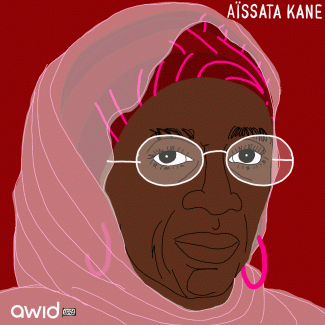
Aïssata Kane, also fondly known as “Yaye Kadia” (Mother Kadia), was a feminist with a lifelong committment in advocating for African and especially Mauritanian women’s rights.
In her career as a politician, she was appointed Minister of Family Protection and Social Affairs in 1975, the first time a woman held such a position and in which Aïssata fervently worked to improve the status of women in her country.
This work included advancing girls’ and women’s education, fighting against the practice of force-feeding of young women, lobbying for an inclusion of a marital rights provision, and advocating for a female representation quota to be created in the Parliament.
“[Aïssata] realized all her passions with humility, courage and determination. She didn’t want to disturb anyone by her fight on all these fronts at the same time.” Ball Halimata Dem, Aïssata’s niece
She founded the National Union of Women of Mauritania (UNFM), co-creating and publishing Marienou for them, a magazine dedicated to the emancipation of Mauritanian women. Aïssata also directed several sub-regional and local organizations, including as the President of the International Association of Francophone Women (AIFF) and as a resolute ecologist, she was President of the Association for the Protection of the Environment in Mauritania (APEM).
In 2018 she received the Pioneer Woman Award. It honors her work in advancing Mauritania’s women’s status and recognizes her strong leadership and sense of innovation.
Aïssata passed away on 10 August 2019.
Welcome to Crear | Résister | Transform: a festival for feminist movements!
AWID is committed to creating an online space that invites and challenges us all to operate from a place of courage, curiosity, generosity and shared responsibility.
We invite you to co-create spaces with us that are free of harassment and violence, where everyone is respected in their gender identity and expression, race, ability, class, religion, language, ethnicity, age, occupation, type of education, sexuality, body size, and physical appearance. Spaces where we recognize inequalities in our world and strive to transform them in our own interactions with each other.
This means that we are able to listen, understand and relate to each other. To feel close, in spite of it all being virtual. For this, we will make interpretation available and open channels (like chat and other tools) for you to react and share. To hear each other better, we invite you to wear headphones during the conversation. If it is possible for you , we suggest that you close your email and any other likely source of distraction while you are in the conversation.
Let us celebrate the multiple ways in which knowledge shows up in our lives. We invite you to approach the conversation with curiosity and openness to learn from others, allowing ourselves to unlearn and relearn through the exchange, as a way to start collectively building knowledge.
We are committed to holistically approaching accessibility by being mindful of different physical, language, mental and safety needs. We want a space that is welcoming of folks from various backgrounds, beliefs, abilities and experiences. We will be proactive but we also ask that you communicate your needs with us, and we will do our best within our capacity to address these needs.
We all commit individually and collectively to respect each other’s privacy and to seek people’s consent before sharing any images or content generated during the conversation that involves them.
Creating a safer, respectful and enjoyable environment for the conversations, is everybody's responsibility.
If you notice that someone is behaving in a discriminatory or offensive manner, please contact the reference person who will be indicated at the beginning of the session.
Any participants that express oppressive language or images, will be removed from the call and will not be readmitted. We will not engage with them in any way.

Sim, o inquérito pode ser acedido através de um smartphone.
En participant à une activité exclusive pour les membres, j'ai été particulièrement touchée de voir que chacun·e y avait sa place et qu’il n’y avait pas le moindre jugement. Toute la session a été dynamique et vivante.- Kirthi Jayakumar, Fondatrice, The Gender Security Project, Inde
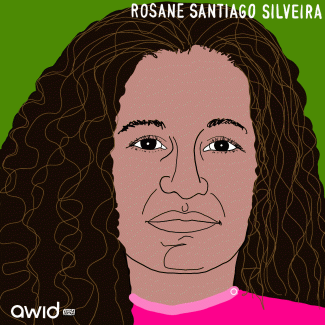
Rosane Santiago Silveira era conocida afectuosamente como «Rô Conceição». Fue una activista ambiental y por los derechos humanos que luchó fervientemente para proteger el medio ambiente en las zonas más amenazadas.
Esta lucha incluyó la defensa así como también la protección ambiental en la isla de Barra Velha, cuando estuvo amenazada por la exploración petrolera, mediante campañas contra la apropiación de tierras y la expansión de las plantaciones de eucaliptus en el Estado de Bahía, donde Rosane integraba el Consejo de la Reserva Extractivista de Cassurubá.
«La Reserva Extractiva es un área protegida donde las familias residentes se ganan la vida con productos naturales extraídos del bosque. Estas actividades ayudan a mantener la integridad del bosque.» - Global Justice Ecology Project (fuente original: Rede Brasil Atual)
Rosane participó en actividades sindicales, y en movimientos culturales y por los derechos humanos. Dedicó gran parte de sí misma, no solamente a las causas que la afectaban directamente, sino a problemas de la tierra, los bosques, los ríos y las comunidades cuyos derechos y vidas están continuamente en riesgo.
Fue torturada y asesinada el 29 de enero de 2019 en Nova Viçosa, una ciudad del sur de Bahía.
«Lamentablemente, hoy existe un sentimiento de inseguridad total, por la ausencia del Estado en la investigación de estos delitos. Estuvimos con ella en Navidad, todos se dieron cuenta de que estaba preocupada, y ahora sabemos que había recibido tres amenazas de muerte.» - Tuian, hijo de Rosane, en una entrevista con Rádio Brasil Atual (fuente original: Rede Brasil Atual)

Notre rapport annuel 2012 fournit les points saillants de notre travail durant l'année pour contribuer de manière hardie, créative et efficace à la promotion des droits des femmes et l'égalité de genre dans le monde entier.
Amusez-vous en regardant des vidéos, des photos et des histoires sur nos contributions !
نعم. ندعوكم/ن لمشاركتنا بالأمور التي تجدونها مهمة بالنسبة لكم/ن عن طريق الإجابة على الأسئلة المفتوحة في نهاية الاستطلاع.
Do you have questions regarding the AWID Forum or related activities? We have answers!
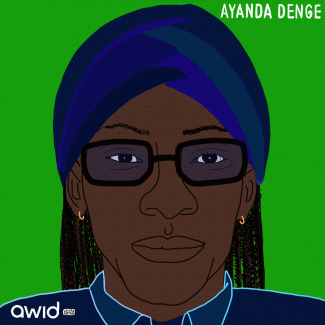
« Je suis un miracle… Je suis donc née d’une mère! Moi qui commence à bégayer, J’ai eu une vie à nulle autre pareille... » - Ayanda Denge (lisez le poème entier ci-dessous)
En tant qu’activiste fervente et engagée de la justice sociale, elle s'est battue pour les droits des travailleures du sexe, des personnes trans et des personnes vivant avec le VIH et le sida. Elle a également été une conférencière motivatrice sur la sensibilisation au cancer ainsi que fait campagne en faveur de logements sociaux et abordables, en particulier au profit des pauvres et des travailleures. Ayanda s'est dressée comme une montagne contre les différents visages souvent violents de la discrimination.
« Lorsque vous êtes transgenre, ce n’est pas une double dose, mais une triple dose de stigmatisation et de discrimination que vous recevez. Vous êtes discriminé·e en raison de votre identité sexuelle, en raison de votre travail et en raison de votre statut sérologique VIH. » - Ayanda Denge, 2016
Elle a été présidente par intérim de la Sex Workers Education and Advocacy Taskforce (SWEAT, groupe de travail sur l’éducation et la défense des travailleures du sexe) et coordonnatrice de liaison pour Sisonke, un mouvement national de travailleures du sexe sud-africain.
« D’ici, de notre siège régional à SWEAT, où je siège au conseil d'administration, en passant par Sisonke, un mouvement de travailleures du sexe au Cap, nous ne faisons qu’un. Nous avons un même cri et c'est un cri qui est reconnu dans le monde entier par les travailleures du sexe de toute la planète. Nous voulons la décriminalisation du travail du sexe ». - Ayanda Denge, 2016
Elle vivait dans la maison Ahmed Kathrada, qui était occupée par la campagne Reclaim the City en faveur de logements sociaux. En 2018, Ayanda avait été élue responsable de la maison. Le 24 mars 2019, elle a été poignardée à mort dans sa chambre. L'année précédente, un autre résident avait été tué.
Reclaim the City fait le lien entre la sécurité des résident·e·s des maisons et le gouvernement de province qui les prive d'électricité et du droit humain à l'eau potable :
« Nous ne pouvons dissocier la sécurité des femmes et des personnes LGBTQI vivant dans le squat du refus du gouvernement de la province du Cap-Occidental de rétablir l'électricité et l'eau potable dans la maison Ahmed Kathrada.
La maison est dans le noir complet le soir. Nous avons besoin de lumière pour nous protéger les un·e·s les autres. On a l'impression que la province veut punir les pauvres et les ouvrier·ère·s, dont le seul crime était d'avoir besoin d'un toit. Certes, ils ont le droit de ne pas être d’accord avec nos raisons de squatter, mais ils devraient avoir honte de faire passer la politique avant la sécurité et la dignité des résident·e·s de cette ville.
Repose en paix, camarade Ayanda Denge, nous reprenons le flambeau et nous nous souviendrons de toi dans cette lutte pour un logement décent et central. »
Poème d’Ayanda :
Je suis un miracle…
Je suis donc née d’une mère!
Moi qui commence à bégayer,
j’ai eu une vie à nulle autre pareille.
Née dans la douleur
Nourrie par la pluie
Pour gagner en hauteur
Je vivais dans les égouts.
Là je verse une larme,
je me relève et brandis ma lance.
Les voix résonnent, n’ayez pas peur
Des défis à relever dans l’année,
Des défis de souffrance dans mon dossier;
La communauté applaudit, croyant que j’ai gagné la course;
Mais en réalité mon travail avance à pas de tortue;
À genoux je m’incline et demande grâce.
Car le Seigneur
Est mon épée;
Pour rappeler à l’humanité
Qu’il apporte la sérénité.
Pourquoi, Seigneur, suis-je ce miracle?
Le Seigneur me répond par la pluie et le tonnerre,
Pour avoir interrogé mon père
Qui a dans le livre des agneaux
Un prénom nommé Ayanda.
Dans la rue ma vie n’a jamais été douce
Les personnes que j’ai dû croiser;
Parfois, je ne les saluais jamais;
Et même lorsque j’avais besoin de manger;
Je préférais tirer ma révérence
Plutôt que de prendre place.
Écoutez le poème de la voix d'Ayanda
« Car ma vie est pareille à celle d’une fleur de lotus, hors des eaux sombres et troubles, j'ai fleuri pour être belle et forte… »- Ayanda Denge, regardez et écoutez
« Ayanda, je voudrais te dire que dans nos coeurs, dans nos esprits, tu es toujours une survivante. Tu n’es plus là mais tu es partout, parce que tu es amour. Comme c’est merveilleux d’être aimé·e, et de donner de l’amour. Et c’est là, Ayanda, le cadeau que tu nous as fait. Merci pour tout cet amour, nous avions vraiment besoin de toi. Je te promets qu’à l’avenir, nous nous engageons tou·te·s à poursuivre la lutte à laquelle tu as consacré tant d’énergie et de temps. Et nous nous engagerons à obtenir justice pour cette fin de vie abominable que tu as connue. » - Transcription d’un message, lors d’un hommage d'adieu à Ayanda
« Ayanda était une activiste par nature. Elle connaissait ses droits et n’hésitait pas à se battre pour les droits des autres. En ce qui me concerne, je n’ai pas été surprise qu’elle s’implique auprès de nombreuses organisations, il était évident qu’elle aimait les gens. Elle ne défendait pas nécessairement les droits des LGBTI, mais les droits de toutes et de tous. » - la soeur d’Ayanda
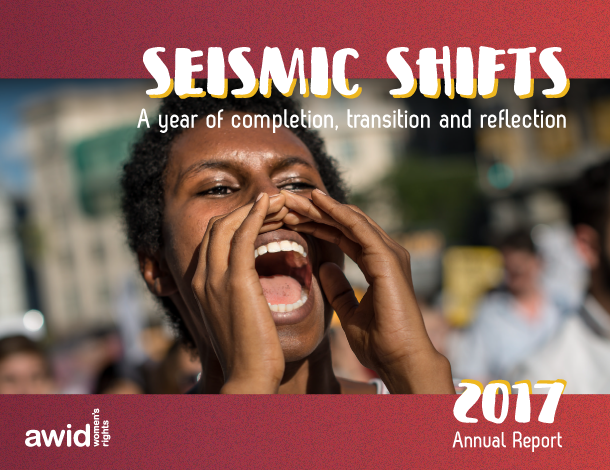
We have contributed to some major victories, like expanding the women’s rights funding landscape with ground-breaking, far-reaching research and advocacy. At the same time, we have experienced some devastating setbacks, including the assassination of Women Human Rights Defenders (WHRDs) like Berta Cacares of Honduras, Gauri Lankesh of India and Marielle Franco of Brazil, as well as the rise of anti-rights mobilizing in human rights spaces.
Five years ago, we committed to our movement-building role by producing knowledge on anti-rights movement trends, as well as on issues that feminists often engage with less, like illicit financial flows. We advocated side by side with our movement partners, strengthening young feminist and inter-generational activism, and expanding the holistic protection of WHRDs. As we close out the strategic plan, we are proud of our accomplishments and our growth as an organization. We end 2017 with renewed commitment, insights and learning for the continued struggle ahead!