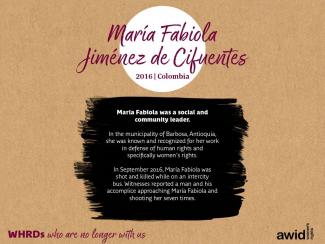
María Fabiola Jiménez de Cifuentes
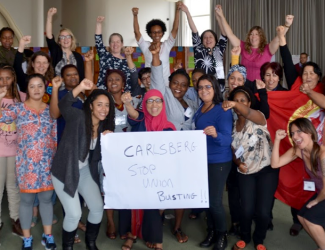
Women human rights defenders (WHRDs) worldwide defend their lands, livelihoods and communities from extractive industries and corporate power. They stand against powerful economic and political interests driving land theft, displacement of communities, loss of livelihoods, and environmental degradation.
Extractivism is an economic and political model of development that commodifies nature and prioritizes profit over human rights and the environment. Rooted in colonial history, it reinforces social and economic inequalities locally and globally. Often, Black, rural and Indigenous women are the most affected by extractivism, and are largely excluded from decision-making. Defying these patriarchal and neo-colonial forces, women rise in defense of rights, lands, people and nature.
WHRDs confronting extractive industries experience a range of risks, threats and violations, including criminalization, stigmatization, violence and intimidation. Their stories reveal a strong aspect of gendered and sexualized violence. Perpetrators include state and local authorities, corporations, police, military, paramilitary and private security forces, and at times their own communities.
AWID and the Women Human Rights Defenders International Coalition (WHRD-IC) are pleased to announce “Women Human Rights Defenders Confronting Extractivism and Corporate Power”; a cross-regional research project documenting the lived experiences of WHRDs from Asia, Africa and Latin America.
"Women Human Rights Defenders confronting extractive industries: an overview of critical risks and Human Rights obligations" is a policy report with a gender perspective. It analyses forms of violations and types of perpetrators, quotes relevant human rights obligations and includes policy recommendations to states, corporations, civil society and donors.
"Weaving resistance through action: Strategies of Women Human Rights Defenders confronting extractive industries" is a practical guide outlining creative and deliberate forms of action, successful tactics and inspiring stories of resistance.
The video “Defending people and planet: Women confronting extractive industries” puts courageous WHRDs from Africa, Asia, and Latin America in the spotlight. They share their struggles for land and life, and speak to the risks and challenges they face in their activism.
Challenging corporate power: Struggles for women’s rights, economic and gender justice is a research paper outlining the impacts of corporate power and offering insights into strategies of resistance.
AWID acknowledges with gratitude the invaluable input of every Woman Human Rights Defender who participated in this project. This project was made possible thanks to your willingness to generously and openly share your experiences and learnings. Your courage, creativity and resilience is an inspiration for us all. Thank you!

La recherche documentaire peut se dérouler tout au long de votre initiative. Elle peut vous aider à encadrer vos travaux, à choisir des questions de sondage et à comprendre vos résultats.
Dans cette section
- Préciser le contexte
- S’appuyer sur les connaissances existantes
- Sources éventuelles d’information pour la recherche documentaire
1. Sites Web et rapports annuels des donateurs
2. Sources d’information en ligne
La réalisation de recherches documentaires tout au long de votre initiative peut vous aider à encadrer vos travaux, à choisir les questions de sondage et à vous fournir une clarté contextuelle, tout en rehaussant votre compréhension des résultats de votre sondage. Vous pourriez notamment comparer les similarités et les différences entre les résultats de votre sondage et l’information diffusée par la société civile et les donateurs.
Il se peut que vous déceliez des tendances dans les résultats de votre sondage et que vous souhaitiez mieux les comprendre.
Par exemple, vos données de sondage pourraient révéler que les budgets des organisations diminuent, mais cela ne vous dit pas pour quelle raison cette situation se produit. L’analyse des publications vous donne un contexte et vous révèle certaines des raisons pour lesquelles ces tendances surviennent.
La recherche documentaire garantit également que vous appuyez votre recherche sur les connaissances existantes touchant à votre sujet d’intérêt, confirmant ainsi la validité et la pertinence de vos résultats.
Vos résultats pourraient être complémentaires ou contradictoires par rapport aux connaissances actuelles, mais ils doivent faire référence aux données existantes sur le sujet.
Pour que votre recherche soit complète et englobe tout le panorama du financement qui entoure votre sujet, examinez une gamme de secteurs de financement.
Vous pouvez notamment considérer :
- Les fonds pour les femmes
- Les fondations privées et publiques
- Les organisations non gouvernementales internationales (ONGI)
- Les agences bilatérales et multilatérales
- Les acteurs et actrices du secteur privé
- Les philanthropes
- Les groupes de financement participatif
Inclure tout secteur pertinent dans le cadre de référence de votre recherche.
Par exemple, vous pourriez décider qu’il est important d’effectuer des recherches sur les organisations non gouvernementales (ONG) locales.
Voici des sources directes d’information sur les actions des bailleurs de fonds qui contiennent habituellement des renseignements sur les politiques et les budgets. Si vous réalisez vos recherches avant d’interviewer les donateurs, vos questions seront mieux ciblées et vos interviews plus solides.

• 1-2 mois
• 1 personne (ou plus) chargée de la recherche
7. Synthétisez les résultats de votre recherche
Sí, invitamos a compartir más impresiones acerca de alguna cuestión que sea de importancia para ti respondiendo a las preguntas abiertas al término de la encuesta.
.
We believe that the economy, the market, the financial system and the premises upon which they are built are critical areas of feminist struggle. Thus, our vision for a just economy goes beyond promoting women’s rights and empowerment in the market, to evaluating the role of gendered oppressions in shaping economic arrangements and transforming these to ensure gender and economic justice.
We are neither starting from zero, nor alone in this attempt to put forward feminist propositions for a just economy. Many of the propositions herein have been advanced or exist in practice within diverse communities challenging and resisting the mainstream market and growth-based economic systems.
It is also very important to note that there is growing awareness of the fact that micro solutions are not always the answer to macro problems, even if they represent important spaces for resistance and movement building and that there may be limitations to particular alternatives to address the injustices of the current capitalist system at a global scale.
However, feminist alternatives for a just economy are critical to create dents in the system and draw lessons for transformative systemic change. Here we cannot presume to offer a comprehensive nor a complete account on how to create a just feminist economic model, or even models. But we can, but rather draw from cross-movement dialogue with trade unions, environmental, rural and peasants movements, to articulate the propositions for the journey towards this vision.
The neoliberal model driving the global economy has repeatedly demonstrated its inability to address the root causes of poverty, inequalities, and exclusion. Neoliberalism, and has in fact contributed to the very creation and exacerbation of these injustices.
Characterized by globalisation, liberalization, privatisation, financialisation and conditional aid, mainstream development policies over the past 3 decades have wreaked havoc on livelihoods over the past 3 decades. These policies have also sustained a trajectory of deepening inequalities, gendered injustices, and environmental destruction that the world can no longer afford to endure.
While there are people those who assert that economic growth, facilitated by giving free reign to corporations and businesses, can sustain a tide that will (eventually) raise all boats.
However, the notion of development that has prevailed for the past decades, built for the most part upon the premise of limitless economic growth, is going through an ideological crisis.
The myth of economic growth as a panacea for our problems is being debunked.
Au besoin, vous avez la possibilité de sauvegarder vos réponses en cours d’enquête, pour y revenir plus tard. KOBO enregistrera vos brouillons de réponses dans le coin supérieur gauche de la page de l'enquête et rechargera votre dossier lorsque vous reviendrez à l'enquête. Assurez-vous simplement de continuer à partir du même ordinateur et du même navigateur.
une identité de genre latino-américaine
Le terme travesti désigne une identité de genre latino-américaine sans équivalent dans d'autres langues, et exclusivement féminine. C'est une personne désignée de genre masculin à la naissance qui s'identifie comme une femme.
Elles doivent toujours être adressées avec le pronom “elle”. Travesti n'est pas seulement une identité de genre située en dehors de la binarité de genre, c'est aussi une identité culturelle enracinée dans les mouvements latino-américains.
Le terme était initialement péjoratif, mais a ensuite été réapproprié comme symbole de résistance et de dignité. Chaque travesti est trans parce qu'elle ne s'identifie pas au genre désigné à la naissance, mais toutes les travesti ne se considèrent pas comme femmes trans, car travesti est déjà une identité de genre en soi.
Référence: Berkins, Lohana. (2006). Travestis: una Identidad Política . Trabajo presentado en el Panel Sexualidades contemporáneas en las VIII Jornadas Nacionales de Historia de las Mujeres/ III Congreso Iberoamericano de Estudios de Género Diferencia Desigualdad. Construirnos en la diversidad, Villa Giardino, Córdoba, 25 al 28 de octubre de 2006.

La búsqueda de medios alternativos de producción alimentaria a partir de la sostenibilidad ambiental está ganando terreno en todas las regiones. Esta búsqueda mundial presenta una característica común: la necesidad de involucrar a la población rural y sobre todo a las mujeres, teniendo en cuenta sus prioridades y conocimientos locales, aplicando el principio de la agroecología.
La agroecología es una forma de practicar la agricultura o de utilizar tecnologías sin dañar el ambiente. Se propone quebrar el modelo hegemónico de desarrollo rural basado en los latifundios y monocultivos que beneficia sobre todo a las empresas agrícolas y afianza la exclusión social.
En la agricultura familiar, la agroecología se manifiesta como resistencia al modelo actual de desarrollo y sus problemas sociales, culturales, ambientales y económicos. Se opone a la falta de autonomía de la población campesina en cuanto a capital financiero y encarna una forma de resistencia al modelo de agronegocios actual.
Las iniciativas que se basan solo en la agroecología pueden no ser suficientes para resolver todos los problemas de marginación e invisibilidad de las mujeres. Por eso, una perspectiva feminista es fundamental para analizar las normas asociadas con la idea de familia que actualmente se postula como institución perfecta, así como con las condiciones de subordinación de las mujeres.
En términos más simples: para que la agroecología pueda liberar su potencial emancipatorio, es importante que los debates en torno a ella incluyan una reflexión sobre los roles de género socialmente construidos.

No, it's not. This survey builds on AWID’s 20-year history of mobilizing more and better funding for feminist-led social change and is the third iteration of our Where is the money for feminist organizing? research. Our aim is to repeat the WITM survey every 3 years.
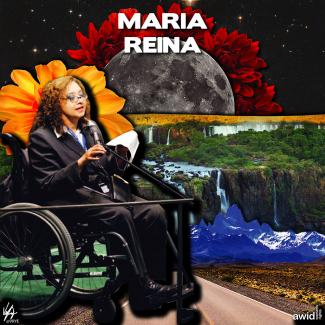
She represented the International Disability and Development Consortium during the negotiation of the United Nations Convention on the Rights of Persons with Disabilities (2001-2006).
Her work was devoted to the implementation of the goal of the Convention - realization of universal human rights by, for and with persons with disabilities for an inclusive, accessible and sustainable world.
In her words, her leadership was about “...serving the disability community, starting with small tasks that others may not wish to do”.
She passed away on October 27, 2017 in her hometown of Rosario, Argentina.
Read more about María Verónica Reina in her own words
Feminist Realities are embedded in the multiple ways that show us that there is a different way of living, thinking and doing - from the daily expressions of how we live and relate to each other, to alternative systems of governance and justice. Feminist Realities resist dominant power systems such as patriarchy, capitalism, and white supremacy.
These are powerful propositions that orient us toward a vision of what is possible, and show how feminist organizing is blazing a path toward justice in movements and communities around the world.
Download your full Magazine (PDF)