L´AWID est une organisation féministe mondiale qui consacre ses efforts à la justice de genre, au développement durable et aux droits humains des femmes
Forum de l'AWID : Co-créer nos horizons féministes
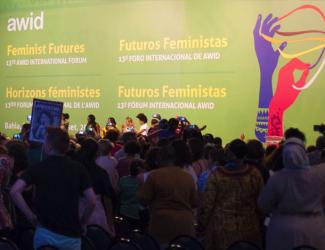
En septembre 2016, 1800 féministes et défenseur-e-s des droits des femmes venu-e-s des quatre coins de nos mouvements se réunissaient sur les côtes de Bahia à l’occasion du 13ème Forum international de l’AWID.
Cette section met l’accent sur les victoires, les enseignements et les ressources qui ont couronné nos conversations. Nous vous invitons à l’explorer, la partager et laisser vos impressions.
L’un des principaux éléments à retenir de ce Forum a été la nécessité d’élargir et d’approfondir notre travail de collaboration entre mouvements pour faire face à une montée des fascismes et des fondamentalismes, une exacerbation de la cupidité des entreprises et un changement climatique en progression.
L’AWID a donc travaillé avec plusieurs allié-e-s pour ériger ces semences de résistance :
Les mouvements peuvent aussi bénéficier d’une nouvelle méthodologie pour envisager nos horizons féministes. (à venir bientôt !)
A travers son prochain plan stratégique et le processus de son Forum, l’AWID s’engage à poursuivre et approfondir les rapports, les apprentissages et les processus amorcés lors du Forum 2016, tout en s’inspirant de l’actualité.
Et maintenant ?
Le monde est bien différent de celui qu’il était l’an dernier et il continuera à changer dans les années à venir.
Le prochain Forum de l’AWID se tiendra dans la région Asie-Pacifique (les dates et le lieu exacts seront annoncés en 2018). Nous attendons avec impatience de vous y retrouver !
A propos du Forum de l’AWID
Les Forums de l’AWID ont vu le jour en 1983, à Washington DC. Depuis, ils revêtent de nombreux aspects et incarnent, selon les personnes, tantôt un processus itératif visant à affiner nos analyses, notre vision et nos actions, un évènement clé galvanisant les féminismes des participant-e-s et leurs organisations ou un espace politique offrant refuge et solidarité aux défenseur-se-s des droits humains.
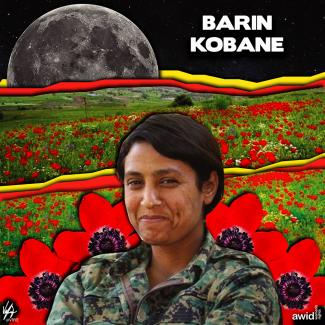
Barin integraba la unidad de batalla formada íntegramente por mujeres de la Unidad de Protección del Pueblo Kurdo (YPG).
La mataron cuando estaba en servicio activo.
La periodista libanesa Hifaa Zuaiter escribió: «Barin representa todo lo que hemos oído acerca del coraje de las combatientes kurdas, y su muerte es mucho más que el matar a un rival o el resultado de una lucha política o étnica. El horror de exhibir su cuerpo sólo porque es una mujer surge del hecho de que ella se atrevió a amenazar la hegemonía masculina al convertirse en una combatiente en un campo de batalla que se suponía era solo para hombres».
Tendencias anti-derechos en los sistemas regionales de derechos humanos
Chapter 6
En la Comisión Africana y en el Sistema Interamericano, los actores antiderechos impulsan nociones esencialistas de cultura y género para impedir el avance de los derechos y socavar las responsabilidades. Como vemos, los actores anti-derechos están ejerciendo su influencia sobre los sistemas regionales de derechos humanos, así como en los espacios internacionales.
La Comisión Africana de Derechos Humanos y de los Pueblos ha comenzado a definir a los derechos sexuales y de las mujeres como un menoscabo a su capacidad de ocuparse de los «derechos reales» y como contrarios a los «valores africanos», con lo cual se establece un precedente anti-derechos preocupante. La anulación del estatus de observador de la Coalición de Lesbianas Africanas es un ejemplo de esta tendencia y muestra la forma en que el espacio para el involucramiento feminista panafricanista está siendo restringido.
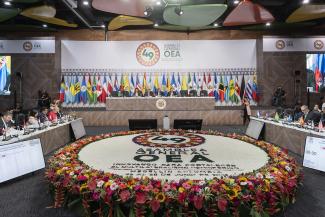
En la Organización de Estados Americanos (OEA) y en el Sistema Interamericano de Protección de los Derechos Humanos, las estrategias anti-derechos incluyen la oenegización de grupos religiosos, la utilización de discursos seculares, y la cooptación de marcos de discriminación. La influencia antiderechos se ha materializado de diversas maneras, que incluyen la intimidación de activistas trans y la obstrucción de la introducción de lenguaje progresista en las resoluciones.
Índice de contenidos
Silenciamiento de feministas en el Sistema Africano de Derechos Humanos
Grupos anti-derechos en América Latina: Asamblea General de la Organización de Estados Americanos (OEA) y el Sistema Interamericano de Protección de los Derechos Humanos
Incluso en tiempos de crisis climática, los gobiernos continúan alentando el crecimiento de las industrias agrícolas a gran escala. Estas actividades envenenan la tierra, amenazan la biodiversidad y destruyen la producción de alimentos y los medios de vida locales. Mientras tanto, aunque las mujeres producen la mayoría de nuestros alimentos en el mundo, casi no poseen tierra.
¿Qué pasaría si percibiéramos la tierra y la Naturaleza no como una propiedad privada para ser explotada, sino como una totalidad con la cual aprender y coexistir en armonía? ¿Y si repararíamos nuestras relaciones con la tierra y adoptaríamos alternativas más sostenibles que nutran tanto al planeta como a sus comunidades?
Nous Sommes la Solution (Somos la Solución, NSS) es uno de los muchos movimientos liderados por mujeres que se esfuerzan por lograr este objetivo.
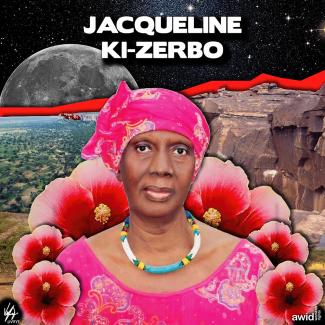
Jacqueline était une éducatrice malienne pionnière de la cause féministe et nationaliste.
Elle a d’abord enseigné l'anglais au Sénégal avant d'être recrutée en 1961 par le Lycée Philippe Zinda Kaboré à Ouagadougou, au Burkina Faso. Etant donné son engagement militant, elle a pris part au soulèvement populaire du 3 janvier 1966. Entre 1961 et 1966, Jacqueline était par ailleurs responsable de la presse syndicale, La voix des enseignants. Elle a été nommée directrice du Cours normal des jeunes filles (aujourd’hui connu sous le nom de lycée Nelson Mandela) jusqu'en 1974 et s'est consacrée à l'éducation des filles et à la promotion des droits des femmes.
En 1984, elle a reçu le prix Paul G. Hoffmann pour sa contribution remarquable en matière de développement national et international.
Gender Impact Investing & The Rise of False Solutions:
An Analysis for Feminist Movements
Gender Impact Investing (GII) is now trending as a solution to gender inequality. Yet, as our report indicates, it is actually part of the problem. Public and private institutions marketing GII equate it with promotion of gender equality and with increased resources for women and girls.
Neither claim is evidence-based.
Rather, GII is another expression of subjecting our lives and societies to the same financial logic that has shaped, and continues shaping, the profound inequalities in our world.
With this report, AWID offers the readers - feminists, gender justice advocates and stakeholders in gender impact investing - a critical analysis and substantiated evidence to understand GII, its narratives, and economic and political implications for feminist movements.
Snippet - Jobs and opportunities intro
If you’re looking to have an impact through your work in feminist, social justice and other non-profit organizations, we hope this page provides a start.
Here you will find open vacancies and call for applications from AWID and the Alliance for Feminist Movements, when available. Follow us on social media to be in the loop.
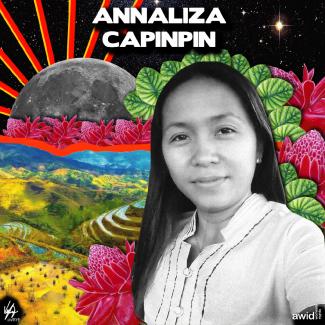
Known as “Ate Liza,” Annaliza was the president of the Agrarian Reform Council for Mindanao Pioneers, an umbrella group in Tacurong City, Philippines.
A loved mother of four, teacher and community leader, Annaliza is remembered by her community as “she who leads when no one wants to lead, she who talks when no one wants to talk, she who stood with courage to help the agrarian reform beneficiaries to own lands.”
Annaliza was shot dead by unknown assailants in front of the Sultan Kudarat State University (SKSU) while on her way to Salabaca National High School in Esperanza.
Her family have said “Naghihintay pa rin kami ng hustisya para sa kanya” (we are still waiting justice for her).
A Joy to the World: Six Questions with Naike Ledan
Interviewed by Chinelo Onwualu
Naike Ledan is a social justice defendant, a committed feminist that brings forward 20 years of experience in human rights and health justice advocacy, women’s empowerment, the fight for universal access to basic services and social inclusion, as well as civil society capacity building. She has built extensive work in Canada, West and southern Africa, as well as in Haiti, in civil rights advocacy, capacity building for CSOs, while emphasising the social determinants of structural exclusion. She values the principles of shared leadership, anticolonial, anti-oppressive, and anti-patriarchal spaces.
Chinelo You’re billed as a trans rights activist; I’m curious about how you made that journey.
Naike So, I grew up in Haiti until I was 18, then I lived in Montreal for 19 years. Coming back to Haiti in 2016, I thought I would be coming back home, but the place had changed and I had to readjust. I did not necessarily reconnect in the way that I’d expected to with childhood family and friends. I came back as an expat with a comfortable work situation, and I felt very much like a foreigner for a very long time. And at the same time, I felt very much at home because of the language, the understood silence, the not having to explain when we start singing a commercial – you know, that thing we share, that energy, that space, that spirit.
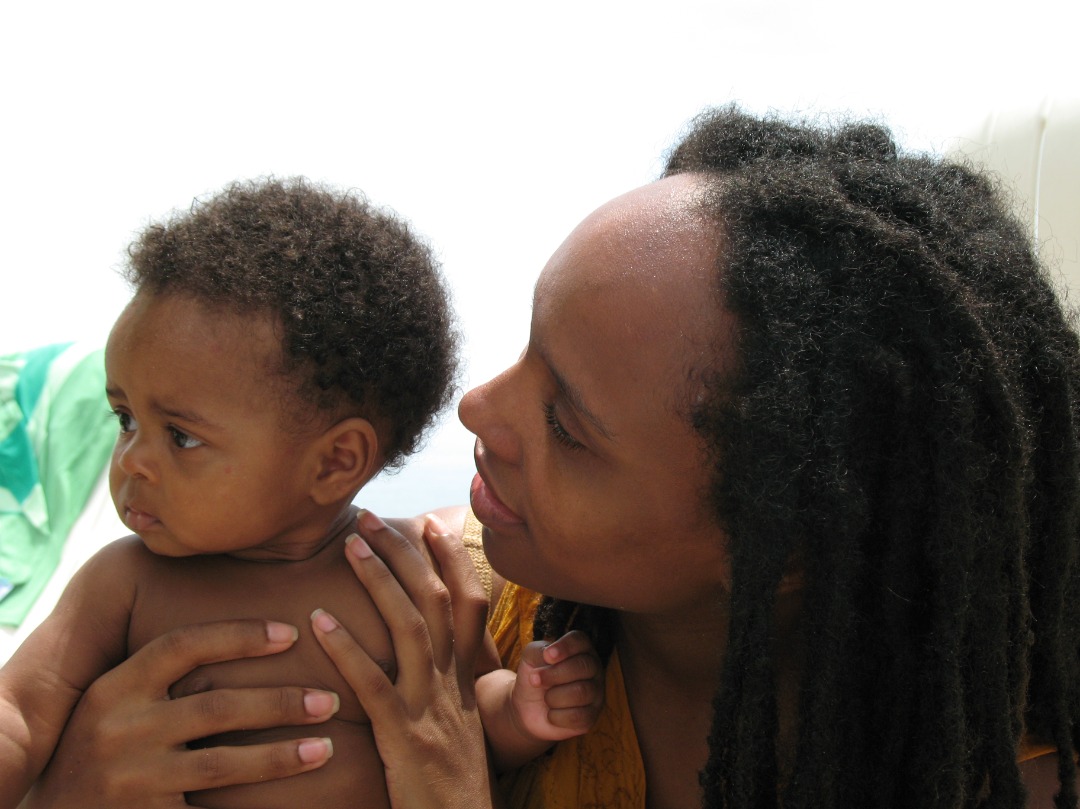
My return to self-love – I would call “rebirth” – coinciding with giving birth to my first child, giving birth to myself, and falling in love with my queerness or same-gender lovingness. (Photo credit: Naike Ledan)
What helped me was, I loved the work of going into the country and documenting people’s knowledge. So I left the comfort. I became a country director of a regional organisation that was queer as fuck! Most of my work was to find resources and build the capacity of civil society. My strategy was to go into the countryside, look for all these little organizations, help build their capacity, and fund them. I was not interested in politicians and shaking hands and taking pictures . I had a very good ally, Charlot Jeudy – the [queer] activist that got killed three years ago in his house. We got very close after an Afro-queer film festival we were planning got banned in Haiti. But it made a lot of noise and sparked conversations about queerness everywhere, so Charlot introduced me to every little CSO in every little corner of the country. And I would just be there to help organisation[s] with registering legally or building their strategic plan. So it’s been a lot of these kinds of work that made me a queer activist and by extension, a trans activist. Although I don’t call myself that – an activist. It’s such a loaded word, you know? And it’s something people call you. I think I’m just a lover and a fighter .
Chinelo Tell me about the workshop you conducted with AWID for the festival. What was it about and what was the context?
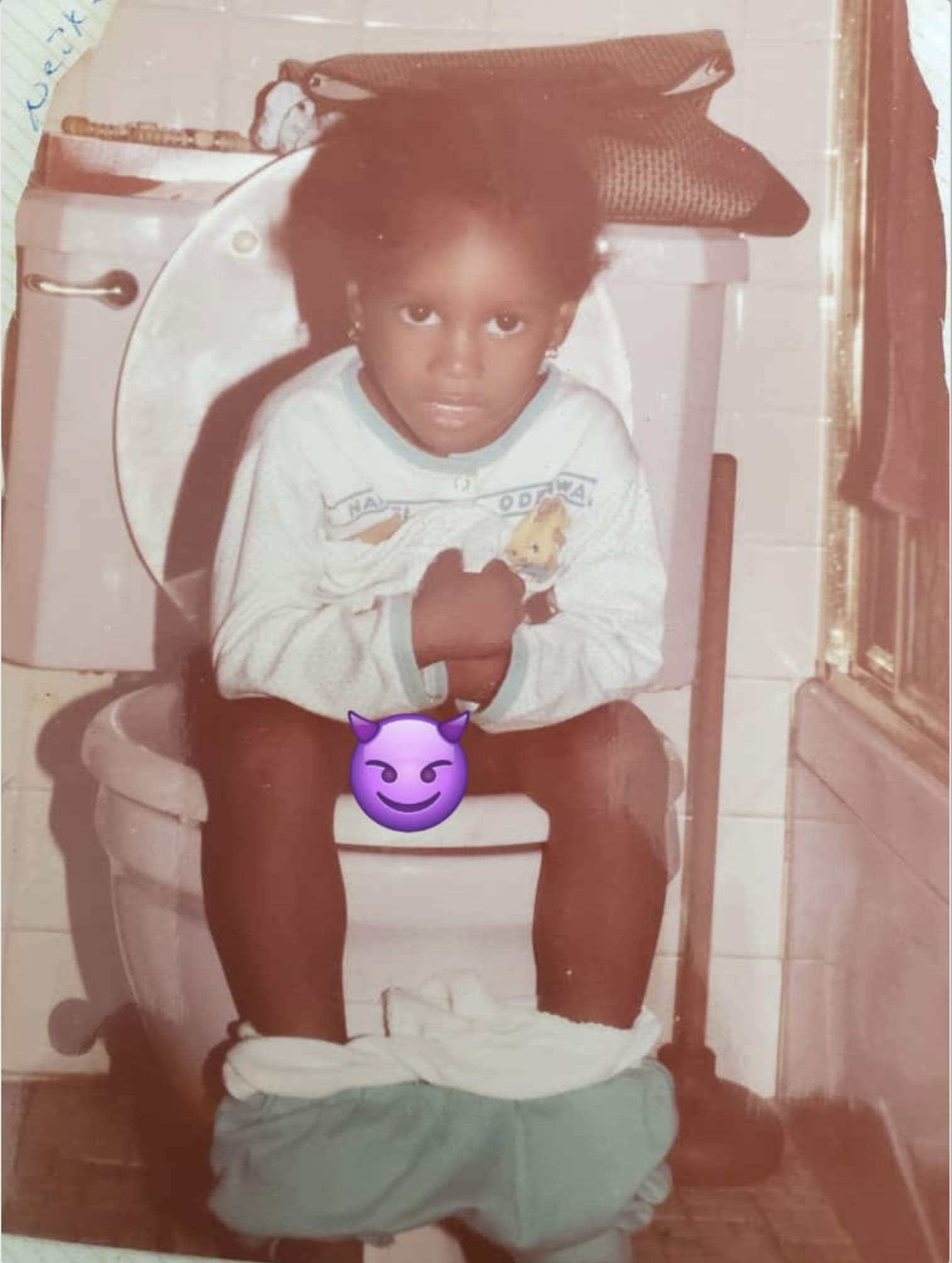
My deep self awareness during my childhood years and my engagement in questioning inequalities and injustice at a very very young age (+/- 4 years old). (Photo credit: Naike Ledan)
Naike International media doesn’t really talk about Haiti, but with a political environment that is as bad as ours, the economic environment is even more catastrophic. Being a more middle class Haitian, speaking different languages, having different passports, I was initially hesitant to take the space. But I often see myself as a bridge more than someone that would talk about themself. That is how I came to invite Semi, who is a brilliant young trans woman from outside Port-au-Prince, to take the space to talk for herself and walk us through the ecosystem of the realities for trans women in Haiti. We ended up building a session about uninclusive feminism – or, I would say, formal feminist spaces – and how trans girls in Haiti do not have spaces where they can contribute to women’s knowledge and sharing of women’s realities. So the AWID festival was the opportunity for me to give the space to the women who should have it. We had a wonderful time; we had wine online while hosting the conversation. My co-facilitator, Semi, shared what it is like to be a trans child/girl/woman at different stages of her life. She also shared the dangers of the street, of poverty, of exclusion, of “not passing,” and her victories as well.
Chinelo What is the relationship of trans women to feminist organizations in Haiti? What has been your experience with that?
Naike It’s been really hard – heartbreaking, actually – the experience of trans women in Haiti. From not existing at all to just being extremely sexualized. The other thing that’s been happening is how they’re being killed, and how those killings have gone unreported in the media. This is how non-existent, how erased trans women are. They’re everywhere but not in job settings, not in feminist settings, not in organizational settings. Not even in LGBT organizations. It’s only recently, and because of a lot of advocacy push, that some of these organization are kind of readjusting, but in feminist spaces, this is still out of the question. We are still having to deal with the old exclusionary discourse of “They’re not women. Of course, if they can pass…” The culture of passing, it’s a risk management conversation – how much you pass and how much you don’t pass and what it means for your body and the violence it inflicts. In the trans-exclusionary realities we live in, which are reproduced in a lot of feminist spaces, those that pass completely may be considered girls, but only to a certain extent. But how about falling in love, how about having a conversation, how about being in the closet, how about wanting a certain aesthetic, or a career? So really, the conversation about hormone therapy becomes about risk reduction, as Semi herself shared at the workshop. But we don’t have the option of hormone therapy, we don’t have the medical framework nor the system to support those who would like to pursue that option.
Chinelo When you talk about the way that trans people and queer people are thought of in society, it sounds like it might be similar to Nigeria, which can be a deeply homophobic environment.
Naike Haiti is a very complex country in a very beautiful way. Nothing is simple, you know, nothing is ever one way. Haitians are very tolerant – and they’re also very homophobic. You’re going to find regions in the countryside where people aren’t that homophobic at all because all the Vodou temples there, and this is a religion that respects life. One basic principle of the Vodou religion is that all children are children. So, there is no right or wrong in the religion. For the longest time, people thought of Haiti as a haven, a place where people are tolerant – we’re talking 70s, 80s, pre-HIV, 90s even. Then you had the earthquake [in 2010] where around 300,000 people died. And then all this money came from the south of the US through the Evangelicals to rebuild the country and find Jesus. So, the homophobia in Haiti is very recent. In the depth, in the heart of the soul of the culture, I cannot really say that it is homophobic. But in the everyday life, it surely lands on the skin of queer people, that violence. And that of women, of poor women, of dark women as well, because colorism runs deep in the Caribbean.
Chinelo How have you managed this? What’s been your strategy for survival?
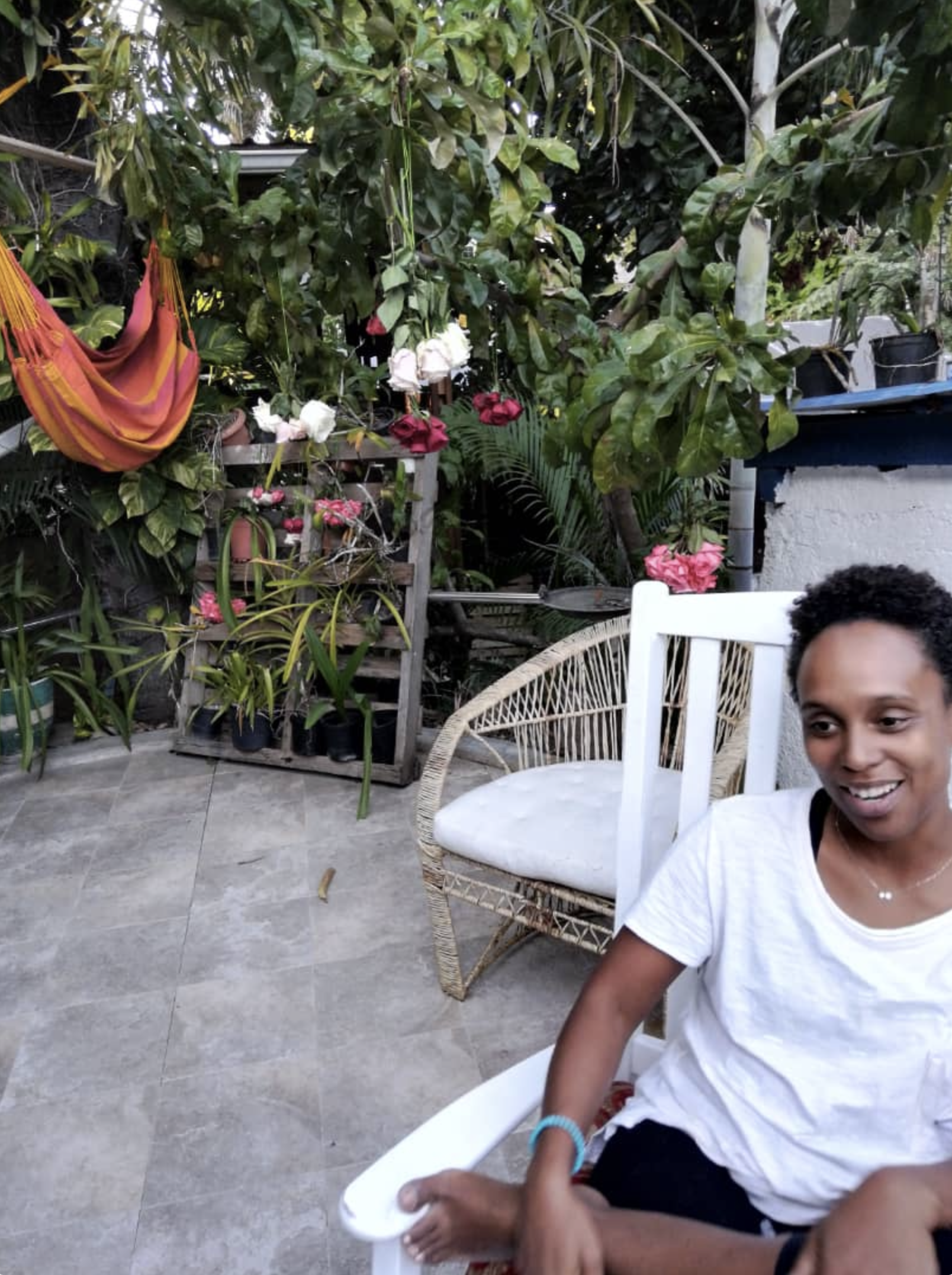
My return to Haiti as part of my decolonizing process, and choosing to physically position my senses and my family’s senses to magic and blackness uncompromisingly. (Photo credit: Naike Ledan)
Naike I’m really in love with my work. I love working. When I first arrived, I was working with this horrible NGO but I was doing amazing work. I was always in the countryside, conversing and learning from people, from women. And that filled my heart for so long because I’m very much in love with my culture, with black people, with black women – old black women, black babies. It just fills me up in a spiritual way. When we were in Canada my kids were in these all-white schools and tokenized. They did not speak Creole nor French. And now, they’re running free in the yard and starting to fight in Creole. I also found hubs of survival with the people I met. I created bonds with the queers and others who were weirdos like me and it’s been really wonderful. But now I’m struggling because I don’t feel safe in Haiti anymore. We have about 40 kidnappings per week in Port-Au-Prince – and it’s been like that since 2018. I’ve developed anxiety and panic attacks. So It’s time to go, and I’ve been asking myself, “where is home?” I spent 19 years in Montreal but I never felt at home there. When I left, I never missed it so I don’t want to go back. I’ve been crying a lot lately because it feels like entering a second exile.
Chinelo What’s your relationship to pleasure, leisure, and rest?
Naike My relationship with pleasure, leisure, and rest are for me one and the same. It is the lived moment when I indulge in the heat of the sun on my face for example. It is pleasure, leisure, and rest at the same time.
Pleasure: My go-to space, most solely a haven of celebration of myself. I reserve myself the power and the right to be loud or quiet in the enjoyment of the pleasure I experience. All the pleasure I viciously and abundantly indulge in, including and not limited to the pleasure of solitude and silence.
Leisure: biking, music festivals, eating, wine discoveries, dancing in Haitian traditional Vodou dances are amongst many that occur at the moment.
Rest: is what I live for. As an overachiever and a person that is literally in love with work, it is a paradox how lazy I am. No one knows that because all of what the world sees is this: an accomplished overworker. They do not know how I can just, uncompromisingly and profoundly indulge in idleness.
ExploreTransnational Embodiments
This journal edition in partnership with Kohl: a Journal for Body and Gender Research, will explore feminist solutions, proposals and realities for transforming our current world, our bodies and our sexualities.
نصدر النسخة هذه من المجلة بالشراكة مع «كحل: مجلة لأبحاث الجسد والجندر»، وسنستكشف عبرها الحلول والاقتراحات وأنواع الواقع النسوية لتغيير عالمنا الحالي وكذلك أجسادنا وجنسانياتنا.
With smart filtering for Who Can Fund Me? Database, you can search for funders based on:
FRMag - Ghosts Of Girlhood
Ghosts Of Girlhood
by Akua Antiwiwaa
There is an old, hazy picture laying in front of me. In it I am dressed in all white, from the pearl beads fastened into my hair and tucked against my ears, to the ones that trail loosely around my tiny wrists. (...)