

Análisis Especiales

AWID es un organización feminista internacional de membresía, que brinda apoyo a los movimientos que trabajan para lograr la justicia de género y los derechos de las mujeres en todo el mundo.

Foro de AWID: Co-creando futuros feministas

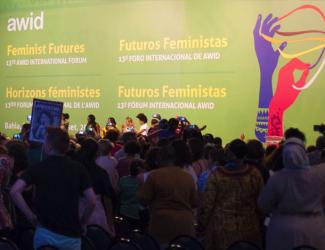
En septiembre de 2016, 1800 feministas y activistas por los derechos de las mujeres de todos los rincones de nuestros movimientos se congregaron en las costas de Bahia, en el 13º Foro Internacional de AWID.

En esta sección se destacan los logros, los aprendizajes y los recursos que surgieron de las ricas conversaciones mantenidas. Te invitamos a analizar, compartir y comentar.


¿Qué ha pasado desde 2016?

Uno de los aportes más importantes del Foro fue la necesidad de ampliar y profundizar nuestro trabajo entre movimientos, frente a la confluencia de los fascismos en auge, fundamentalismos, codicia corporativa y cambio climático.

Con esto en mente, AWID, en asociación con múltiples aliadxs, ha estado trabajando para que estas semillas de resistencia:

AWID se ha comprometido, mediante su próximo plan estratégico y su proceso del Foro, a continuar y profundizar las relaciones, las lecciones y los procesos iniciados en el Foro 2016 y basándonos en el momento actual.

¿Que pasa ahora?

El mundo es un lugar muy diferente de lo que era un año atrás, y seguirá cambiando en los próximos años.

El próximo Foro de AWID se realizará en la región del Pacífico Asiático (el lugar y la fecha exactos serán anunciados en 2018). Esperamos que te unas a nosotrxs.

Sobre el Foro de AWID

Los Foros de AWID comenzaron en 1983 en Washington DC. Desde entonces, el evento ha crecido hasta convertirse en muchas cosas para muchas personas: un proceso iterativo para darle forma a nuestros análisis, objetivos y acciones; un hito crucial que fortalece los feminismos de lxs participantes e infunde energías a sus procesos de organización; un hogar político donde lxs defensoras de derechos humanos encuentran un santuario y solidaridad.

Más información sobre los Foros anteriores

Contenido relacionado

Forum 2024 - FAQ - Registration EN

Registration

Snippet WCFM Title Menu (EN)

wcfm-logo-horizontal

LEARN MORE GET THE USER GUIDEWHO CAN FUND ME DATABASE  JOIN THE DATABASE

Celluloid Ishtar | Small Snippet

Celluloid Ishtar

When I was 6, I learned that my grandfather owned a movie theater. My mother recounted to me how it had opened in the early 1960s, when she was also about 6 years old. She remembered that they screened The Sound of Music on the first night...

Read more

Illustration of film reel

Lorena Borjas

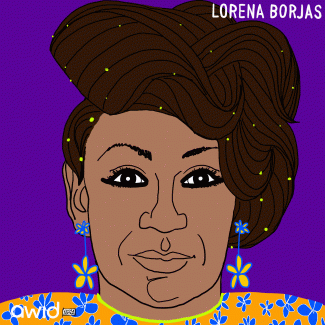
Lorena Borjas, una mujer trans latina y activista, vivía y trabajaba en el barrio de Jackson Heights de Queens, en la ciudad de Nueva York. En esas calles, cuidó de su comunidad durante años, defendiendo los derechos de las personas trans e inmigrantes, apoyando a lxs sobrevivientes del tráfico humano y del abuso, y haciendo campaña por los derechos de lxs trabajadorxs sexuales y de las personas que viven con VIH y SIDA.

Lorena era fuerte e incansable en su lucha por apoyar, defender y proteger a quienes son más marginalizadxs y discriminadxs por la transfobia, la misoginia y el racismo.

«Ella nos empujaba a brillar auténticamente, a  convertirnos en un grito de subversión que dice “Aquí estoy, y merezco felicidad también”.» - Cecilia Gentili, activista trans amiga de Lorena

Luego de haber enfrentado ella misma numerosos traumas y dificultades como mujer trans inmigrante y víctima de tráfico humano, recabó conocimientos y memoria emocional de la fuente de sus propias experiencias para ayudar a construir y fortalecer la comunidad de la cual era parte, y que era parte de ella. Algunas de las formas en que llevó esto a cabo fue organizando y movilizando apoyo, que abarcaba desde proveer preservativos y conectar a las mujeres trans con distintos servicios sociales, hasta armar una clínica para el testeo de VIH en su propia casa.

«Era un alma tan bella que ayudaba a otrxs, aun cuando su propio camino era difícil y doloroso como inmigrante, como inmigrante trans. Creía que la comunidad trans necesitaba amor, aceptación, y compasión, y lo daba todo.» - Luchia Dragosh, supervisora de producción de QPTV de un documental sobre Lorena

En sus más de 25 años de activismo, también fundó con Chase Strangio (abogadx y activista por los derechos trans) el Lorena Borjas Community Fund. Este fondo ayuda a lxs diferentes integrantes de su comunidad (y en especial a las personas trans) que lidian con problemas de inmigración, para evitar el ciclo de arresto-cárcel-deportación.

Lorena falleció en marzo de 2020 por complicaciones derivadas del COVID-19.

Su enorme y hermoso legado será llevado adelante a través de las calles de Queens por la red y la comunidad que ella ayudó a crear.

« Continuaremos su trabajo desde donde ella lo dejó, un trabajo que es esencial para el bienestar de “mis pájaras”, como llamaba Lorena a las chicas trans de Queens que protegía bajo su ala.» - Cecilia Gentili


Tributos:

 «Lorena nos trajo luz, cuando atravesábamos tiempos muy oscuros aquí en Nueva York. Nos trajo luz cuando tuvimos que enfrentar la epidemia del crack, cuando tuvimos que enfrentar la crisis del SIDA, cuando tuvimos que enfrentar los cambios en las políticas de inmigración.» - Cristina Herrera, fundadora y CEO de Translatina Network y amiga de Lorena

«Lorena ha hecho más que nadie que yo conozca para arrojar luz sobre la epidemia del tráfico en las comunidades transgénero y para ayudar a otras mujeres trans a escapar de la explotación.» - Lynly Egyes, representante de Borjas en nombre del Transgender Law Center

Mira un documental sobre Lorena Borjas (solo en inglés)

Lee un artículo publicado en The New Yorker sobre Lorena Borjas (solo en inglés)

Lee una nota de opinión de Cecilia Gentili publicada en The New York Times (solo en inglés)
AWID IN 2015: Building Collective Impact

In 2015 AWID grew and diversified.

We ramped up preparations for the 13th AWID international Forum, focused a lot of energy on the Post 2015 Development Agenda and Financing for Development processes, and continued the core work of our priority areas:


A sneak peak inside the report

The context

  • We continue witnessing the rapid breakdown in democracy and democratic institutions, with spaces for dissent shrinking.
  • Multiple and concurrent systemic crises (energy, food, finance and climate) continue to deepen inequalities and pose major challenges.
  • Corporations are a leading power in determining the development agenda.
  • Violence against WHRDs remains an urgent problem.
  • Religious fundamentalisms are pervasive and increasingly powerful.
  • New forms of online gender-based violence have emerged.

In response, we are moving out of our silos.

Increasingly, women’s rights and other movements worldwide are articulating the systemic and intersectional nature of these and other problems. We are making better connections with the agendas of other social and environmental movements for solidarity, alliance building and collective responses. We are also seeing greater visibility of these movements fighting for justice on the ground.


Our Impact

  • For effective strategizing and advocacy, we need facts
  • To exchange knowledge and join hands in solidarity, we need  a strong online community
  • To build our collective power, we need to work together
  • To influence international processes,  we need to increase our access and voice
  • To reposition power we need to give visibility and emphasize  the important role that feminist and women’s rights movements  are already playing
     

Our Members

As at 31st December, 2015 we had:


Read the full report


Can an individual or organization send multiple applications?

You are welcome to submit up to 2 activities as the organizer. You can still be a partner on other applications.

WITM - Refreshed INFOGRAPHIC 1 EN

Ever wondered what budgets for feminist organizations look like?

In 2023, feminist and women's rights organizations had a median annual budget of USD 22,000. Behind that median lies disparity and inequality: while a few groups access large-scale resources, the vast majority survive on shoestring budgets. 
A closer look at actual budgets reveals major income diversity and inequality.

Explore the data on the size of feminist budgets 

استنارة بضوء البدر: تجربة “بي دي إس إم” أفريقية COMIC moongirls | Snippet Small AR

استنارة بضوء البدر: تجربة “بي دي إس إم” أفريقية

هل اختبرتم من قبل لحظات من الصفاء الذهني العميق أثناء أو بعد ممارسة الجنس؟

اقرأ المزيد هنا

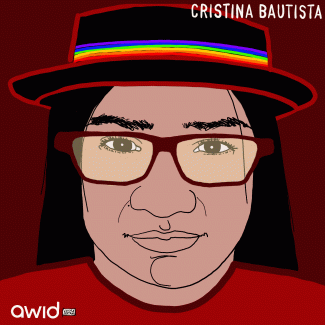
Cristina Bautista

« Si nous nous taisons, ils nous tuent, et si nous parlons [ils nous tuent] aussi. Alors parlons. »  -  Cristina Bautista, 2019

Cristina Bautista était membre de la communauté autochtone du peuple Nasa, qui vit dans la région nord du Cauca en Colombie. Elle participait à la résistance en tant que leader, défenseuse des droits fonciers, travailleuse sociale et gouverneure de la réserve autochtone Nasa de Tacueyó.

Défenseuse infatigable des droits du peuple Nasa, Cristina s’est exprimée haut et fort contre la violence à l’égard de sa communauté. Dans un discours devant les Nations Unies, elle appelait à protéger les vies des femmes autochtones et à les impliquer dans différents domaines de la vie. En 2017, Cristina était membre du Bureau des Nations Unies pour les droits humains des personnes autochtones. Le Fonds de contributions volontaires des Nations Unies pour les populations autochtones lui a octroyé une subvention en 2019. 

« J’aimerais mettre en lumière la situation actuelle du peuple autochtone en Colombie, le meurtre de leaders autochtones, la répression de la contestation sociale. Au lieu d’aider, l’accord de paix a renforcé la guerre et l’exploitation de territoires sacrés en Colombie… Actuellement, nous travaillons en tant que femmes, dans presque toutes les nations autochtones, à un avenir meilleur pour nos familles. Je ne veux pas voir plus de femmes vivre dans ces conditions en milieu rural. Il nous faut des opportunités qui permettent aux femmes autochtones de participer à la vie politique, à l’économie, à la société et à la culture. J’acquiers une réelle force aujourd’hui, en voyant toutes ces femmes ici, et en voyant que je ne suis pas seule. » - Cristina Bautista, 2019

Cristina a été assassinée le 29 octobre 2019, ainsi que quatre autres membres de la garde autochtone désarmée, dans une attaque potentiellement menée par des membres de « Dagoberto Ramos », un groupe dissident FARC.  

D’après Global Witness, « le nombre d’assassinats de leaders communautaires et sociaux·les a terriblement augmenté en Colombie au cours de ces dernières années ». 

« La communauté nasa a prévenu à maintes reprises les autorités au sujet des menaces qui pèsent sur leur sécurité. Malgré les efforts déployés par les gouvernements colombiens successifs, les peuples autochtones continuent de faire face à d'importants risques, surtout les dirigeants communautaires ou religieux comme Cristina Bautista.» - Point presse des Nations Unies, 1er novembre 2019

Visionnez le discours de Cristina Bautista d’août 2019 où elle dénonce de précédents assassinats de membres de la garde autochtone (en espagnol)

Annual Report 2010

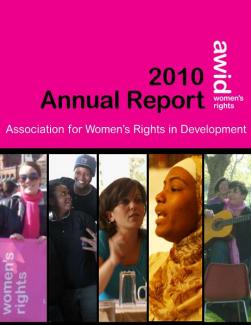
AWID 2010 Annual Report Cover

Our 2010 Annual Report highlights the major accomplishments of each of our strategic initiatives during the year.

Along with activity highlights, we include a brief analysis of the impact of our initiatives as well as reflections from our members and partners that further illustrate the relevance of AWID’s work and its connection to broader women’s rights movements. 

This interactive document is complete with links to our websites and recent publications with in-depth information on the issues we address in the report.

Read online

Snippet - COP30 Intro - ES

Súmate al movimiento feminista abocado a recuperar la acción por el clima del control corporativo

Con 1773 cabilderos de los combustibles fósiles presentes en la COP29 del año pasado, nos dirigimos, junto con otres feministas a Belém (Brasil) del 10 al 21 de noviembre de 2025. Allí continuaremos denunciando las soluciones falsas, llamando la atención sobre la captura corporativa, y exigiendo que los Estados cumplan sus compromisos bajo las Responsabilidades Comunes pero Diferenciadas y las Capacidades Respectivas (en inglés) para impulsar las alternativas económicas feministas.

USD 2,7 billones para gasto militar. USD 300.000 millones para la justicia climática. Estamos aquí para dar vuelta el relato.

Acciones Nodos Herramientas

Sigue la campaña

Disintegration | Content Snippet FR

Mercredi une note arrive
avec une adresse au dos.

    17 h, ce soir.

L’écriture sur l’invitation—
frêle et brusque—
je l’ai vue cinq fois en cinq ans.

Mon corps se réveille,
fébrile. 

Je dois d’abord me baiser moi-même. 

La marée est haute ce soir et
je
jouis.

Je veux tout ralentir,
goûter le temps et l’espace, les graver
en mémoire.

*

Je ne suis jamais allée dans cette partie de la ville auparavant.
Les endroits inconnus m’excitent,
la façon dont les membres et les veines et les os
résistent à la pourriture,
leur sort incertain.

Arrivée à la porte, je réfléchis à deux fois.
Le couloir est tout noir
et ça me fait faire une pause.

De l’autre côté,
un portail d’odeurs et de couleurs
s’ouvre comme une malédiction,
dans un après-midi ensoleillé.

La brise
fait danser mes cheveux,
pique leur curiosité,
les obligent à se déplacer.

J’entends le fauteuil roulant vrombir,
façonnant les ombres.
Puis je les vois :
un visage de lynx
et un corps comme le mien
et je me retrouve à désirer les deux
de nouveau.
 
La créature me fait signe d’approcher.

Ses gestes écrivent une phrase;
tandis que je m’avance,
je note ses détails :

    flétrir, chair, bonheur

À sa commande, la vigne recouvre le couloir
étreignant des pierres chaudes,
serpentant le long du mur.

Cela devient un verbe,
« escalader »,
et je suis réorientée quand leurs griffes pointent
vers le lit de vigne au centre.

J’entends les roues derrière moi,
puis ce son.
Il résonne
comme aucun autre.
Ses longues ailes noires
montent vers le plafond
puis iel se précipite vers l’avant.

La vision féline scrute chaque détail,
chaque changement,
chaque désir.

Le désir peut-il liquéfier vos muscles? 

      Peut-il agir plus doux que le 
      plus puissant des tranquillisants?

Un lynx coud le monde
à travers nos différences,
tissant de la dentelle autour de mes genoux.

Le désir peut-il écraser la distance du monde, comprimant les secondes?

Iel se rapproche encore,
oeil de lynx rencontrant oeil humain,
reniflant l’air,
transformant le corps en
urgence.

Iel a battu des ailes.
Remuées,
les vignes s’emmêlent autour de ma taille/de mes pertes.

Sa langue amincit le temps,
terrains mouvants,
apaise, avec sa magie,
ce qui remue dessous.

      Je vois le monde en toi, 
      et le monde est épuisé.

Puis iel plaide :

      Laisse-moi me régaler de toi.


Ayanda Denge

“I am a wonder… Therefore I have been born by a mother! As I begin to stutter, my life has been like no other…” - Ayanda Denge  (read the whole poem below)

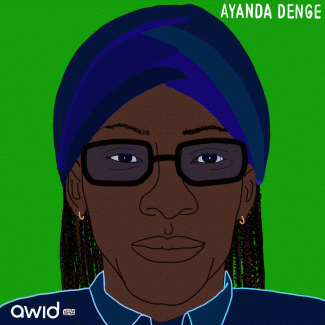
Ayanda Denge was a transwomxn, sex worker, activist, poet. She was Xhosa, from Port Elizabeth in the Eastern Cape of South Africa. After travelling through different cities of the country, she moved to Cape Town. 

As a committed and fervent social justice activist, she fought for the rights of sex workers, trans persons, and for those of people living with HIV and AIDS. She was also a motivational speaker on cancer awareness, and campaigned for affordable and social housing, especially for poor and working-class people. Ayanda stood tall as a mountain against different and often abusive faces of discrimination. 

“Being transgender is not a double dose, but it’s a triple dose of stigmatisation and discrimination. You are discriminated against for your sexual identity, you are discriminated against for your work, and you are discriminated against for your HIV status.” - Ayanda Denge, 2016

She was acting chairperson at the Sex Workers Education and Advocacy Taskforce (SWEAT) and also worked as an Outreach Coordinator at Sisonke, a national sex workers’ movement in South Africa. 

“From us, from our regional head office, to SWEAT where I sit on the board, to Sisonke, a movement of sex workers in Cape Town. We all amalgamate, we have one cry and it’s a cry that is recognised internationally by international sex workers. We want decriminalisation of sex work.” - Ayanda Denge, 2016

She lived in the Ahmed Kathrada House, which was being occupied by the Reclaim the City campaign for social housing. In 2018, Ayanda was elected house leader. On 24 March 2019, she was stabbed to death in her room. The year prior, another resident was killed.

Reclaim the City draws a connection between the safety of the house residents and the Provincial Government withholding electricity and the human right to water: 

“We cannot separate the safety of women and LGBTQI people living in the occupation from the refusal by the Western Cape Provincial Government to turn the electricity and water back on at Ahmed Kathrada House.

The house is pitch black at night. We need lights to keep each other safe. It is as if the Province wishes to punish poor and working class people, whose only crime is that we needed a home. While they may disagree with our reasons for occupying, they should be ashamed of themselves for putting politics before the safety and dignity of residents of this city.

Rest in Peace comrade Ayanda Denge, we shall remember you as we carry the torch forward in the struggle for decent well-located housing.”

Poem by Ayanda: 

I am a wonder…
Therefore I have been born by a mother!
As I begin to stutter,
My life has been like no other.
Born in pain
Nourished by rain
For me to gain
Was living in a drain.
As I shed a tear
I stand up and hold my spear.
Voices echo, do not fear
Challenges within a year,
Challenges of hurt are on my case;
Community applauds as they assume I have won my race;
But in reality my work strides at a tortoise pace;
On bended knee I bow and ask for grace.
For the Lord
Is my Sword;
To remind humanity
That he provides sanity.
Why Lord am I this wonder?
The Lord answers me with the rain and thunder,
For questioning my father
Who has in the book of lambs
A name called Ayanda.
From the streets my life was never sweet
The people I had to meet;
At times I would never greet;
Even though I had to eat;
I’d opt to take a bow
Rather than a seat

Listen to the poem in Ayanda’s voice

“For my life represents that of a lotus flower, that out of murky and troubled waters I bloomed to be beautiful and strong...” - Ayanda Denge, watch and listen 


Tributes: 

“Ayanda, I want to say to you that you are still a survivor, in our hearts and minds. You are gone but you are everywhere, because you are love. How beautiful it is to be loved, and to give love. And Ayanda, that is the gift that you have given us. Thank you for all of the love, we truly did need you. Going forward, I promise to you that we will all commit to continue with the struggle that you have dedicated so much energy and your time to. And we will commit ourselves to pursuing justice in this awful ending to your life.” - Transcript of a message, in a farewell Tribute to Ayanda

“Ayanda was an activist by nature. She knew her rights and would not mind fighting for the rights of others. For me, it was no shock that she was involved with many organizations and it was known that she was a people’s person. It did not need to be the rights of LGBTI but just the rights of everyone that she stood for.” - Ayanda’s sister
 

Demo article

Snippet - COP30 - International Eco-Socialist Encounter - ES

Encuentro Ecosocialista Internacional

Paneles, talleres, plenarias y espacios de intercambio entre colectivos, activistas y organizaciones que luchamos para recorrer de forma colectiva el camino hacia una agenda y un programa de lucha por el ecosocialismo.

📅 8 - 11 de noviembre de 2025
📍 Buenos Aires, Argentina

Regístrate aquí

Embodying Trauma-Informed Pleasure | Small Snippet ES

Encarnar un placer consciente del trauma

El trauma no es el evento mismo; es cómo responden nuestros cuerpos a los eventos que sentimos como peligrosos. A menudo queda atravesado en el cuerpo, hasta que lo abordamos. No se puede convencer a nuestro cuerpo de que no responda, simplemente lo hace. 

Leer más


Margarita Salas Guzmán

Biography

Margarita is a feminist and LGBTIQA activist from Latin America; her passion is social transformation and collective wellbeing. She holds degrees in Psychology, Communications and Public Administration, as well as certificates in Public Policy, Leadership, Management & Decision Making. In her professional capacity, Margarita has had extensive experience with grassroots organizations, national and regional NGOs, universities and the public sector, developing facilitation, capacity building, political advocacy, communications & policy assessment.

Position
Special Projects Manager
Add to stories
Off