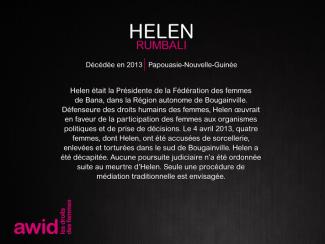
Helen Rumbali
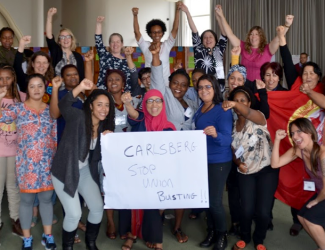
Defensoras de derechos humanos de todo el planeta defienden sus tierras, medios de subsistencia y sus comunidades ante las industrias extractivas y el poder corporativo. Ellas hacen frente a fuertes intereses económicos y políticos que promueven el robo de tierras, el desplazamiento de comunidades, la pérdida de los medios de subsistencia y la degradación del medioambiente.
El extractivismo es un modelo económico y político de desarrollo que mercantiliza la naturaleza y prioriza la ganancia por sobre los derechos humanos y el medioambiente. Arraigado en la historia colonial, refuerza las desigualdades sociales y económicas tanto a nivel local como global. Muchas veces, las mujeres negras, rurales e indígenas son las más afectadas por el extractivismo, y además son notablemente excluidas de la toma de decisiones. Desafiando estas fuerzas patriarcales y neocoloniales, las mujeres se alzan en defensa de los derechos, las tierras, las personas y la naturaleza.
Las defensoras que enfrentan a las industrias extractivas, experimentan una diversidad de riesgos, amenazas y violaciones, incluidas la criminalización, la estigmatización, la violencia y laintimidación. Sus historias dan cuenta de marcados aspectos de violencia sexual y de género. Entre los perpetradores se incluyen autoridades estatales y locales, las corporaciones, la policía, el ejército, las fuerzas paramilitares y de seguridad privada, y en algunos casos, sus propias comunidades.
AWID y la Coalición Internacional de Mujeres Defensoras de Derechos Humanos (WHRDIC por su sigla en inglés) tienen el placer de anunciar «Defensoras de derechos humanos confrontado al extractivismo y al poder corporativo»; un proyecto interregional de investigación que documenta las experiencias vividas por las defensoras de Asia, África y América Latina.
Alentamos a activistas, integrantes de movimientos sociales, la sociedad civil organizada, donantes y responsables de políticas públicas, a leer y utilizar estas producciones para el trabajo de incidencia, con fines educativos y como fuente de inspiración:
«Defensoras de derechos humanos confrontando a las industrias extractivas: un panorama de los riesgos críticos y las obligaciones en materia de derechos humanos» es un informe sobre políticas desde la perspectiva de género (en inglés, pronto disponible en español). Analiza las formas de violaciones y los tipos de perpetradores, hace referencia a las obligaciones relevantes en derechos humanos e incluye recomendaciones de políticas para los estados, corporaciones, la sociedad civil y donantes.
«Tejiendo la Resistencia a través de la Acción: Las Estrategias de las Defensoras de Derechos Humanos contra a las Industrias Extractivas» es una guía práctica que expone formas creativas y deliberadas de acción, tácticas exitosas e inspiradoras historias de resistencias.
El video «Defendiendo a las Personas y al Planeta: Mujeres Confrontando a las Industrias Extractivas» está protagonizado por defensoras de derechos humanos de África, Asia y América Latina, que comparten sus luchas por la tierra y la vida, y hablan de los riesgos y desafíos que enfrentan en su activismo.
«Desafiar al poder corporativo: Las luchas por los derechos de las mujeres, la justicia económica y de género» es un informe de investigación que explica los impactos del poder corporativo y ofrece ideas sobre estrategias de resistencia.
AWID reconoce con gratitud las invaluables contribuciones de cada Defensora de Derechos Humanos que ha sido parte de este proyecto. Esta guía ha sido posible gracias su generosidad y apertura al compartir sobre sus experiencias y lecciones. Su coraje, creatividad y resiliencia son una inspiración para todxs nosotrxs. ¡Muchas gracias!
« J’ai constaté la discrimination dans la rue, que ce soit par des taquineries ou des agressions verbales qui y ont lieu. Je me suis aussi faite plein d’ami·e·s et j’y ai rencontré plusieurs personnes. Il se peut que ce soit dangereux là-bas, mais je suis une survivante, et pour le moment, c’est là où je suis. » - Sainimili Naival
Elle a demandé aux responsables et acteurs politiques de fournir des politiques et des services adaptés au handicap, comme la construction de rampes dans les villes et les villages afin d'accroître leur accessibilité. Les barrières physiques n’étaient pas les seules qu’elle aspirait à modifier. Sur la base de sa propre expérience, elle savait que des changements plus difficiles devaient être menés dans les sphères économiques et sociales. Bon nombre des défis avec lesquels sont aux prises les personnes handicapées trouvent leurs racines dans les attitudes discriminantes et stigmatisantes.
Survivante et combattante, Sainimili a contribué à co-créer des réalités féministes qui renforcent l’inclusion et font évoluer les attitudes par rapport à l’égalité des personnes handicapées. Elle a été membre de la Spinal Injury Association of Fiji (SIA) ainsi que participé à la formation « Démarrez votre entreprise » de l’Organisation internationale du Travail à Suva via le projet « Pacific Enable » (le Pacifique rend possible) du Forum Asie-Pacifique sur le handicap. Elle a ainsi pu transformer ses idées en une entreprise qui lui était propre. Elle était commerçante sur l’étal de marché 7 de Suva, offrant des services de manucure, tout en gérant un stand au marché des femmes SIA pour y vendre de l’artisanat, des suls et des objets historiques. Sainimili planifiait d’élargir son commerce et de devenir une employeuse majeure de personnes handicapées.
Outre son activisme, elle était également médaillée de tennis de table et une récente championne.
Avec sa personnalité vive, Sainimili était unique. On savait toujours lorsqu’elle était dans la pièce car ses rires et ses histoires étaient la première chose qu’on pouvait remarquer. - Michelle Reddy
Sainmili est décédée en 2019.
En la Comisión Africana y en el Sistema Interamericano, los actores antiderechos impulsan nociones esencialistas de cultura y género para impedir el avance de los derechos y socavar las responsabilidades. Como vemos, los actores anti-derechos están ejerciendo su influencia sobre los sistemas regionales de derechos humanos, así como en los espacios internacionales.
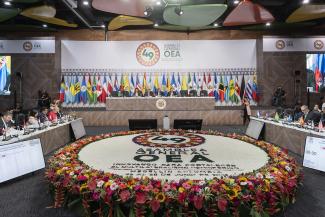
La Comisión Africana de Derechos Humanos y de los Pueblos ha comenzado a definir a los derechos sexuales y de las mujeres como un menoscabo a su capacidad de ocuparse de los «derechos reales» y como contrarios a los «valores africanos», con lo cual se establece un precedente anti-derechos preocupante. La anulación del estatus de observador de la Coalición de Lesbianas Africanas es un ejemplo de esta tendencia y muestra la forma en que el espacio para el involucramiento feminista panafricanista está siendo restringido.
En la Organización de Estados Americanos (OEA) y en el Sistema Interamericano de Protección de los Derechos Humanos, las estrategias anti-derechos incluyen la oenegización de grupos religiosos, la utilización de discursos seculares, y la cooptación de marcos de discriminación. La influencia antiderechos se ha materializado de diversas maneras, que incluyen la intimidación de activistas trans y la obstrucción de la introducción de lenguaje progresista en las resoluciones.
Não. Tem por base a história de 20 anos da AWID de mobilizar mais financiamento de maior qualidade para mudanças sociais lideradas por feministas e é a terceira edição do nosso inquérito “Onde está o dinheiro para organização feminista?”. O nosso objetivo é repetir o inquérito WITM a cada 3 anos.
Linda Porn is yet another heroine of feminist union organizing and sex worker activism nationally (in Spain) and transnationally.
Originally from Mexico, she has been living in Spain since the 2000s. She is a sex worker, an activist, a single mother and a multidisciplinary artist. Drawing from these different identities, she uses performance, video art and theater to vizibilize struggles at the intersections of transfeminism, sex work, migration, colonialism and motherhood.
She combines art and sex work while caring for her daughter as a single mother.
Linda also belongs to sex workers collectives that fight for their rights, such as the OTRAS union and CATS Murcia. She also co-founded the group 'Madrecitas' - that visibilises and denounces racist institutional violence against migrant families. Violence to which she and her daughter were subjected as a sex worker and migrant single mother.
You can follow her art work here.
The AWID Forum will be organized around 6 interconnected topics. These ‘anchors’ center feminist realities.
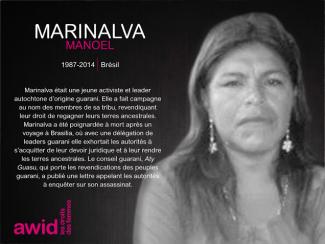
“But when was the master
ever seduced from power?
When was a system ever broken
by acceptance?
when will the BOSS hand you power with love?
At Jo’Burg, at Cancun or the U.N?
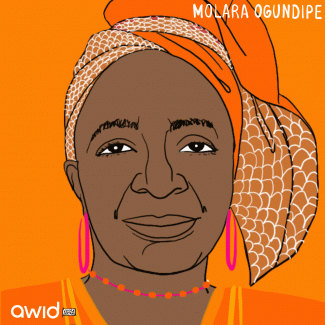
– Molara Ogundipe
Across the different continents and countries, Professor Ogundipe taught comparative literature, writing, gender, and English studies using literature as a vehicle for social transformation and re-thinking gender relations.
A feminist thinker, writer, editor, social critic, poet, and activist Molara Ogundipe succeeded in combining theoretical work with creativity and practical action. She is considered to be one of the leading critical voices on African feminism(s), gender studies and literary theory.
Molara famously coined the concept of “stiwanism’ from the acronym STIWA – Social Transformations in Africa Including Women recognizing the need to move “away from defining feminism and feminisms in relation to Euro-America or elsewhere, and from declaiming loyalties or disloyalties.”
In her seminal work ‘Re-creating Ourselves’ in 1994, Molara Ogundipe (published under Molara Ogundipe-Leslie) left behind an immense body of knowledge that decolonized feminist discourse and “re-centered African women in their full, complex narratives...guided by an exploration of economic, political and social liberation of African women and restoration of female agency across different cultures in Africa.”
In speaking about the challenges she faced as a young academic she said:
”When I began talking and writing feminism in the late sixties and seventies, I was seen as a good and admirable girl who had gone astray, a woman whose head has been spoilt by too much learning".
Molara Ogundipe stood out for her leadership in combining activism and academia; in 1977 she was among the founding members of AAWORD, the Association of Women in Research and Development. In 1982 she founded WIN (Women In Nigeria) to advocate for full “economic, social and political rights” for Nigerian women. She then went on to establish and direct the Foundation for International Education and Monitoring and spent many years on the editorial board of The Guardian.
Growing up with the Yoruba people, their traditions, culture, and language she once said :
“I think the celebration of life, of people who pass away after an achieved life is one of the beautiful aspects of Yoruba culture.”
Molara’s Yoruba ‘Oiki’ praise name was Ayike. She was born on 27 December 1940 and at the age of 78, Molara passed away on 18 June 2019 in Ijebu-Igbo, Ogun State, Nigeria.
إن كانت لديكم/ن أسئلة أو أمور تثير قلقكم/ن، الرجاء التوجه الينا عن طريق هذا النموذج وكتابة "استطلاع أين المال" في العنوان أو راسلنا على [email protected]

Yamile Guerra fue una conocida abogada, líder comunitaria y activista política de la región colombiana de Santander.
Trabajó activamente para resolver las disputas entre comunidades locales y empresas promotoras, y abogó contra la apropiación ilegal de las tierras. Yamile ocupó varios cargos políticos, entre ellos la Secretaría General del Gobierno de Santander en Bogotá, y se presentó también a la Alcaldía de Bucaramanga. En los últimos años de su vida, Yamile se volvió cada vez más activa en las causas medioambientales contra los desarrollos urbanos, particularmente, en la defensa de los humedales biodiversos de Santurbán contra los desarrollos urbanos, una región que abastece de agua dulce a casi 2 millones de personas .
Según su familia y amigxs, Yamile recibía amenazas de muerte a diario y había pedido protección a las autoridades.
"Ella era muy consciente de este problema [litigio de tierras] y manifestó repetidamente que se sentía insegura". - Alixon Navarro Muñoz, periodista y amigo de la familia Guerra.
El 20 de julio de 2019, Yamile fue asesinada a tiros por dos hombres en Floridablanca, Santander. Acababa de terminar de discutir con ellos por una disputa de tierras. Un sospechoso fue arrestado más tarde por su asesinato y admitió haber recibido un pago por llevar a cabo su asesinato. Según varios informes, o Yamile fue la tercera integrante de su familia en ser asesinada a causa de las disputas por tierras. El padre de Yamile, Hernando Guerra, había sido asesinado también varios años antes.
El asesinato de Yamile forma parte de una ola de violencia y asesinatos sistemáticos contra cientos de activistas sociales y defensorxs de los derechos humanos en Colombia. Según el Instituto de Estudios para el Desarrollo y la Paz (INDEPAZ), en el momento de la muerte de Yamile, más de 700 líderes comunitarios y activistas de derechos humanos habían sido asesinadxs desde que el país firmó un acuerdo de paz en agosto de 2016. La mayoría de ellxs fueron asesinadxs por enfrentar el tráfico ilegal de drogas y las operaciones mineras. Las personas indígenas, afrocolombianas y las mujeres defensoras de derechos humanos son lxs activistas que corren mayor riesgo.
Menos de una semana después de la muerte de Yamile, miles de colombianxs marcharon por pueblos y ciudades sosteniendo fotos en blanco y negro de activistas que habían sido asesinadxs, en las pancartas se podía leer: "Sin líderes no puede haber paz" y "No más derramamientos de sangre".
Yamile Guerra tenía solo 42 años en el momento de su asesinato.
Interviewed by Chinelo Onwualu

 |
Naike Ledan is a social justice defendant, a committed feminist that brings forward 20 years of experience in human rights and health justice advocacy, women’s empowerment, the fight for universal access to basic services and social inclusion, as well as civil society capacity building. She has built extensive work in Canada, West and southern Africa, as well as in Haiti, in civil rights advocacy, capacity building for CSOs, while emphasising the social determinants of structural exclusion. She values the principles of shared leadership, anticolonial, anti-oppressive, and anti-patriarchal spaces. |
Chinelo You’re billed as a trans rights activist; I’m curious about how you made that journey.
Naike So, I grew up in Haiti until I was 18, then I lived in Montreal for 19 years. Coming back to Haiti in 2016, I thought I would be coming back home, but the place had changed and I had to readjust. I did not necessarily reconnect in the way that I’d expected to with childhood family and friends. I came back as an expat with a comfortable work situation, and I felt very much like a foreigner for a very long time. And at the same time, I felt very much at home because of the language, the understood silence, the not having to explain when we start singing a commercial – you know, that thing we share, that energy, that space, that spirit.
What helped me was, I loved the work of going into the country and documenting people’s knowledge. So I left the comfort. I became a country director of a regional organisation that was queer as fuck! Most of my work was to find resources and build the capacity of civil society. My strategy was to go into the countryside, look for all these little organizations, help build their capacity, and fund them. I was not interested in politicians and shaking hands and taking pictures
Chinelo Tell me about the workshop you conducted with AWID for the festival. What was it about and what was the context?
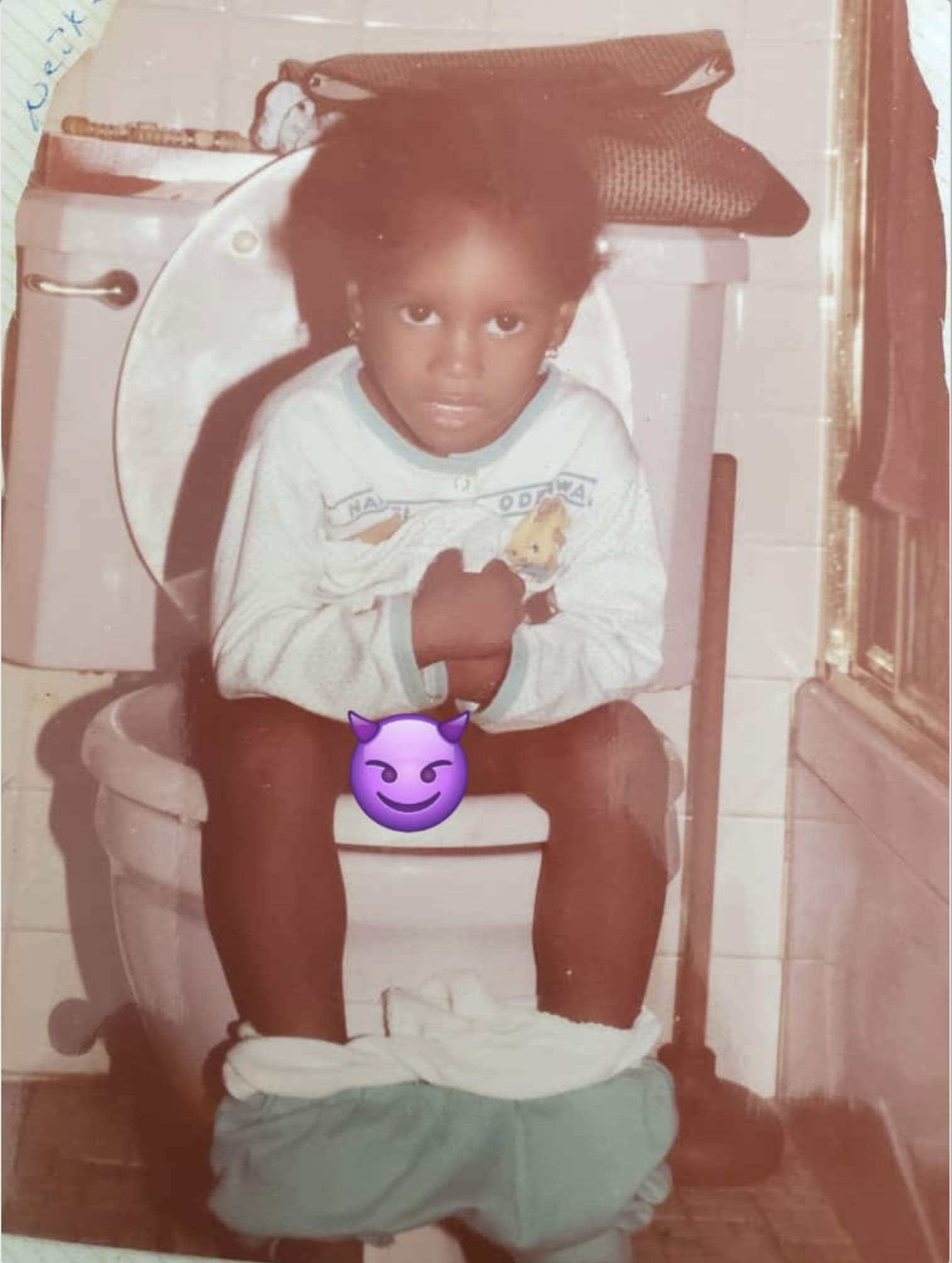
Naike International media doesn’t really talk about Haiti, but with a political environment that is as bad as ours, the economic environment is even more catastrophic. Being a more middle class Haitian, speaking different languages, having different passports, I was initially hesitant to take the space. But I often see myself as a bridge more than someone that would talk about themself. That is how I came to invite Semi, who is a brilliant young trans woman from outside Port-au-Prince, to take the space to talk for herself and walk us through the ecosystem of the realities for trans women in Haiti. We ended up building a session about uninclusive feminism – or, I would say, formal feminist spaces – and how trans girls in Haiti do not have spaces where they can contribute to women’s knowledge and sharing of women’s realities. So the AWID festival was the opportunity for me to give the space to the women who should have it. We had a wonderful time; we had wine online while hosting the conversation. My co-facilitator, Semi, shared what it is like to be a trans child/girl/woman at different stages of her life. She also shared the dangers of the street, of poverty, of exclusion, of “not passing,” and her victories as well.
Chinelo What is the relationship of trans women to feminist organizations in Haiti? What has been your experience with that?
Naike It’s been really hard – heartbreaking, actually – the experience of trans women in Haiti. From not existing at all to just being extremely sexualized. The other thing that’s been happening is how they’re being killed, and how those killings have gone unreported in the media. This is how non-existent, how erased trans women are. They’re everywhere but not in job settings, not in feminist settings, not in organizational settings. Not even in LGBT organizations. It’s only recently, and because of a lot of advocacy push, that some of these organization are kind of readjusting, but in feminist spaces, this is still out of the question. We are still having to deal with the old exclusionary discourse of “They’re not women. Of course, if they can pass…” The culture of passing, it’s a risk management conversation – how much you pass and how much you don’t pass and what it means for your body and the violence it inflicts. In the trans-exclusionary realities we live in, which are reproduced in a lot of feminist spaces, those that pass completely may be considered girls, but only to a certain extent. But how about falling in love, how about having a conversation, how about being in the closet, how about wanting a certain aesthetic, or a career? So really, the conversation about hormone therapy becomes about risk reduction, as Semi herself shared at the workshop. But we don’t have the option of hormone therapy, we don’t have the medical framework nor the system to support those who would like to pursue that option.
Chinelo When you talk about the way that trans people and queer people are thought of in society, it sounds like it might be similar to Nigeria, which can be a deeply homophobic environment.
Naike Haiti is a very complex country in a very beautiful way. Nothing is simple, you know, nothing is ever one way. Haitians are very tolerant – and they’re also very homophobic. You’re going to find regions in the countryside where people aren’t that homophobic at all because all the Vodou temples there, and this is a religion that respects life. One basic principle of the Vodou religion is that all children are children. So, there is no right or wrong in the religion. For the longest time, people thought of Haiti as a haven, a place where people are tolerant – we’re talking 70s, 80s, pre-HIV, 90s even. Then you had the earthquake [in 2010] where around 300,000 people died. And then all this money came from the south of the US through the Evangelicals to rebuild the country and find Jesus. So, the homophobia in Haiti is very recent. In the depth, in the heart of the soul of the culture, I cannot really say that it is homophobic. But in the everyday life, it surely lands on the skin of queer people, that violence. And that of women, of poor women, of dark women as well, because colorism runs deep in the Caribbean.
Chinelo How have you managed this? What’s been your strategy for survival?
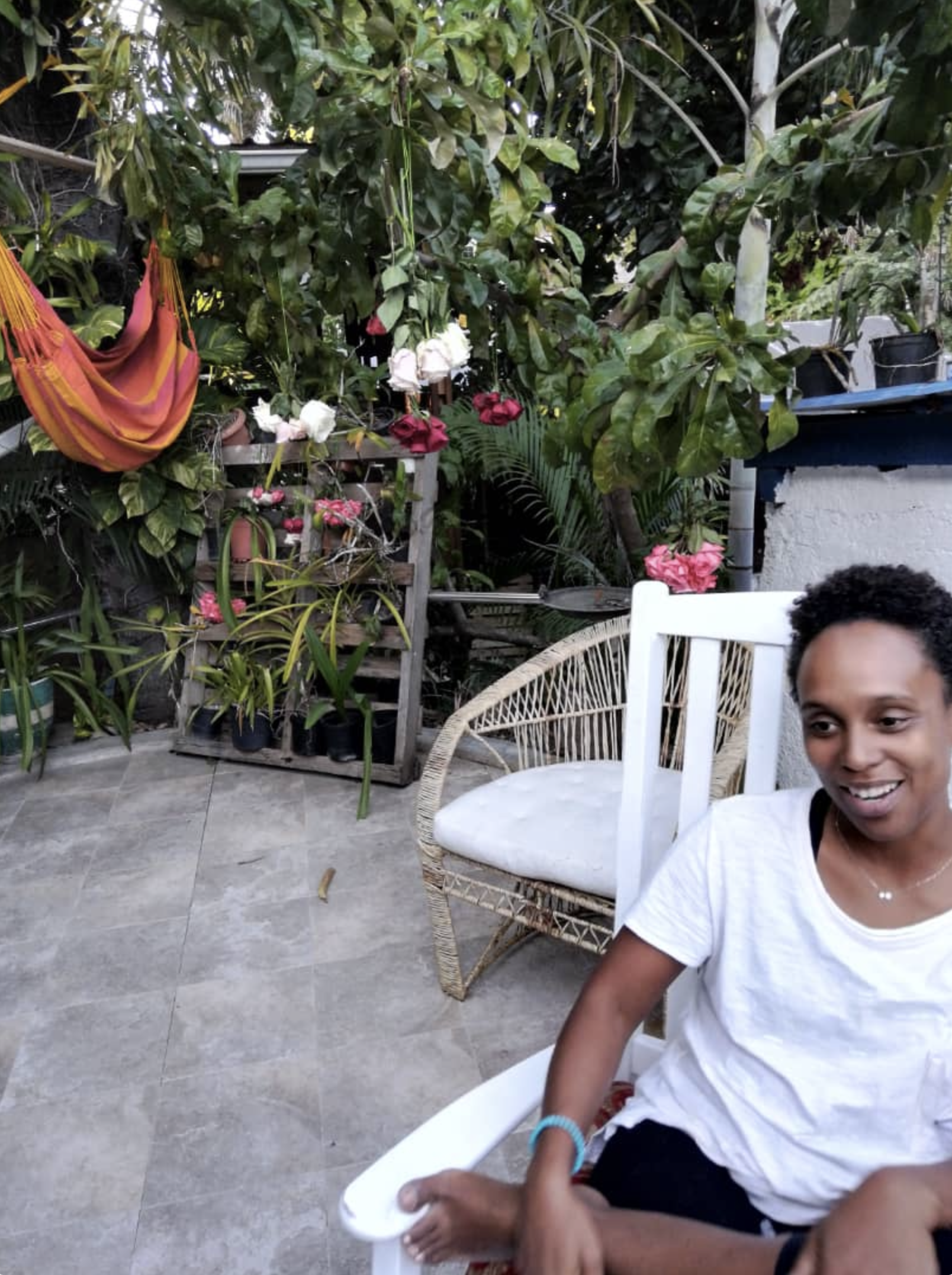
Naike I’m really in love with my work. I love working. When I first arrived, I was working with this horrible NGO but I was doing amazing work. I was always in the countryside, conversing and learning from people, from women. And that filled my heart for so long because I’m very much in love with my culture, with black people, with black women – old black women, black babies. It just fills me up in a spiritual way. When we were in Canada my kids were in these all-white schools and tokenized. They did not speak Creole nor French. And now, they’re running free in the yard and starting to fight in Creole. I also found hubs of survival with the people I met. I created bonds with the queers and others who were weirdos like me and it’s been really wonderful. But now I’m struggling because I don’t feel safe in Haiti anymore. We have about 40 kidnappings per week in Port-Au-Prince – and it’s been like that since 2018. I’ve developed anxiety and panic attacks. So It’s time to go, and I’ve been asking myself, “where is home?” I spent 19 years in Montreal but I never felt at home there. When I left, I never missed it so I don’t want to go back. I’ve been crying a lot lately because it feels like entering a second exile.
Chinelo What’s your relationship to pleasure, leisure, and rest?
Naike My relationship with pleasure, leisure, and rest are for me one and the same. It is the lived moment when I indulge in the heat of the sun on my face for example. It is pleasure, leisure, and rest at the same time.
Pleasure: My go-to space, most solely a haven of celebration of myself. I reserve myself the power and the right to be loud or quiet in the enjoyment of the pleasure I experience. All the pleasure I viciously and abundantly indulge in, including and not limited to the pleasure of solitude and silence.
Leisure: biking, music festivals, eating, wine discoveries, dancing in Haitian traditional Vodou dances are amongst many that occur at the moment.
Rest: is what I live for. As an overachiever and a person that is literally in love with work, it is a paradox how lazy I am. No one knows that because all of what the world sees is this: an accomplished overworker. They do not know how I can just, uncompromisingly and profoundly indulge in idleness.

This journal edition in partnership with Kohl: a Journal for Body and Gender Research, will explore feminist solutions, proposals and realities for transforming our current world, our bodies and our sexualities.
نصدر النسخة هذه من المجلة بالشراكة مع «كحل: مجلة لأبحاث الجسد والجندر»، وسنستكشف عبرها الحلول والاقتراحات وأنواع الواقع النسوية لتغيير عالمنا الحالي وكذلك أجسادنا وجنسانياتنا.
Are you job hunting? One of the perks of joining the AWID Community, is getting access to our community curated jobs board. You'll get to explore new opportunities, and you will also have the chance to share vacancies and call for proposals with all members.
par Rode Wanimbo
Seigneur, nous sommes indignes. C’est nous qui avons péché car Ève a mangé le fruit dans le jardin d’Eden. (...)
< illustration : « Offrandes pour les vies Noires » par Sokari Ekine
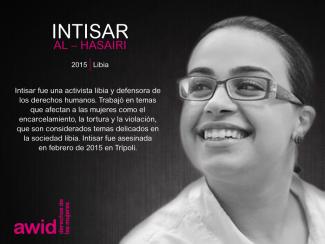
Binta Sarr était une activiste pour la justice sociale, économique, culturelle et politique, en plus d’avoir occupé le poste d’ingénieure hydraulique au Sénégal. Après 13 années de service, celle-ci a choisi de quitter le fonctionnariat pour travailler auprès de femmes rurales et marginalisées.
Cet engagement a donné lieu à la création de l’Association pour la promotion des femmes sénégalaises (APROFES), un mouvement de base auquel est venu se greffer une organisation fondée par Binta en 1987. L’une de ses approches était la formation au leadership, non seulement dans le cadre d’activités économiques mais également en lien avec les droits des femmes et leur accès à des fonctions décisionnelles.
“« Les populations à la base doivent s’organiser, se mobiliser, assumer le contrôle citoyen et exiger une gouvernance démocratique dans tous les secteurs de l’espace public. La priorité des mouvements sociaux doit aller au-delà de la lutte contre la pauvreté et être axée sur des programmes de développement articulés et cohérents en adéquation avec les principes des droits humains, tout en prenant en compte leurs besoins et leurs préoccupations tant au niveau national, sous régional que dans une perspective d’intégration africaine et mondiale. » – Binta Sarr
Ancrée dans la conviction de Binta, à savoir que les changements essentiels dans le statut des femmes nécessitent la transformation des attitudes masculines, APROFES a adopté une approche interdisciplinaire et s’est appuyée sur la radio, les séminaires et le théâtre populaire, offert une éducation publique innovante et apporté un soutien culturel aux actions de sensibilisation. Sa troupe de théâtre populaire a créé des pièces sur le thème des castes dans la société sénégalaise, de l’alcoolisme et de la violence conjugale. Binta et son équipe ont également pris en compte l’interconnexion essentielle entre la communauté et le monde élargi.
« Pour APROFES, il s’agit d’étudier et de prendre en compte les interactions entre le micro et le macro, le local et le mondial, ainsi que les différentes facettes du développement. De l’esclavage à la colonisation, le néo-colonialisme et la marchandisation du développement humain, qui représentent la majeure partie des ressources d’Afrique et du Tiers-Monde (pétrole, or, minéraux et autres ressources naturelles), demeurent sous le contrôle des cartels financiers et autres multinationales qui dominent ce monde mondialisé. » – Binta Sarr
Binta était également l’une des membres fondatrices de la section féminine de l’Association culturelle et sportive Magg Daan, et a reçu des mentions élogieuses de la part du gouverneur régional et du ministre de l’Hydrologie pour sa « dévotion aux populations rurales ».
Née en 1954 dans la petite ville de Guiguineo, Binta est décédée en septembre 2019.
« La perte est incommensurable, la douleur est lourde et profonde mais nous allons résister pour ne pas pleurer Binta; nous allons garder l’image de son large sourire en toutes circonstances, pour résister et nous inspirer d’elle, maintenir, consolider et développer son œuvre... » – Page Facebook de l’APROFES, 24 septembre 2019
« Adieu, Binta! Nul doute que ton immense héritage sera préservé. » – Elimane FALL, président de l’ACS Magg-Daan