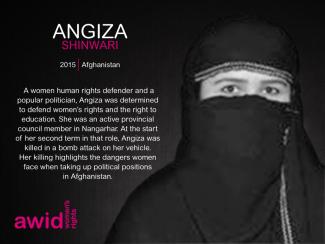
Angiza Shinwari
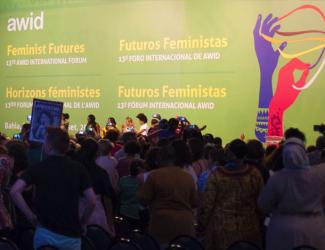
In September 2016, the 13th AWID international Forum brought together in Brazil over 1800 feminists and women’s rights advocates in a spirit of resistance and resilience.
This section highlights the gains, learnings and resources that came out of our rich conversations. We invite you to explore, share and comment!
One of the key takeaways from the 2016 Forum was the need to broaden and deepen our cross-movement work to address rising fascisms, fundamentalisms, corporate greed and climate change.
With this in mind, we have been working with multiple allies to grow these seeds of resistance:
And through our next strategic plan and Forum process, we are committed to keep developing ideas and deepen the learnings ignited at the 2016 Forum.
AWID Forums started in 1983, in Washington DC. Since then, the event has grown to become many things to many peoples: an iterative process of sharpening our analyses, vision and actions; a watershed moment that reinvigorates participants’ feminisms and energizes their organizing; and a political home for women human rights defenders to find sanctuary and solidarity.
This policy governs all pages hosted at www.awid.org, and any other websites under the control of the AWID (the “Website”) and registrations for these sites. It does not apply to pages hosted by organisations other than AWID, to which we may link and whose privacy policies may differ. Please read the following policy to understand our privacy policy regarding nature, purpose, using and sharing of your personal identifiable information that is collected via this website.
Generally, you can browse this website without submitting your personal information to us. However, in some circumstances, we will ask for your personal information.
When you are on the website and are asked for personal information, you are sharing that information only with AWID.
When you register to use the website – for example, subscribe to receive emails from us or apply to become a member - you provide us with the mandatory information about you like Name, country, language to receive email updates and email address. This information is provided by you through secure forms and is stored on secure servers.
Also, while becoming a member or registering for events, you may need to provide payment information. AWID doesn’t store any credit card information on its servers and uses payment gateway to process the payment information.
When you communicate with AWID, provide optional information through forms on the website or use the site to communicate with other members, we collect information about your communication and any information you choose to provide.
When you communicate with us, we collect your communication and any other information you choose to provide us.
In addition, when you interact with the Website, our servers may keep an activity log that does not identify you individually (“Non-Personal Information”). Generally, we collect the following categories of Non-Personal Information:
For more information about cookies, please see www.allaboutcookies.org.
If you do not wish to receive cookies you can easily modify your web browser to refuse cookies, or to notify you when you receive a new cookie, see how here.
AWID uses the information we collect about you to:
If you have subscribed to AWID´s e-newsletters or email updates or you have become a member, we will send you regular communications as specified in the relevant area of the website. You are able to unsubscribe from any of the e-newsletters or email updates at any time by using the unsubscribe information provided in our emails.
The accuracy of your individual identifying information is important to AWID. We are always looking for ways to make it easier for you to review and correct the information that AWID maintains about you through our website. If you change your email address, or if any of the other information we hold is inaccurate or out of date, please write to us here.
Except as explained below, AWID will not disclose any of your personally identifiable information, and will not sell or rent lists containing your information to third parties. AWID may disclose information when it has your permission to do so or under special circumstances, such as when it believes in good faith that the law requires it.
We are continuously implementing and updating administrative, technical, and physical security measures to help protect your information against unauthorized access, loss, destruction, or alteration. Some of the safeguards we use to protect your information are firewalls and data encryption, and information access controls. If you know or have reason to believe that your AWID membership credentials have been lost, stolen, misappropriated, or otherwise compromised or in case of any actual or suspected unauthorized use of your AWID membership account, please contact us through on Contact Us.
This policy may change from time to time. The changed policy will be posted on this website and Last updated date at the end of the policy will be updated. There will be an email update sent to you for the revised policy and if you do not agree with the revised policy, you will have the option to cancel you registration(s) with us. You can also write to us here. We welcome your feedback!
Last updated: May 2019
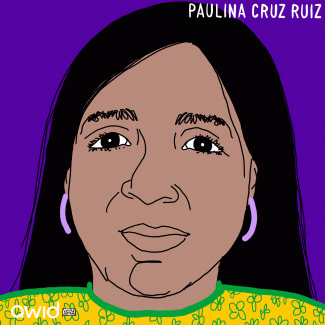
Paulina Cruz Ruiz, from the Rabinal, Baja Verapaz region of Guatemala, was an ancestral Maya Achí (Indigenous) authority and a human rights defender.
She was actively involved in community organizing and resistance, including legal measures against mining projects on Indigenous territory, projects that would severely affect and damage the socio-environmental fabric.
“The extractive industry model promoted by the Guatemalan government and the construction of large-scale development projects on indigenous lands without community consent has been a source of ongoing disputes with resistance movements.” - Minority Rights Group International
Paulina was also part of the March for Dignity, Life and Justice, in which on 1 May 2019 thousands of Guatemalans started a march of eight days against corruption and impunity in the prosecution and assassinations of human rights, peasant and Indigenous leaders and land defenders.
Paulina was murdered on 14 September 2019 near her home in the village of Xococ.
According to the Minority Rights Group International, “one of the major ongoing issues affecting Mayan communities is the increasing activity of the mining industry.”
Read more about the Mayans of Guatemala
Read more about the March for Dignity, Life and Justice
Née à Bahia, dans le nord-est du Brésil, Carmen est une immigrante, militante sociale et mère de 8 enfants.
Carmen a connu l'itinérance à l'âge de 35 ans, après avoir émigré seule à São Paulo. Cela l'a amenée à devenir une ardente défenseuse des communautés vulnérables, marginalisées et invisibles les plus touchées par la crise du logement. Elle est finalement devenue l'une des fondatrices de MSTC en 2000.
En tant qu'organisatrice politique visionnaire et actuelle dirigeante du MSTC, le travail de Carmen a révélé la crise du logement de la ville de São Paulo et inspiré d'autres personnes sur différentes façons d'organiser et de gérer les occupations.
Carmen a été fermement à l'avant-garde de diverses occupations. L'une d'elles est l’Ocupação 9 de Julho, qui sert désormais de scène à la démocratie directe et d'espace où chacun·e peut être soigné·e, entendu·e, apprécié·e et travailler ensemble.
Carmen a longtemps été célébrée pour son audace à redonner vie à des bâtiments abandonnés au cœur de São Paulo.
Pour en savoir plus sur sa vie, vous pouvez la suivre sur Instagram!

Como movimientos feministas y sindicales, juntxs en solidaridad, articulamos los siguientes puntos como una visión colectiva de las economías de los cuidados con los derechos de lxs trabajadorxs domésticxs como eje central.
El trabajo doméstico y de cuidado estuvo en la primera línea de fuego durante y después de la pandemia de COVID-19, al proporcionar los medios para sobrellevar las múltiples crisis globales que se intersectan. El Banco Mundial, el Fondo Monetario Internacional y otras instituciones multilaterales también reconocen la importancia del trabajo doméstico y de cuidados para el sostenimiento de la economía. Sin embargo, vemos que esta atención adopta un enfoque utilitarista (es decir, el trabajo de cuidados contribuye a sostener a la economía "productiva") centrado en el lucro, sin reconocer los cuidados como un derecho humano y un bien público, ni prestar atención a lxs trabajadorxs que realizan la mayor parte de este trabajo.
✉️ By registration only. Register here
📅 Thursday, March 13, 2025
🕒 09.30-11.30am EST
🏢 Outright International Office, 17th Floor, 216 E 45th Street, New York
🎙️AWID speaker: Inna Michaeli, Co-Executive Director
Organizer: Outright International
 |
Human and ethnic-territorial rights Ensuring the defense of human rights and Nature’s rights through alliance-building with local, national, regional and global actors and organizations. |
 |
Sustainable development Ensuring all economic, cultural and environmental activities contribute to sustainable development, food security and income generation, while respecting the self-determination and self-government of Afro-descendant communities. |
 |
Education and training Carrying out training for women and empowering them to carry out women’s rights advocacy in different political, social and economic spaces. For more information, see here! |
Building Feminist Economies is about creating a world with clean air to breath and water to drink, with meaningful labour and care for ourselves and our communities, where we can all enjoy our economic, sexual and political autonomy.
In the world we live in today, the economy continues to rely on women’s unpaid and undervalued care work for the profit of others. The pursuit of “growth” only expands extractivism - a model of development based on massive extraction and exploitation of natural resources that keeps destroying people and planet while concentrating wealth in the hands of global elites. Meanwhile, access to healthcare, education, a decent wage and social security is becoming a privilege to few. This economic model sits upon white supremacy, colonialism and patriarchy.
Adopting solely a “women’s economic empowerment approach” is merely to integrate women deeper into this system. It may be a temporary means of survival. We need to plant the seeds to make another world possible while we tear down the walls of the existing one.
We believe in the ability of feminist movements to work for change with broad alliances across social movements. By amplifying feminist proposals and visions, we aim to build new paradigms of just economies.
Our approach must be interconnected and intersectional, because sexual and bodily autonomy will not be possible until each and every one of us enjoys economic rights and independence. We aim to work with those who resist and counter the global rise of the conservative right and religious fundamentalisms as no just economy is possible until we shake the foundations of the current system.
Advance feminist agendas: We counter corporate power and impunity for human rights abuses by working with allies to ensure that we put forward feminist, women’s rights and gender justice perspectives in policy spaces. For example, learn more about our work on the future international legally binding instrument on “transnational corporations and other business enterprises with respect to human rights” at the United Nations Human Rights Council.
Mobilize solidarity actions: We work to strengthen the links between feminist and tax justice movements, including reclaiming the public resources lost through illicit financial flows (IFFs) to ensure social and gender justice.
Build knowledge: We provide women human rights defenders (WHRDs) with strategic information vital to challenge corporate power and extractivism. We will contribute to build the knowledge about local and global financing and investment mechanisms fuelling extractivism.
Create and amplify alternatives: We engage and mobilize our members and movements in visioning feminist economies and sharing feminist knowledges, practices and agendas for economic justice.
“The corporate revolution will collapse if we refuse to buy what they are selling – their ideas, their version of history, their wars, their weapons, their notion of inevitability. Another world is not only possible, she is on her way. On a quiet day, I can hear her breathing”.
Arundhati Roy, War Talk
| Nature of funding: Due to global funding cuts and freezes |
|
 |
Recipient type: Filter for organizations or individual funding opportunities |
 |
Preferred languages: Boil them down to communications language preferences |
| Funding type: Be it rapid response, grantmaking, seed, direct aid and more |
|
 |
Movement and Struggle: Connect with funders that speak to your movement |
Paseando por el barrio del Raval en Barcelona, puede que te encuentres con Metzineres, una cooperativa feminista por y para mujerxs que consumen drogas y que sobreviven múltiples situaciones de vulnerabilidad.
Imagínate un lugar libre de estigma, donde lxs mujerxs puedan consumir drogas de manera segura. Un lugar que brinda seguridad, apoyo y acompañamiento a mujerxs cuyos derechos son sistemáticamente vulnerados por la guerra contra las drogas y que sufren violencia, discriminacion y represión como consecuencia.
Justo afuera de la entrada, lxs transeúntes y visitantes son recibidxs con una enorme pizarra que describe consejos, trucos, deseos y dibujos de personas que usan drogas. También hay un calendario que cuenta con una serie de actividades auto-gestionadas por la comunidad de Metzineres. Ya sean talleres de peluquería y cosmética, radio, teatro, comidas comunales ofrecidas a la comunidad o clases de defensa personal, ¡siempre hay algo que hacer!
La cooperativa proporciona sitios de consumo seguros, así como servicios que cubren las necesidades básicas de las personas. Hay camas, espacios de almacenamiento, duchas, baños, lavadoras y una pequeña terraza al aire libre donde la gente puede relajarse o hacer un poco de jardinería.
Metzineres opera dentro de un marco de reducción de daños, que intenta reducir las consecuencias negativas del uso de drogas. Pero la reducción de daños es mucho más que un conjunto de prácticas: es una política anclada en la justicia social, la dignidad y los derechos de las personas que consumen drogas.

Filter your search by funders from different sectors i.e., philanthropic foundations, multilateral funders, women’s and feminist funds
Les soins comme fondations des économies
La pandémie du COVID-19 a mis en évidence la crise mondiale des soins et démontré les échecs du modèle économique dominant qui continue de détruire les services publics essentiels, les infrastructures sociales et les systèmes de soins dans le monde entier.
Cozinha Ocupaçao 9 Julho, de l’Association des Femmes Afro-Descendantes du Cauca du Nord (ASOM) et Metzineres ne sont que quelques exemples d'économies des soins qui se concentrent sur les besoins des personnes marginalisées et de la Nature, ainsi que sur le travail de soins, le travail reproductif, invisible et non rémunéré nécessaire pour assurer la pérennité de nos vies, de nos sociétés et de nos écosystèmes.